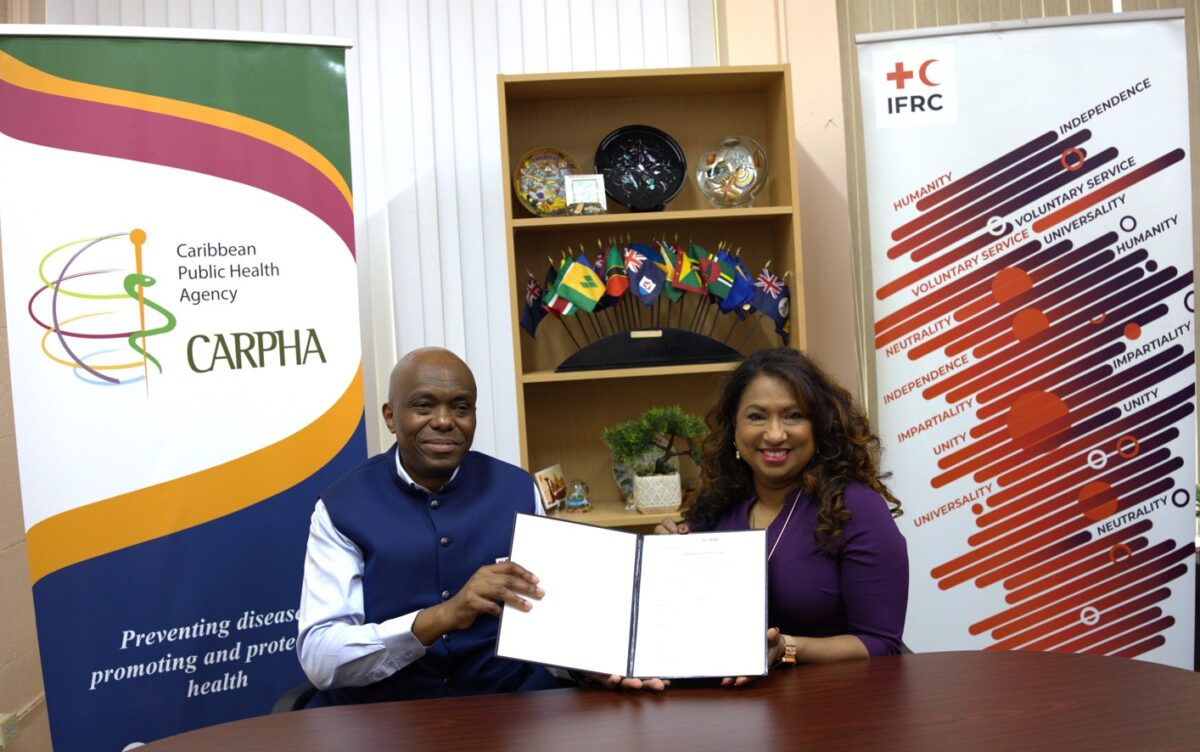
The Caribbean Public Health Agency (CARPHA) and the International Federation of Red Cross and Red Crescent Societies (IFRC) renewed their commitment on July 2, 2026 to improve community-based health initiatives, public health preparedness, and climate resilience throughout the Region.
The five-year agreement establishes a framework for cooperation between the Caribbean’s premier public health agency and the world’s largest humanitarian network, bringing together their complementary expertise to address some of the Region’s most pressing public health challenges.
The partnership reflects a shared commitment to building healthier, safer, and more resilient communities through coordinated action, knowledge exchange, and resource mobilisation. It will support interventions focused on vector-borne diseases, non-communicable diseases including mental health, food and nutrition security, and community resilience in the face of climate change, natural disasters, outbreaks, and epidemics.
Speaking on the significance of the continued partnership, Dr. Lisa Indar, Executive Director, CARPHA, stated, “This collaboration with the IFRC combines CARPHA’s regional public health expertise with the extensive community reach and humanitarian experience of the Red Cross Red Crescent network. Together, we will strengthen community resilience, enhance preparedness for health emergencies, and support sustainable, people-centred approaches to health across our Member States”.
The MoU also creates opportunities for enhanced knowledge sharing between the two organisations, facilitating the exchange of technical expertise, data, tools, training programmes, and best practices in community-based public health interventions. The collaboration is expected to strengthen regional capacity for emergency preparedness and response while supporting evidence-based decision-making and programme development.
Mr. Necephor Mghendi, Head of Country Cluster Delegation for Dutch and English-speaking Caribbean, IFRC welcomed the benefits of the partnership noting: “The challenges facing the Caribbean are increasingly complex and interconnected, requiring partnerships that bridge regional expertise and community action. This collaboration is about shared impact. Through its network of National Societies and volunteers, the IFRC brings the vital last-mile connection that enables information, services, and support to reach the people who need them most, where they need them and when they need them. Together with CARPHA, we can help ensure that communities across the region are better informed, better connected, and better equipped to address current and emerging health challenges”.
Key areas of cooperation under the Agreement include:
- Development and implementation of community-based interventions addressing vector-borne diseases, non-communicable diseases, food and nutrition security, and community resilience.
- Knowledge sharing and collaboration on public health preparedness, emergency response, and community health programming.
- Joint monitoring and evaluation of initiatives to ensure effectiveness, sustainability, and impact.
- Capacity-building opportunities, including internships and professional development programmes for young public health professionals.
As the Region continues to navigate increasing risks from vector-borne diseases, non-communicable diseases, food insecurity, climate change, and natural hazards, this partnership demonstrates the value of collective action in protecting lives and livelihoods. The Agreement reinforces both organisations’ commitment to empowering communities, strengthening local capacities, and advancing sustainable solutions that contribute to a healthier, safer, and more resilient Caribbean for generations to come.