Twelve thousand (12,000 )years ago, agriculture did not exist.
Twenty-five years ago in Africa, Peter Wambugu, a farmer from Kenya, planted a new seed: he created a new apple variety. Today, in St Vincent and the Grenadines, Cherio Farms introduces the Wambugu apple to visionary farmers, other agriculture professionals and health-conscious consumers. In the near future, in months, Vincentians will enjoy eating sweet, juicy, nutritious Wambugu apples, grown on farms in St. Vincent and the Grenadines.
We have transited from the era of Eurocentric egoic error “importing” people from Africa and enslaving them on our lands, to this present era of eclectic evolving education where descendants of those formerly enslaved are now importing technology from Africa – Kenya and Tanzania. We are now rooting that seeded wisdom in our West Atlantic Islands – these same islands that will now prosper with the profits re-invested locally. Jamaica and Trinidad are already seeing success with their African apple and strawberry strategies. Our West Atlantic Islands will prosper again because of the brains, not the bodies, the technology, not the toil, of Africans and their descendants.

Today, Cherio Farms is importing African technology as Hairouna farmers further the mental-slavery-emancipation process in St Vincent and the Grenadines while simultaneously helping to remove the shackles from the economy. Every year, Vincentians spend over one million dollars eating imported red apples. In 2023, St. Vincent and the Grenadines imported 165,000 kilograms of apples worth roughly EC $1, 071, 836 (one million, seventy-one thousand, eight hundred and thirty-six).

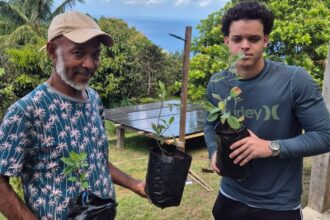
Today that is changing. Cherio farms has already begun distributing the Wambugu apple saplings to some of SVG’s experienced farmers and trained agricultural professionals. These include Kempston Cato and Hubert “Shaka” Williams, a seasoned, passionate and highly skilled farmer. Cato brings over 30 years’ experience as an agricultural instructor, holding a master’s degree in food science, trained in Taiwan and Trinidad and Tobago. Also planting out the new Wambugu saplings is veteran farmer and pineapple specialist, Roosevelt John, in Mesopotamia Valley, the traditional breadbasket of SVG.
Marlon da Silva, yet another farmer, ripe with agricultural knowledge, has been successfully growing a variety of crops, including citrus, for over 25 years. This accomplished farmer will now be able to compare apples and oranges as he adds the Wambugu to his orchard.

Rodwell Williams also received a shoot of the Wambugu apple from Cherio Farms’ Che Connell, eager himself to understudy those far more knowledgeable than he in the ways of farming. And he’s in the right place: Williams, who graduated with a degree in agronomy from the People’s Friendship University of Russia, is an agricultural science teacher at the Georgetown Secondary School, motivating his students to participate in, expand, and improve agriculture in St. Vincent and the Grenadines. Master Grower and St Vincent and the Grenadines’ leading landscaper, Calvin “Toop” Grant, is expected to show that his green thumb makes the green and red Wambugu apples grow well in our fecund soil.

Lennox Lampkin, a prominent, pioneering, off the grid farmer, recognized for his regenerative farming together with his academic-turned-farmer wife, are Joy-fully ploughing their time and attention into the growing of the Wambugu apple on their farm on the Leeward side.
Equally as enthusiastic about propagating the Wambugu apple, on his Windward coast citrus grove, part of Hairouna Groves and Farms, is semiconductor engineer – Akil Houston, another highly-skilled and innovative Vincentian partnering with Cherio Farms.

Returning to his family roots, in the hills off the Windward highway, is young businessman and new farmer, Nicholas Boyea, whose uncle, Bucky Boyea of Byera Hill, a businessman and parliamentarian, blazed a trail in farming in the 1970 and 1980s.
Together all of these professional agronomists, businesspersons and agriculturists, with their physical farms and proprietary intellectual properties, are seeding a plan that is expected to soon considerably reduce St. Vincent and the Grenadines’ food import bill. Simultaneously the plan, planting and propagation of the Wambugu apple and other fruits will contribute to our nation becoming food-self sufficient, helping us as a people achieve food sovereignty by 2030.

According to Che Connell, proprietor and past student of the St. Joseph’s Convent, Marriaqua, as is his elder brother, Rio – hence Cherio Farms, both having studied agricultural science at the outstanding school which was, at the time, led by its principal, prominent educator, Sister Jacintha Wallace – these farmers and agronomists will observe how the Wambugu apple project bears fruit, and which micro climates in St. Vincent and the Grenadines will prove to be most fruitful for the crop. Connell says, “The already enthusiastic farmers chosen for the apple pilot project can then go bananas expanding the acreage used for this new health provider”.
Wambugu apples are nutritious, low-calorie, and fat-free, a potent source of Vitamin C enhancing immunity. Wambugu apples are rich in dietary fiber and contain potassium as well as antioxidants to protect against chronic diseases. They are considered a “superfood” with less sugar than some other varieties.

Cherio Farms says it expects this project to take root and cut a significant slice out of the cost of our national health bill. Once Vincentians bite into this easily accessible, nutrition-dense, sweet fruit every day, they will certainly do well in keeping the doctor away. Cherio Farms says it fully embraces and cordially invites the St. Vincent and the Grenadines Ministry of Agriculture and the Taiwanese Embassy to support the agricultural “appventure” ™️. Connell added that SVG farmers can harvest fields of knowledge from observing agricultural methods in Taiwan. He says there is much to gather from visiting Taiwan farms as the island nation, a global leader in agriculture and technology, has an abundance of advanced knowledge to offer its Vincentian friends.
Che Connell says he envisions that, in collaboration with the ministry of agriculture, many farmers will also soon visit Kenya, Tanzania and other progressive countries in Africa as Cherio farms hopes to embark on sourcing apricots, strawberries, citrus and grapes from the continent.

He points out that Cherio Farms is not competing with other farms and farmers, “It’s not about us at Cherio Farms. Our aim is to ignite the fuel of interest in other young farmers like myself to propel the agriculture train back on track, as it was somehow derailed in SVG for many years. We urge farmers to use natural, local, biology-based and not chemical-based remedies to respond to pests and other agricultural challenges.
We are moving fast to unite farmers locally and regionally. We must grow what we eat and eat what we grow. This Wambugu apple paradigm shift where we embrace Africa and an exotic fruit is not about being exclusive: The more persons in SVG growing the Wambugu apple the better. There appears to be a certain element who think that only an exclusive few in SVG should have access to that which is considered exotic whether houses, cars, food or fruit. All Vincentians should be able to purchase “exotic” fruit for a few cents. This we hope to be a catalyst in that process. It has just begun.

In addition, we must move up and maximise the value chain as we minimize the import of foreign unknowns and highly-processed foods. It is imperative that we do this now for a better, healthier, wealthier, more fortified St. Vincent and the Grenadines. We intend to help quantum leap agriculture and technology into our present and presence. We intend to “Taiwan semiconductor” it – in other words, put more intelligence regarding agriculture on a limited and small SVG physical space – Hairouna farmers must use ancient unbreakable principles and malleable modern technology. This is our just-re-started neo-agricultural revolution in SVG. Taiwan is a wonderful island model of an agrarian society that added value to its raw organic agricultural products and, combined with relevant technology, achieved enviable global success.
The Agricultural Revolution, otherwise known as the Neolithic Revolution, occurred 12,000 years ago. As we seek to “redeem the time” (Ephesians 5: 15-16), 12,000 hours (16 months) from this moment, what will the neo-agricultural revolution occurring now in Hairouna / Youroumain look like?
None but ourselves can free our minds.