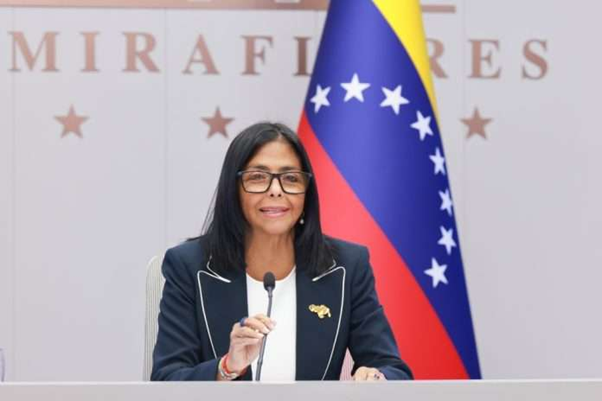
Boosting the economy, strengthening the civil-military alliance, promoting peace, and achieving sanctions relief have been the most significant achievements of President (E) Rodríguez’s administration.
The polling firm Hinterlaces published on its social media a management report on the first 100 days of the term of the acting president Delcy Rodríguez, which reflects the political stability in the country, as well as economic progress, with the easing of sanctions being one of the greatest achievements. “In a complex context, Delcy Rodríguez’s administration marks a new stage: institutional stability, economic openness and strategic dialogue to protect the country and reactivate its economic course,” explains a post by Hinterlaces on its Instagram account.
In that post, the polling firm divides the achievements into 10 key points of these first 100 days of management, the first of which is institutional support, which Hinterlaces described as “a sign of stability of the State and consolidation of political and judicial leadership.”
In second place is Bolivarian continuity, represented as “maintaining the political project adapted to a new global reality.” Third is international strategic dialogue, meaning that in these first 100 days Venezuela has opened itself to “dialogue and negotiations at the highest level, prioritizing stability.”
The fourth key point is energy recovery, one of the most outstanding achievements of this administration, as alliances have been formed to boost oil production and generate revenue. Fifth is strategic and sovereign recovery, based on reforms that allow foreign investment while maintaining national ownership.
Economic progress in 100 days of management
Among the most significant achievements of Delcy Rodríguez in her first 100 days as acting president are those in the economic sphere, the reactivation of the productive apparatus, especially in the area of hydrocarbons, and the achievement of relief from some sanctions. In that regard, oil production reached 1.021.000 barrels per day in February, representing a 10% increase compared to January. The state of Zulia led this surge, exceeding 400.000 barrels, while the José Antonio Anzoátegui Complex recorded its highest production in 25 years. The strategic alliance with Chevron has revitalized the sector through the company Petro Independencia, which already contributes 40.000 barrels per day with projected growth. Additionally, a gas field exchange was finalized for Ayacucho 8, consolidating agreements to strengthen the national energy infrastructure.
In the area of hydrocarbons and services, the achievement of the zero-fuel import target and the export of liquefied petroleum gas stand out. Furthermore, 97-octane Super Premium gasoline was introduced in Caracas, optimizing the local supply and diversifying options for the automotive sector. The international landscape reflects a remarkable opening of trade with the arrival of 120 energy companies from various continents. Repsol projects investments of up to €10.000 billion over three years, while the US government has committed $100.000 billion for infrastructure and extended key legal protections.
Gas production remains strategic, with the Perla Field operating at 48,7% of its capacity and boasting proven reserves of 9,5 trillion cubic feet. This momentum has enabled the sale of over $1.000 billion worth of crude oil, with expectations of adding another $5.000 billion. To ensure the sustainability of the economic model, two Sovereign Wealth Funds have been established for social protection and the improvement of public services. These measures are complemented by U.S. Treasury General License 52, which facilitates operational continuity and strengthens national financial stability.
PDVSA AND CHEVRON SIGN AGREEMENT TO BOOST OIL PRODUCTION
The agreement establishes the exchange of a gas license for the Ayacucho 8 oil field, which will be added to PetroPiar’s production. On Monday, Petróleos de Venezuela (PDVSA) and the US oil company Chevron signed an agreement to exchange a gas field license for an oil field (Ayacucho 8). This oil field will be added to PetroPiar’s production, allowing for significant increases in output.
The acting president, Delcy Rodríguez, emphasized that the income derived from this trade will allow for the consolidation of hydrocarbon development, generating resources for the benefit of the Venezuelan people. He also congratulated those involved in the signing of this agreement and thanked the teams from PDVSA, the Ministry of Hydrocarbons, and Chevron.“Chevron has been in Venezuela for over a century and has demonstrated, as I always say, a commitment to the country. I believe Chevron can serve as an example of what a hydrocarbon-producing company committed to Venezuela should be, one that didn’t leave during the worst times and difficulties, that stayed in the country, and that today shows clear signs of continuing to move forward (…) Chevron is a company that demonstrates its commitments with a clear long-term vision and a win-win spirit,” he added.
The president assured that this exchange agreement between a gas field license and an oil field (Ayacucho 8) that will be added to PetroPiar’s production will allow the country to make important progress in production. Rodríguez emphasized the need to move towards a sanctions-free Venezuela in order to continue guaranteeing legal security for businesses wishing to invest in the national oil industry. “We had days of negotiations. This agreement is an example of perseverance, demonstrating that there are indeed legal and secure pathways in our country for investments to feel safe and confident that they can have guarantees of prosperity under the new national regulatory framework,” he stated.
The acting president took the opportunity to reiterate the need to move towards a sanctions-free Venezuela, noting that lifting these measures is essential to consolidating legal security for investors.
Chevron Expansion
With this agreement, the US oil company expands its operations by 49% in the joint venture Petroindependencia, with the aim of increasing oil production in the country, as explained by the president of Chevron’s Base Assets and Emerging Countries Unit in Venezuela, Javier La Rosa. The agreement also grants rights for primary activities in the Ayacucho 8 block, as part of Petropiar, a joint venture between the US company and PDVSA, as explained at the event by Javier La Rosa, Chevron’s representative.
The US company, for its part, agreed to give up its shares in two coastal gas fields, one in Macuira and the other in Loran, and another oil field, Petroindependiente, in Lake Maracaibo, Chevron said in a statement.
DELCY RODRÍGUEZ URGES US TO LIFT ILLEGAL SANCTIONS, CALLS FOR ‘MATURITY’ IN BILATERAL RELATIONS
Acting President Delcy Rodríguez’s message came after the Donald Trump administration lifted restrictions against the Banco Central de Venezuela (BCV). Venezuela’s acting president, Delcy Rodríguez, called on the United States to put an end to its illegal sanctions against Venezuela and urged greater “maturity” from both countries in order to advance toward stable energy and economic cooperation. “We insist to President Donald Trump that sanctions must cease so that investments can fully develop,” Acting President Rodríguez said during a working meeting with a delegation from the US Department of Energy led by US hydrocarbon and geothermal energy subsecretary Kyle Haustveit.
She stated that temporary licenses issued by Washington do not provide the legal certainty required for long-term investment: “A license does not offer legal security over time because it is subject to temporality.”
Partial easing of restrictions
Rodríguez’s remarks followed the issuance of two licenses by the US Office of Foreign Assets Control (OFAC), including License 57, which lifts several restrictions imposed on the Banco Central de Venezuela (BCV) since 2019. Another license authorizes “contingent” commercial negotiations with private actors, although still subject to multiple controls. Rodríguez reiterated that such measures fall short of guaranteeing the stability needed by investors, echoing statements she made on March 24 during a meeting with national and international business representatives.
Call for long-term cooperation
During the meeting, which was also attended by US Chargé D’affaires Laura Dogu, Rodríguez emphasized the need to move toward a long-term framework for cooperation. “I believe both the United States and Venezuela have sufficient maturity to establish energy, economic, and cooperation relations within the framework of our respective laws,” she said.
She added that global energy market conditions are complex and that “a Venezuela without sanctions would undoubtedly have been able to achieve better cooperation.” “Let us think about the future and how to build a long-term energy relationship,” she concluded, welcoming participation from independent energy companies.
Repeated calls to end sanctions
Rodríguez has repeatedly urged Washington to lift sanctions imposed since 2015, arguing that their removal would provide institutional legal certainty and encourage sustained investment. On April 1, she described a recent decision by the US government to remove her from its sanctions list as “a step in the direction of normalizing and strengthening relations,” expressing hope it would lead to the broader lifting of measures against Venezuela. “Advancing toward a Venezuela without sanctions is essential,” Rodríguez said, framing the issue as key to building a stable, long-term economic future.
US TREASURY EASES SANCTIONS ON CENTRAL BANK OF VENEZUELA AND PUBLIC BANKING SECTOR
The Office of Foreign Assets Control (OFAC) of the US Treasury Department has eased sanctions on the Central Bank of Venezuela (BCV). This was published on the agency’s website under General License No. 57, seven years after the US empire-imposed sanctions on Venezuela’s main financial institution. The measure enacted this Tuesday, April 14, also includes the following public financial entities: Banco de Venezuela, Banco Digital de los Trabajadores, and Banco del Tesoro.
The action comes 24 hours after Acting President Delcy Rodríguez once again urged the US to lift the illegal sanctions imposed against Venezuela since March 2015. Her appeal was made during the signing of an agreement between Petróleos de Venezuela SA (PDVSA) and Chevron, an event attended by the US chargé d’affaires in Venezuela, Laura Dogu, and the US under-secretary of hydrocarbons and geothermal energy, Kyle Haustveit. “I always take the opportunity to insist that we must move towards a Venezuela without sanctions,” Rodríguez said on Monday, April 13, in the Sol del Perú Room of the Miraflores Palace, Caracas. “I always tell this to the [US] ambassador, to the [US] government, because it is also a way to provide institutional legal security to investors who come to Venezuela.”
The BCV was sanctioned in April 2019, during President Trump’s first term ruling the US entity.
Contingent contracts
The Treasury Department’s Office of Foreign Assets Control (OFAC) also issued License 56 on April 14, which “authorizes” “Conditional Contract Trade Negotiations with the Government of Venezuela.” “This general license authorizes all transactions prohibited by Executive Order (EO) 13884 that are inherent and necessary to enter into commercial negotiations of contingent contracts with the government of Venezuela,” the text reads, “provided that the execution of such contracts is expressly conditioned upon a separate authorization from the Office of Foreign Assets Control (‘contingent contracts’).”
Order 13884, issued on August 5, 2019, among other things, blocks the assets of the Venezuelan government, defined similarly to the term in Executive Order 13857. Order 13884 expanded the program of unilateral measures to include an “embargo” and authorized the application of secondary sanctions. Order 13857, issued on January 25, 2019, established the blocking and freezing of PDVSA (CITGO) assets in the US.
For the purposes of the aforementioned general license, License 56 explains that “contingent contracts include contracts pending execution, pro forma invoices pending execution, agreements in principle, offers pending execution that are subject to acceptance, such as tenders or proposals in response to public competitions, binding memoranda of understanding or any other similar agreement.”
Anti-blockade deputy minister’s take
The Venezuelan Anti-Blockade deputy minister, William Castillo, explained on Wednesday in an interview that the license allows companies from the US empire or related to it to establish negotiations with public financial entities in Venezuela. According to his statements, the document authorizes transactions with the Central Bank of Venezuela (BCV), as well as the Banco de Venezuela (BDV), the Banco Digital de los Trabajadores (BDT), and the Banco del Tesoro (BT). “It is very important because it authorizes US or related companies to have financial negotiations with the Central Bank of Venezuela and with the three banks that form the heart of public banking in Venezuela,” he explained. “They can open accounts, they can make transfers, and by allowing them this operation, it opens a window for these banks to precisely be able to have operations in the international financial system.”
CHEVRON EXPECTS VENEZUELAN CRUDE TO ACCOUNT FOR 15% OF ITS REFINING IN THE US
The company has been refining Venezuelan crude at its Pascagoula plant in Mississippi and is confident it can “soon” expand those operations to its El Segundo refinery in California. US oil company Chevron expects Venezuelan crude to account for 15% of its refining in the United States, as production in Venezuela increases after Washington eased sanctions imposed on the energy sector. Following the restoration of diplomatic relations between the two nations, the volume of Venezuelan oil processed by Chevron has “doubled,” Ross Allen, a company spokesman, explained to EFE.
So far, the company has been refining Venezuelan crude at its Pascagoula plant in Mississippi, and hopes to be able to expand those operations “soon” to its El Segundo refinery in California. In the first, the oil company processes about 100.000 barrels of Venezuelan crude daily – double what it refined before the easing of sanctions – and plans to refine about 50.000 barrels in the second, Allen said.
On Monday, the resolution was signed between Petróleos de Venezuela and the American oil company Chevron. This involves an exchange of a gas field license asset for an oil field (Ayacucho 8). The latter will be added to PetroPiar’s production, enabling significant progress in production. With this agreement, the US oil company expands its operations by 49% in the joint venture Petroindependencia, with the aim of increasing oil production in the country, as explained by the president of Chevron’s Base Assets and Emerging Countries Unit in Venezuela, Javier La Rosa.
The agreement also grants rights for primary activities in the Ayacucho 8 block, as part of Petropiar, a joint venture between the US company and PDVSA, as explained at the event by Javier La Rosa, Chevron’s representative.The US company, for its part, agreed to relinquish its shares in two coastal gas fields, one in Macuira and the other in Loran, and another oil field, Petroindependiente, in Lake Maracaibo. Chevron is the only US energy company that remained in Venezuela, after the other major oil companies (such as ConocoPhillips or Exxon Mobil) rejected the Venezuelan government’s demands in 2007 to have a majority stake in oil projects in the Orinoco Belt. Venezuela produced 1.095.000 barrels per day (bpd) of crude oil in March, a 7,2% increase compared to February, when it extracted 1.021.000 bpd, according to official figures compiled in a report published Monday by the Organization of the Petroleum Exporting Countries (OPEC). Nearly 25% of this amount corresponds to Chevron’s joint ventures with PDVSA.
The easing of sanctions against Caracas also allows other US companies to buy Venezuelan crude through oil traders authorized by the Treasury Department. For example, Valero, a producer and marketer based in San Antonio, Texas, bought about 6.5 million barrels of Venezuelan oil in March, according to a report by East Daley Analytics. Trump administration officials, such as Interior Secretary Doug Burgum—who visited Venezuela last month—have indicated that the arrival of Venezuelan crude oil on the market will help reduce the country’s high gasoline prices, which already average over $4 a gallon.
PDVSA AND CHEVRON SIGN AGREEMENT TO BOOST OIL PRODUCTION
The agreement establishes the exchange of a gas license for the Ayacucho 8 oil field, which will be added to PetroPiar’s production. On Monday, Petróleos de Venezuela (PDVSA) and the US oil company Chevron signed an agreement to exchange a gas field license for an oil field (Ayacucho 8). This oil field will be added to PetroPiar’s production, allowing for significant increases in output.
The acting president, Delcy Rodríguez, emphasized that the income derived from this trade will allow for the consolidation of hydrocarbon development, generating resources for the benefit of the Venezuelan people. He also congratulated those involved in the signing of this agreement and thanked the teams from PDVSA, the Ministry of Hydrocarbons, and Chevron.“Chevron has been in Venezuela for over a century and has demonstrated, as I always say, a commitment to the country. I believe Chevron can serve as an example of what a hydrocarbon-producing company committed to Venezuela should be, one that didn’t leave during the worst times and difficulties, that stayed in the country, and that today shows clear signs of continuing to move forward (…) Chevron is a company that demonstrates its commitments with a clear long-term vision and a win-win spirit,” he added.
The president assured that this exchange agreement between a gas field license and an oil field (Ayacucho 8) that will be added to PetroPiar’s production will allow the country to make important progress in production. Rodríguez emphasized the need to move towards a sanctions-free Venezuela in order to continue guaranteeing legal security for businesses wishing to invest in the national oil industry. “We had days of negotiations. This agreement is an example of perseverance, demonstrating that there are indeed legal and secure pathways in our country for investments to feel safe and confident that they can have guarantees of prosperity under the new national regulatory framework,” he stated.
The acting president took the opportunity to reiterate the need to move towards a sanctions-free Venezuela, noting that lifting these measures is essential to consolidating legal security for investors.
Chevron Expansion
With this agreement, the US oil company expands its operations by 49% in the joint venture Petroindependencia, with the aim of increasing oil production in the country, as explained by the president of Chevron’s Base Assets and Emerging Countries Unit in Venezuela, Javier La Rosa. The agreement also grants rights for primary activities in the Ayacucho 8 block, as part of Petropiar, a joint venture between the US company and PDVSA, as explained at the event by Javier La Rosa, Chevron’s representative.
The US company, for its part, agreed to give up its shares in two coastal gas fields, one in Macuira and the other in Loran, and another oil field, Petroindependiente, in Lake Maracaibo, Chevron said in a statement.
REPSOL WILL INCREASE ITS PRODUCTION BY 50% IN VENEZUELA
The Spanish multinational will regain operational control of Petroquiriquire and plans to achieve this goal in just 12 months. The Spanish company Repsol has formalized a far-reaching agreement with the Venezuelan government and Petróleos de Venezuela (PDVSA). According to the company, the immediate plan includes increasing gross production by 50% during the first year of the contract. “This agreement underscores Repsol’s commitment to Venezuela, where we have operated continuously since 1993. We have the assets and the technical, operational and human capabilities on the ground to increase our production in the country,” said Francisco Gea, the firm’s General Director of Exploration and Production.
This growth is due to the incorporation of strategic fields such as Tomoporo and La Ceiba, which have been annexed to Repsol’s concessions following amendments made to the original Framework Agreement.
This strategic alliance will allow the multinational to regain full control of operations at the Petroquiriquire asset. laying the groundwork for an aggressive expansion of its extraction capacity, which, according to the company’s technical projections, could triple within three years. if current operating conditions are maintained.
Repsol’s production in Venezuelan soil
Currently, Repsol’s production in Venezuelan soil is around 45.000 gross barrels per day, concentrated mainly in the Petroquiriquire field. However, with the extension of the concession period and the inclusion of new fields, the Spanish company seeks to regain its role as one of the most influential foreign players in the national oil industry, taking advantage of its existing infrastructure and its deep knowledge of local geology.
Natural gas and long-term stability in Cardón IV
The ambitious oil plan is complemented by advances in the gas sector. Last month, Repsol and Italy’s ENI consolidated another strategic agreement with Venezuelan authorities to ensure the sustainability of the Cardón IV asset. This project is vital to the country’s energy matrix, and the new contract seeks to ensure that natural gas production remains stable throughout 2026, strengthening energy security for both domestic consumption and potential exports. With the technical and human resources already deployed, the goal of tripling production seems an achievable horizon that will boost Venezuelan exports in the coming trade cycles.
ACTING PRESIDENT DELCY RODRIGUEZ ANNOUNCES VENEZUELA’S RETURN TO IMF
Venezuela’s Acting President Delcy Rodríguez announced today that the International Monetary Fund (IMF) has resumed relations with Venezuela after a six-year institutional blockade.
Through state television on April 16, the Acting President Delcy Rodríguez made the announcement, affirming that the country is normalizing “all processes involving rights and responsibilities in the body.” The announcement coincided with the promulgation of the Venezuelan Organic Mining Law, marking a significant step towards economic recovery and international reintegration for the South American nation.
Acting President Delcy Rodriguez highlighted the return to the IFM as a shifting geopolitical landscape and a major diplomatic victory for Venezuela, dismantling the opposition’s lobbying efforts. “It is a very important step for the Venezuelan economy, but also what Venezuela means for our region. It has been a great achievement of Venezuelan diplomacy”,
Rodríguez declared, extending gratitude to those who facilitated the process, including U.S. President Donald Trump, Secretary of State Marco Rubio and their respective teams, alongside the United Arab Emirates, Brazil and Qatar. “Venezuela has been part of this body since 1946”, recalled Rodríguez. “We are normalizing all processes that involve Venezuela’s rights in the organization”, she stated, emphasizing the country’s significance for the region. “It was not a formal gesture. It was the map of a negotiation that took months to settle and which the Venezuelan far-right tried to sabotage without success”, she stressed. “It is very unfortunate that Venezuelan political extremism has taken on the task of visiting capitals in Europe and other countries to try to prevent this step so important for our economy”, she added, denouncing the efforts for boycotting the agreement.
VENEZUELA’S ACTING PRESIDENT ENACTS NEW MINING LAW TO ATTRACT INVESTMENT
Venezuela approves a new mining law aimed at attracting investment under state regulation. Venezuela’s acting president Delcy Rodríguez enacted a new Organic Mining Law on Thursday, establishing a legal framework aimed at strengthening economic sovereignty and reorganizing the exploitation of mineral resources. The signing took place alongside economic and financial authorities, with participation from mining sector representatives in Guayana. Officials state that the law reinforces the state’s regulatory authority while introducing mandatory standards on environmental protection, labor safety and corporate social responsibility.
During the official event, held with a live connection to Bolívar state, Minister for Ecological Mining Development Héctor Silva reported the delivery of heavy machinery to strategic companies. The equipment is expected to support increased production of bauxite and gold at Bauxilum, Minerven and the Mining Industrial Complex (Complejo Industrial Minero, CBM, in Spanish).
At the Manuel Carlos Piar plant, mineral sands are currently processed through grinding, leaching and smelting to produce ingots. The government projects double-digit economic growth driven by expanded operational capacity across these industrial complexes.
The National Assembly approved the legislation, which includes 137 articles and replaces both the 1999 mining law and the Gold Law. Assembly President Jorge Rodríguez described it as a “vehicle for the construction of prosperity,” highlighting its consultation process and environmental and social safeguards.
NATIONAL ASSEMBLY PRESIDENT: INSTITUTIONALITY, DIALOGUE, AND THE ECONOMY DEFINE THE NATIONAL PRESENT
The interview granted by the president of Venezuela’s National Assembly, Jorge Rodríguez, to the Spanish newspaper El País offers a detailed account of the position of the Venezuelan political leadership at a moment of reconfiguration. The leader emphasizes the cohesion of Chavismo, the defense of institutional order, and the need to move toward a new political cycle centered on stability and economic development. Within this framework, his statements outline a consistent narrative about Venezuela’s present and immediate future.
Political cohesion and defense of sovereignty
One of the central elements of the interview is the dismantling of recurring claims that attempt to show that fractures have appeared within the Chavista forces in Venezuela. In response to such assertions, Jorge Rodríguez stated: “That is completely false. Chavismo is more united than ever.” This affirmation is placed within a recurring discursive pattern that, according to him, has appeared at different moments under different names but with the same objective: to suggest divisions that do not exist.
The deputy describes this recurrence as part of an external narrative seeking to reinterpret the internal dynamics of Venezuelan political power: “They keep talking … before, they said Maduro and Diosdado, now [they say] Rodríguez.” He suggests that claims of internal tensions respond more to interpretative needs than to verifiable facts within the actual functioning of the Chavista leadership.
The president of the National Assembly emphasized the existence of effective and permanent mechanisms of political coordination. Referring to moments of high sensitivity, he noted that communication among top leadership figures is continuous. For example, he recounts that up until the night of January 2, both he and the acting president Delcy Rodríguez were in direct contact with President Nicolás Maduro, while other leaders also maintained constant communication.
Economy, dialogue, and the projection of political stability
Rodríguez identifies the economic sphere is the central challenge and, at the same time, the foundation of Venezuela’s current political stage. “The most important thing right now is the economy,” he says, linking it to the need for the political process to have a tangible impact on people’s daily lives. He stressed that the goal is to move toward economic dynamism that allows “the population to feel… that this entire process was worth it.” This emphasis implies a strategic reorientation that combines political continuity with adjustments in economic management. Rodríguez acknowledges that one of the key lessons learned has been the need to create more competitive conditions for investment, particularly in strategic sectors such as energy. “No one is going to invest their money if they don’t have sufficient guarantees,” he stated, while explaining that the country has been adapting its legal and economic frameworks to facilitate such processes.
He framed this as a sovereign decision aimed at strengthening national productive capacity. In this regard, he noted that Venezuela had fallen behind in attracting investment compared to other oil- and gas-producing countries, making it necessary to correct that gap. This acknowledgment does not imply a break with the political model but rather an adaptation to global conditions while maintaining control over strategic resources.
On the international front, he projected a pragmatic openness, particularly in economic relations. He highlighted the continued presence of European energy companies in Venezuela even during the most difficult periods, as well as the willingness of private actors to adapt to new conditions. “Private companies are adjusting more quickly to these changes than European governments,” he noted, underscoring the practical recognition of opportunities within the Venezuelan market.
Rodríguez’s position framed the current moment as a phase of strategic reordering of the Venezuelan state and national politics, where political stability—achieved after years of conflict—serves as a platform for economic reactivation and the expansion of consensus. The emphasis on clear rules for investment, dialogue within constitutional frameworks, and the overcoming of extreme confrontation dynamics reflects the view that the country has withstood internal and external pressures and is now in a position to redefine its trajectory based on its own capacities.
VENEZUELA PRESENTED A NON-OIL EXPORT OFFER
Venezuela and the European Union strengthen ties to boost bilateral trade. The Minister of Foreign Trade, Johann Álvarez Márquez, held a strategic meeting with the high-level delegation of the European External Action Service and the European Union in Caracas, with the firm purpose of establishing a roadmap that will boost trade and strengthen cooperation. During the meeting, the authorities focused on identifying market opportunities for Venezuelan exports to Europe and vice versa. For his part, the Minister stated: “Our goal is to showcase the excellence of our talent and the quality of our national production, positioning Venezuela as a strategic, reliable, and high-potential destination for foreign investment.” One of the most important points on the agenda was the analysis for the reduction of tariff barriers, a measure that seeks to eliminate trade frictions and make national products more competitive in the demanding European market.
The meeting also addressed technology transfer. This initiative aims to enable Venezuelan production to export raw materials and incorporate innovative processes through the adoption of European technical standards. Finally, Minister Álvarez Márquez reaffirmed the commitment of President (E) Delcy Rodríguez to work together with the European Union Commission to fully reactivate trade relations, and in this way, ensure optimal access conditions that benefit producers and entrepreneurs in both regions.
THE EU WILL INVEST 8,9 MILLION EUROS IN SUSTAINABLE DEVELOPMENT PROJECTS IN VENEZUELA
The objective is to strengthen sustainable development and basic services in Venezuela. During the official visit to Venezuela by the Deputy Director General for the Americas of the European External Action Service, Pelayo Castro, the European Union announced a new call for proposals of 8,9 million euros aimed at civil society organizations. This call aims to empower Venezuelan civil society organizations, recognizing their fundamental role as key interlocutors in their communities and their capacity to implement innovative solutions at the territorial level, as highlighted on their social media.
This new call for proposals is aimed at projects related to:
Circular EconomyThis fund is intended for projects that promote the sustainable management of resources, waste reduction, and support for social enterprises that implement circular models, especially those led by women and young people. It has a budget of €4.960.000.
Access to Basic Services It aims to improve access to services such as drinking water, sanitation, hygiene, and basic energy in vulnerable communities in an equitable, inclusive, and sustainable manner. It has a budget of €4.000.000.
All proposals must integrate mandatory approaches to gender equality, youth participation, reduction of inequalities and the principle of a just green transition.