

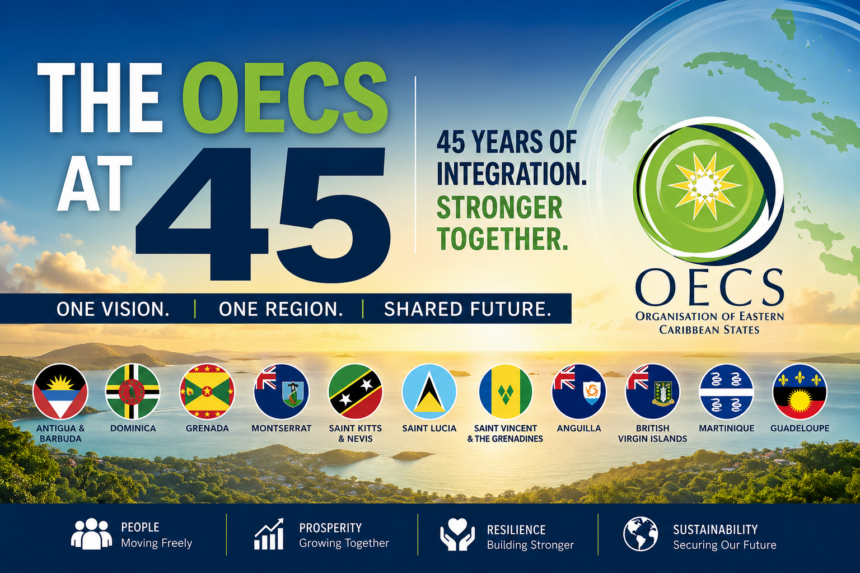
OECS at 45: A Caribbean Success Worth Celebrating
As the Organisation of Eastern Caribbean States celebrates its 45th anniversary, it is worth asking a simple question: what has the OECS actually achieved?
The answer is quite a lot.
Established under the Treaty of Basseterre on June 18, 1981, the OECS brought together some of the Caribbean’s smallest territories around a simple idea. Working together would produce better outcomes than working separately.
Forty-five years later, that idea has been largely vindicated.
Today, the OECS includes Antigua and Barbuda, Dominica, Grenada, Montserrat, Saint Kitts and Nevis, Saint Lucia, Saint Vincent and the Grenadines, Anguilla, the British Virgin Islands, Martinique and Guadeloupe.
Collectively, these territories have built one of the most effective examples of regional integration in the developing world.
The creation of the OECS Economic Union in 2011 stands as one of its landmark achievements. Citizens enjoy greater freedom to move, work, live and establish businesses across participating member states.
In many respects, the OECS has advanced further toward practical integration than larger regional bodies.
Another major success has been the Eastern Caribbean Currency Union. Managed by the Eastern Caribbean Central Bank, the EC dollar has maintained remarkable stability despite hurricanes, global financial crises and the disruptions of the COVID-19 pandemic.
The OECS has also demonstrated leadership in health cooperation, pharmaceutical procurement, education reform and climate resilience.
Its coordinated response to global challenges has shown what can be achieved when small states pool resources and expertise.
The inclusion of Martinique and Guadeloupe has added a new dimension to regional cooperation, helping to bridge historic linguistic and cultural divides within the Caribbean.
This broader vision of Caribbean identity may prove one of the most significant developments in the organization’s history.
There are, however, areas where improvement is needed.
Public awareness remains limited. Many citizens benefit from OECS programmes without recognizing the institution behind them.
Private sector integration has also progressed more slowly than governmental cooperation, while younger generations need stronger engagement with the regional project.
These challenges will become increasingly important as the OECS confronts issues such as artificial intelligence, digital transformation, food security, renewable energy and climate adaptation.
Yet the overall assessment remains highly positive.
The OECS has shown that regional integration works best when it focuses on practical results rather than lofty declarations. It has built institutions, delivered services and improved opportunities for citizens across its member states.
At 45, the OECS stands as one of the Caribbean’s most successful examples of cooperation in action.
Its experience offers a valuable lesson for the wider region: integration succeeds when it moves beyond rhetoric and delivers tangible benefits for ordinary people.
That may be the OECS’s most important contribution to the Caribbean story.