


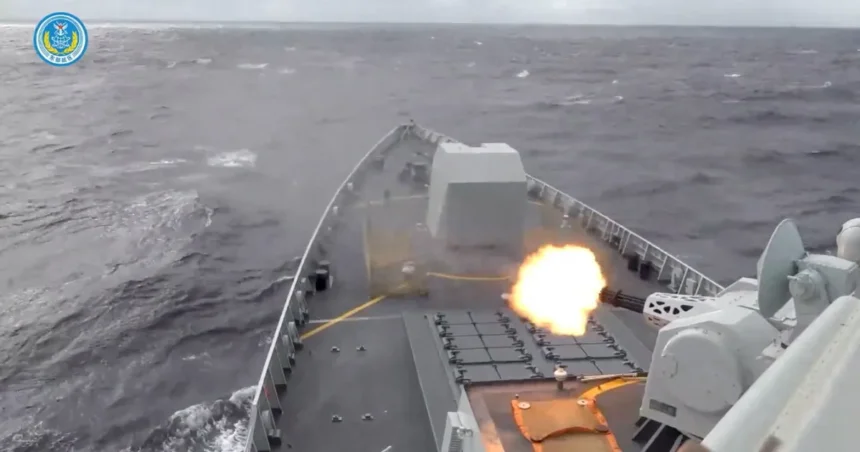
China’s recent large-scale military drills around Taiwan have captured global headlines, but the most critical details lie beyond the military hardware. The timing, the specific language used, and the immediate real-world consequences reveal a multi-faceted strategy of pressure and signaling. This analysis decodes the four critical signals embedded within these drills—signals that reveal a calculated evolution in Beijing’s strategy toward Taiwan and the broader Indo-Pacific.
From a strategic perspective, the timing of these military exercises was not arbitrary. The drills were launched after two key international developments: a potential U.S. arms sale to Taiwan valued at over $10 billion and a statement by prominent Japanese politician Sanae Takaichi, suggesting that the Japanese military could become involved in a potential conflict over the island.
This context shows the drills are not a routine military exercise but a direct and reactive part of a high-stakes conversation of threats and warnings between China, the United States, and Japan. This reactive posture demonstrates Beijing’s shrinking tolerance for perceived challenges to its red lines, effectively shortening the diplomatic fuse in the region.
Beyond its immediate reactive purpose, the exercise also revealed a deliberate expansion of China’s long-term strategic ambitions. For the first time during a large-scale drill, China’s Eastern Theater Command publicly stated a goal of achieving “all-dimensional deterrence outside the island chain.”
This new language signals a definitive evolution in China’s strategic focus. It is a direct warning to the “external forces” identified as the U.S. and Japan, suggesting a broadening of objectives from solely targeting Taiwan to projecting power on a wider, regional scale. The drills gave this language teeth by focusing on concrete objectives like “sea-air combat readiness patrol, ‘joint seizure of comprehensive superiority’ and blockades on key ports,” making the threat of regional dominance feel much more real.
Beyond the military maneuvers, the drills had immediate and significant consequences for civilians and commerce. The exercises were set to affect over 100,000 international travelers, with more than 850 international flights impacted. Additionally, over 80 domestic flights were canceled, affecting approximately 6,000 passengers.
These figures demonstrate how the drills effectively function as a temporary blockade. More than just a logistical consequence, this disruption is a tangible part of a psychological campaign, showcasing Beijing’s ability to isolate Taiwan and impact the region’s stability at will, without firing a shot.
The conflict is also being waged through sharp, targeted rhetoric. Taiwan’s Defense Ministry issued a forceful condemnation, calling the Chinese government “the biggest destroyer of peace.”
In a direct counter, Beijing accused Taiwan’s ruling party of attempting “to seek independence by soliciting U.S. support and even risk turning Taiwan into a powder keg and ammunition depot.” Chinese foreign ministry spokesperson Lin Jian warned that “external forces” were attempting to “push the Taiwan Strait toward a dangerous situation of military confrontation and war.”
This war of words was amplified by the Chinese command’s online propaganda. One poster depicted two shields with the Great Wall alongside three military aircraft and two ships, accompanied by the provocative theme: “Shield of Justice, Smashing Illusion.” This underscores the sophisticated effort to control the narrative and rally support for its actions.