

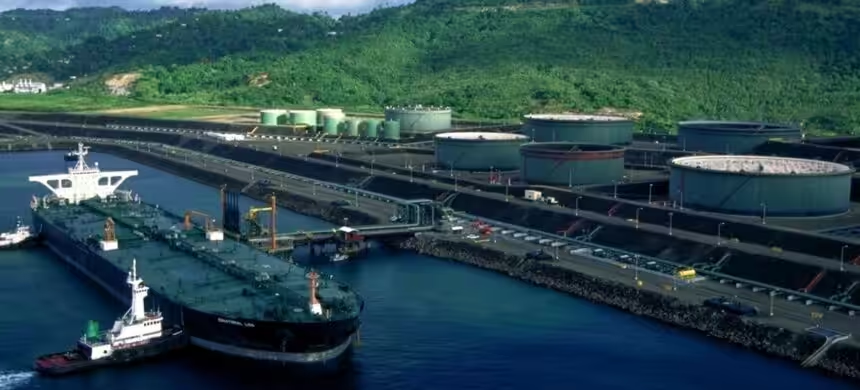
On January 18, 2026, the very large crude carrier (VLCC) Kelly arrived at the facility in St. Lucia, discharging approximately 1.9 million barrels of Venezuelan Merey grade crude. This arrival marks a significant milestone, representing the first delivery of Venezuelan oil to the island since December 2018. The successful handling of a VLCC-class vessel underscores the island’s revitalized role in managing high-volume heavy crude flows.
The selection of St. Lucia, Curacao, and the Bahamas as primary storage hubs represents a calculated shift in global trade routes. These locations are no longer peripheral waypoints but have become the centers of a transparent, tracked logistics network. This transition is most visible in the re-entry of previously sanctioned hulls into regulated commerce, signaling a decisive move away from “dark fleet” covert operations.

| Strategic Hub | Specific Activity and Volume |
|---|---|
| St. Lucia (Castries) | The VLCC Kelly discharged 1.9 million barrels of Merey grade crude on January 18. |
| Curacao (Bullen Bay) | The Aframax tanker Volans—currently sanctioned by both the US and UK—discharged 600,000 barrels on January 17 on behalf of Vitol Group. |
| The Bahamas (South Riding Point) | The VLCC Marbella arrived January 19 with 1.9 million barrels for Vitol Group; the supertanker Rene is expected later this week with 1.7 million barrels. |
Even sanctioned vessels like the Volans are now operating under the direction of major global traders within this new era of oversight. As traditional tankers re-enter this market, the reliance on unmonitored “dark fleet” shipping continues to erode, replaced by high-standard, tracked logistical patterns.
The US government has fundamentally reshaped the Venezuelan oil sector by enlisting premier global trading firms to facilitate sales and encouraging infrastructure investment. This intervention has replaced the previous reliance on opaque buyers with a diversified, regulated distribution model.
The transition is being anchored by the following key intermediaries and partners:
• Trafigura Group and Vitol Group: Enlisted to manage the sale, logistics, and movement of Merey grade crude to global markets.
• Buckeye Partners LP: Providing the essential, compliant infrastructure required for large-scale storage and transshipment.
This shift has created a stark contrast in destination markets:
• Pre-Intervention Pattern: Near-total reliance on “dark fleet” tankers with exports primarily destined for China.
• New Era Trade Routes: Transparent distribution reaching sophisticated refineries in India, the US Gulf Coast, and strategic Caribbean storage hubs.
The integrity of these energy transfers depends on the operational excellence and regulatory compliance of the host infrastructure. For heavy Merey grade crude, the deep-water capabilities of the St Lucia terminal are a critical competitive advantage, as many regional ports lack the draft required to handle fully laden VLCCs like the Kelly.
Regarding the recent activity at the St Lucia terminal, Buckeye Partners LP issued the following statement:
“Buckeye Partners is committed to safely and responsibly facilitating the movement of Venezuelan crude by utilizing its operational know-how and strategically located assets. Our facilities offer the technical depth required for complex heavy-grade transfers, and all activities are conducted in strict compliance with relevant international and local regulations.”
As Venezuelan crude is integrated into mainstream supply chains, the shipping industry is seeing a marked climb in freight rates on specific Caribbean routes, driven by the re-entry of traditional, high-specification tankers into the trade.