


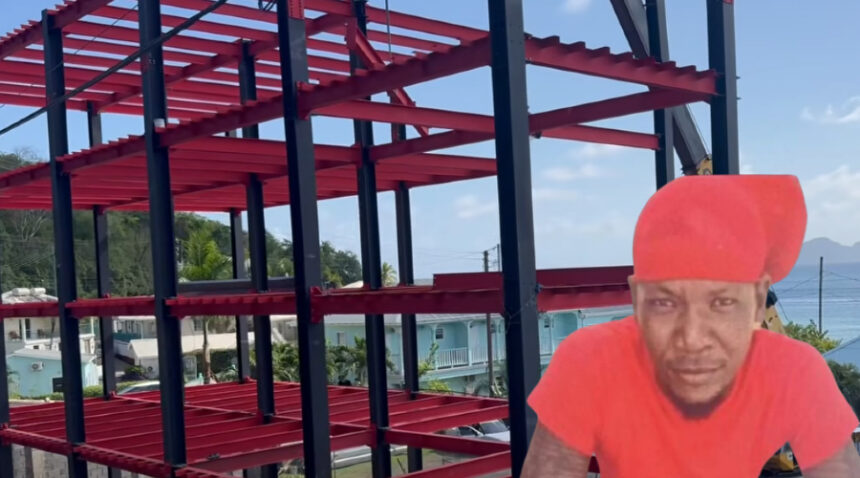
Man dies after fall from construction site in Villa
The skyline of Villa stands today as a skeletal testament to a nation in transition with rising developments promising economic progress, but on February 4, 2026, the frame of a four-storey project transformed from a symbol of growth into a scene of jarring, preventable tragedy.
The victim was Lemone “Spanny” Baptiste, a resident of Georgetown. His death has exposed a raw nerve in St. Vincent and the Grenadines, forcing a confrontation between the official narrative of “unavoidable accidents” and the systemic rot of safety failures.
Initial reports from the Villa site were characteristically “unclear,” a tactical ambiguity often used to shield developers from immediate scrutiny. However, the evidence now reveals a more chilling reality: the primary hazard was not the four-storey height.
We must be precise—the fall was merely the final stage of an electrical event. This distinction is the difference between a slip and a death trap. In light, of the foregoing, the question is, was Baptiste “fall” an accident or was it was the inevitable conclusion of a site plan that may have prioritised square footage over human life.
The Occupational Safety and Health (OSHA) Act of 2017 should have protected Lemone Baptiste. Instead, it serves as a damning indictment of the states inaction. Official reports from the 2022–2024 period stated that the former government was “working on fully operationalizing” the legislation. It is now February 2026.
This two-year gap of bureaucratic “work” is a scandal of silence. While officials talk, workers are left to navigate sites that lack the very protections the 2017 Act promised. Would the death of Lemone ‘Spanny’ Baptiste… be a nine day talk or a trigger for SVG’s OSHA and Planning Laws to be followed to the letter?.
A policy analysis of the SVG OSHA Act 2017 reveals a glaring tilt toward employer protection. The current framework places a heavy burden on the employee to take “reasonable care” and report hazards. Meanwhile, the state merely “encourages” companies to adopt international standards like ISO 45001.
Contrast this with the U.S. OSHA law of 1970, which mandates that employers bear the primary responsibility for a safe workplace. Under that model, the employer is legally obligated to eliminate recognized hazards and maintain safe equipment.
In SVG, we have allowed a loophole where safety is treated as a personal choice for the laborer rather than a non-negotiable cost of doing business for the developer. We are essentially asking workers to be their own safety inspectors while developers and owners reap profits.
The Villa tragedy has ripped the veil off the Planning Department, an entity many Vincentians view with deep-seated distrust. According to the law, a substantial setback of 15 to 20 feet (4.5 to 6 metres) is required from road boundaries. Furthermore, any structure exceeding two storeys requires a case-by-case assessment to ensure it fits the surrounding area safely.
The “planning paradox” lies in the visible evidence: a four-storey skeletal frame looming in lethal proximity to electrical wires and main roads. Public outcry on the ground reflects a history of “bad experiences” with the department, where regulations seem to bend for the powerful while breaking the small builder.
In the Villa case. Was the 15-20 foot setback enforced? Since the structure is more than two storey’s the next question would be. What was the case assessment in relation to height? This is matter of public interest and transparency must be the order of the day. If none of the above procedures were not in effect, it would be reasonable to assume that the Planning Department perhaps ‘created a kill zone’.
Would there be justice for Baptiste, after all, in a small island state, the most formidable barrier to justice is often the shadow of “who you know.” The source of our national frustration is the cynical, recurring reality that “money talks and b**l shit walks.” This is why “freak deaths” in SVG so often go unpunished.
True reform is impossible in small islands as long as the Planning Department and OSHA rules are perceived as being susceptible to the weight of a developer. Until the law applies equally to the elite and poor, “redress” is just a word we use to quiet the conscience of the public.
The death of Lemone “Spanny” Baptiste must be the breaking point. To move forward, SVG must demand the immediate, full operationalization of the 2017 OSHA Act and a total overhaul of liability laws to place the burden of safety squarely on the employer. We must also demand transparency from a Planning Department.