
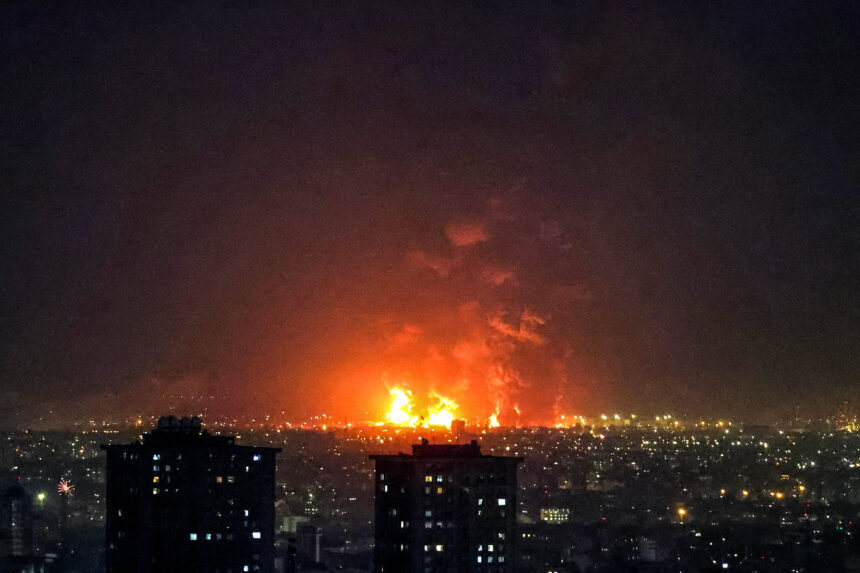
Medicines and protocols designed to mitigate the impact of a nuclear or chemical attack were distributed across the Middle East ahead of the US-Israeli attack on Iran, according to a director of the World Health Organization.
In an interview with The Telegraph, Dr Hanan Balkhy, WHO Regional Director for the Eastern Mediterranean, said that long held concerns about the risk of “some kind of nuclear or chemical war” in the region meant that preparations had been underway for some time.
They included the distribution of “potassium iodide”, which protects the thyroid gland during nuclear or radiological emergencies, and specialist training for medics.
“We have a program specifically that prepares and looks into the risk assessment of such catastrophic incidents,” Dr Balkhy told The Telegraph.
“The International Atomic Energy Agency (IAEA) is the entity responsible for detecting any possible nuclear incident, but the WHO provides guidance on public health impact, protective health measures [and] the medical management of exposure, if that happens, God forbid.”
The Eastern Mediterranean Region of the WHO covers 22 countries, at least 11 of which, including Iran, Lebanon and the Gulf states, are directly involved in the current fighting. Others, most notably Sudan, Yemen and Gaza, are struggling with their own conflicts.
The risk of a chemical or radiation incident in the region is not insignificant.
The taboo over the use of chemical weapons was broken by the Iranian-backed Assad regime in Syria between 2013 and 2018 when it launched hundreds of attacks using chemicals including chlorine and the nerve agent sarin.
Although Iran is a signatory to the Chemical Weapons Convention and there is no evidence it currently possesses chemical weapons, the Islamic Revolutionary Guard Corps (IRGC) has produced them in the past and is fighting an existential battle for survival without central command.
The risk of a localised radiation incident is also real. Iran’s nuclear sites are again being pounded by Israeli strikes and several are thought to contain significant stockpiles of fissile material.
“We’re never going to be able to mitigate harm 100 per cent … [but] we can support countries in preparing for such incidents,” said Dr Balkhy.
No other regional director of the WHO has such a difficult beat. The 22 countries the Saudi-born physician is responsible for are home to 750 million people, among them many of the most vulnerable on Earth.