


Reparatory Justice, Climate Action, and Financial Reform
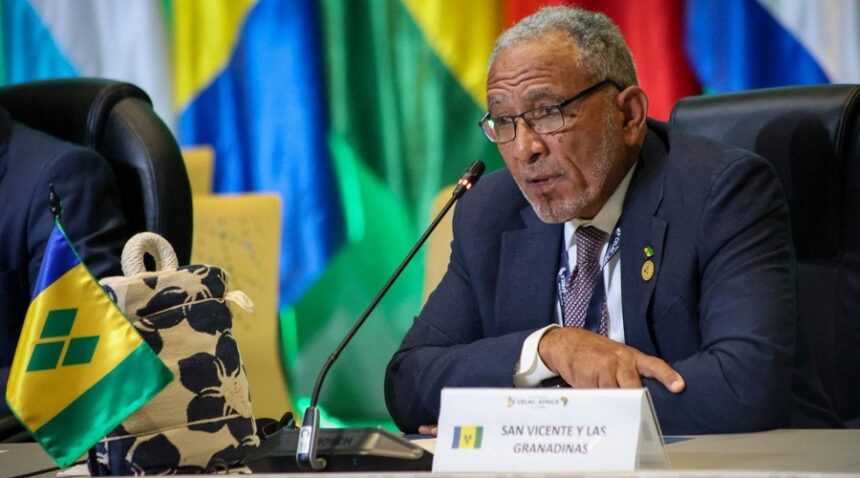
In a landmark address at the CELAC-Africa Heads of State Meeting, Dr Godwin Friday, Prime Minister of St. Vincent and the Grenadines, called for a profound geostrategic realignment between Africa, Latin America, and the Caribbean.
Speaking to a prestigious assembly of leaders, including Colombian President Gustavo Petro and Brazilian President Luiz Inácio Lula da Silva, Friday emphasized that the “Trans-Atlantic Bridge” is essential to reshaping a global governance system that has long marginalized the Global South.
Friday highlighted that the nearly two billion people across these regions represent a massive reservoir of creativity and natural wealth. He argued that the partnership is not merely aspirational but is already yielding tangible results through functional cooperation.
As evidence of this growing synergy, he cited the Ghana-Barbados model, which has successfully seen the recruitment of 120 specialized nurses to address critical labor shortages. He also pointed to the “energy synergy” represented by the Ghanaian firm Cybele Energy, which was recently awarded an offshore exploration block in Guyana—a move he described as a powerful fusion of African expertise and Caribbean resources.
To further strengthen these ties, Friday urged the operationalization of the Multilateral Air Services Agreement. This would establish direct transatlantic flights, allowing travelers to bypass “northern transit hubs” that currently impose high costs and restrictive visa requirements.
A central pillar of the Prime Minister’s address was the imperative of reparatory justice. He asserted that for St. Vincent and the Grenadines and the wider CARICOM region, reparatory justice is inseparable from development and climate justice. He called for it to be treated as a “shared diplomatic enterprise” focused on historical truth and transformative financing rather than a symbolic appeal.
Addressing the climate crisis, Friday noted that his nation remains on the front lines of environmental disaster despite contributing little to global warming. He detailed the devastating impact of recent events, noting that Hurricane Beryl alone caused an estimated loss of 33.3% of the nation’s GDP. Between 2010 and 2024, the country has suffered 12 significant natural hazards, including the 2021 eruption of La Soufrière.
The Prime Minister issued a stern call for a reimagined global financial system, standing firmly with the Bridgetown Initiative to reform the Bretton Woods system. He argued that the current system is “ineffective for the Global South” and unfairly penalizes nations based on income metrics.
Key proposals for reform included:
- The Multi-dimensional Vulnerability Index (MVI): Replacing per capita income metrics with the MVI to accurately reflect the fragility of island and coastal nations and grant them access to concessional financing.
- Debt Pause Clauses: Implementing automatic stays on debt payments following natural disasters or economic shocks to allow nations “breathing room” to prioritize lives over creditors.
- Economic Sovereignty: Supporting the integration of the Pan-African Payment and Settlement System (PAPSS) with CARICOM structures to allow trade in local currencies and reduce dependence on the US dollar.
In a move toward strengthening international law and peace, Friday called for an end to the “anti-development” measures against Cuba, specifically the economic embargo and its designation as a state sponsor of terrorism.
Furthermore, he expressed strong solidarity with Haiti, emphasizing the need for Haitian-led dialogue and support for the elections envisioned for August 2026 under the National Pact for Stability. He urged the CELAC-Africa coalition to help Haiti rebuild with “dignity, sovereignty, and long-term resilience”.
Closing his address, Friday urged the regions to move beyond mere declarations and toward coordinated, strategic action. He envisioned a future where Africa, Latin America, and the Caribbean are no longer peripheral to global decision-making but are the “central architects of a fairer, more inclusive world”.
“Let us go forward together,” the Prime Minister concluded, “united in purpose and inspired by the unshakeable belief that our solidarity is our strength”.