


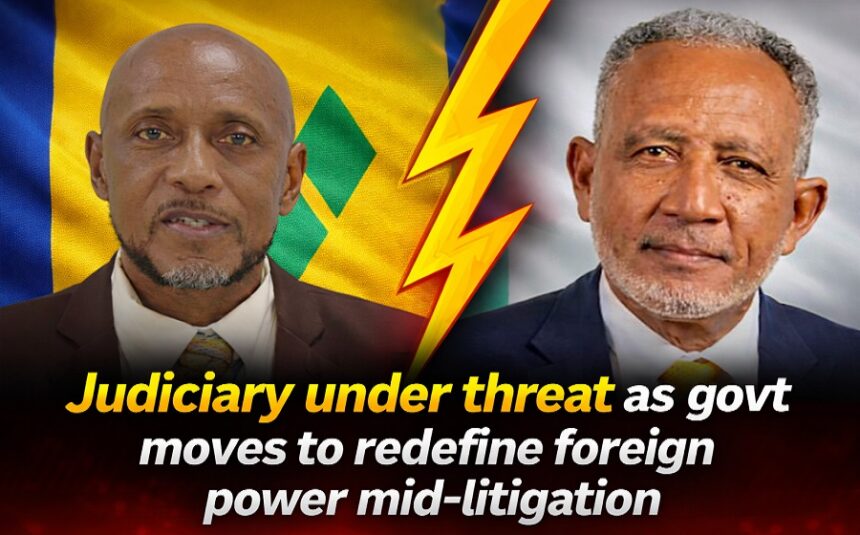
Judiciary Under Threat As Govt Moves To Redefine “Foreign Power” Mid-Litigation
St. Vincent and the Grenadines has been plunged into a deep political and constitutional crisis as the parliamentary opposition vehemently challenges a newly proposed constitutional amendment introduced by the ruling New Democratic Party (NDP) government.
In a highly charged press conference, the Leader of the Opposition, alongside Opposition Senators Carlos James and Keisal Peters, characterized the proposed legislation as a “brazen, self-serving, power grabbing” move that threatens to subvert the nation’s judiciary, electoral process, and foundational democracy.
The amendment aims to retroactively alter the constitutional definition of a “foreign power or state,” a move that the opposition claims is specifically designed to shield two sitting government members from live election petitions currently before the courts.
The controversy centers on Section 26(1)(a) of the St. Vincent and the Grenadines Constitution. This section dictates that no person shall be qualified to be elected as a representative if, by their own voluntary act, they are under an acknowledgment of allegiance, obedience, or adherence to a foreign power or state.
Following the 2025 general elections, the Unity Labour Party (ULP) opposition filed election petitions against two victorious NDP candidates: Prime Minister Godwin Friday (Northern Grenadines) and Fitz Bramble (East Kingstown).
The petitioners, Carlos Williams and Luke Browne, allege that Friday and Bramble were disqualified from running because they hold Canadian citizenship, rendering their statutory declarations of qualification on nomination day false.
The opposition asserts that Canada, despite being a Commonwealth nation, has long been legally interpreted as a foreign state under the constitution.
During early court case management, Dr. Friday dismissed the petitions as “frivolous and a waste of time”.
However, the opposition notes that evidence of their Canadian citizenship has been acknowledged before the court, and expert witness statements on Canadian citizenship law have already been filed by the opposition. The substantive hearings for these election petitions are scheduled to take place before the courts from July 28 to July 30.
With the court dates looming, the government has rapidly introduced a bill to amend the constitution, providing only one week’s notice to the public and the parliamentary opposition.
The bill, standing in Dr. Friday’s name, proposes inserting a new definition into Section 26 of the constitution, stipulating that a “foreign power or state” does not include any country that is a member of the Commonwealth. Crucially, the government intends for this definition to be applied retroactively, taking effect from the very commencement of the nation’s constitution in October 1979.
Furthermore, the amendment includes a “savings provision”. This clause explicitly dictates that nothing in Section 26(1)(a) should be construed as invalidating the nomination, election, or appointment of any representative or senator from 1979 onward simply because they held allegiance to a Commonwealth country at the time.
The Leader of the Opposition heavily criticized this approach, noting that the only two individuals in the country currently facing this specific legal jeopardy are Friday and Bramble, making the legislation inherently self-serving.
The opposition leader accused the government of acting “like a thief in the night,” attempting to upend the accepted definition of a foreign power to retroactively legalize actions that were previously unconstitutional, thereby hijacking an active judicial process.
A primary concern raised during the press conference is the severe violation of the separation of powers. Senator Carlos James emphasized that it is the exclusive role of the judiciary to interpret the constitution. By using their parliamentary majority to alter the law governing a live court case, the government is accused of dictating the outcome of litigation and destroying the integrity of election petitions, which serve as a cornerstone of electoral fairness.
Moreover, the opposition highlighted a historical precedent that directly conflicts with the government’s current agenda. During a prolonged constitutional reform process that culminated in a 2009 referendum, the exact issue of dual citizenship and parliamentary eligibility was heavily debated.
Ultimately, the electorate voted overwhelmingly (over 50% to 40%) to reject the proposed reforms, actively choosing to maintain the constitution’s strict prohibitions on foreign allegiances exactly as they were.
Senator Keisal Peters warned the public that this sets a dark and dangerous precedent for the nation. “If your actions were not invalid, why the need to validate it now?” she questioned, cautioning citizens that a government willing to retroactively amend the constitution for personal political survival without public consultation might easily move to limit fundamental civil rights next.
The potential fallout from the bill extends far beyond St. Vincent’s borders. The opposition has launched a massive regional and global appeal, dispatching formal letters outlining the constitutional crisis to the Christian Council, local trade unions, the OECS Bar Association, the Secretary-General of the Commonwealth, the Organization of American States (OAS), and the Heads of Government of CARICOM.
The opposition’s communication to these bodies stresses that this behavior offends the CARICOM Charter of Civil Society and damages the international reputation of St. Vincent and the Grenadines. The opposition leader noted that foreign investors despise legal uncertainty and arbitrary governance, warning that this overreach could result in devastating economic consequences, job losses, and increased hardship for ordinary citizens.
Furthermore, the opposition raised alarms regarding national security and the future of the country’s governance. Because the amendment blankets all 55 Commonwealth countries, it opens the door for individuals who acquire citizenship via Citizenship by Investment (CBI) programs to legally run for parliament.
The opposition warned of a hypothetical scenario where wealthy foreigners with no historical ties to St. Vincent could purchase a passport, distribute funds to gain local popularity, and ultimately govern the country to serve external agendas.
The opposition has vowed to fight the amendment “politically and legally,” on the floor of the parliament, in the courts, and in the streets. The ULP has called a National Council meeting for May 5 to determine their definitive strategic response, while simultaneously urging citizens to mount a widespread social media campaign to pressure the government.
As the parliamentary debate approaches, the nation remains on edge. The opposition has made it clear that they view this not as a fleeting partisan squabble, but as a monumental battle for the soul of the country’s democracy.
Quoting Dr. Martin Luther King Jr., the opposition leader implored the citizens and civil society of St. Vincent and the Grenadines to recognize the gravity of the moment, stating, “Our lives begin to end the day we become silent about things that matter”.