

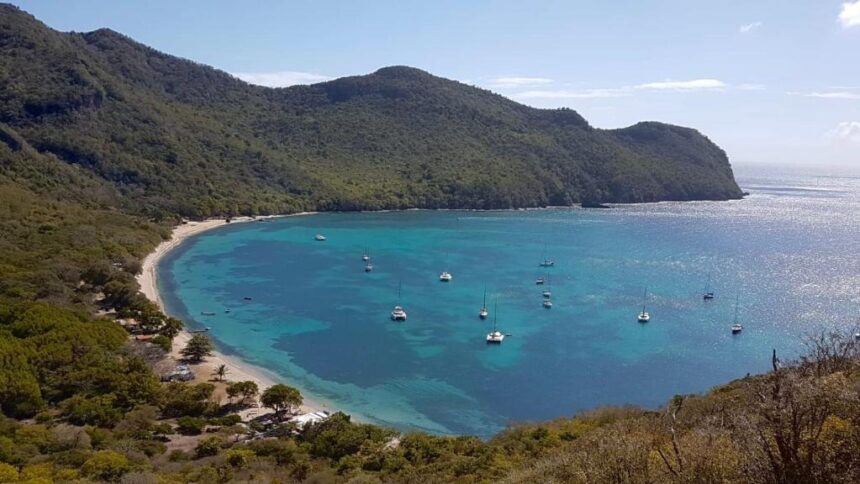
Persistent rumors regarding an alleged secretive sale of a prime 100-acre tract of state-owned coastal land at Chatham Bay have ignited demands for public disclosure and transparency in St. Vincent and the Grenadines. Once the subject of a bitter international legal dispute, the highly valuable property is currently at the center of allegations concerning an undervalued deal.
Opposition Leader Ralph Gonsalves on Monday said, “rumors have circulated widely among legal professionals and the public for weeks that the current St Vincent government has secretly agreed to sell the land for a drastically reduced price of $63 million EC”.
St Vincent Times understands from several sources in the know, that the lands have not been sold.However, the sources did not confirm if the lands are under contract to be sold.
“Thus far, no deed has been registered at the registry, nor has an alien landholding license been visibly processed. The information vacuum has fueled suspicion, including unverified rumors that a sitting cabinet minister might stand to personally benefit from the sale”, Gonsalves said.
Gonsalves said questions have been raised regarding procedural integrity. “The sale of Crown land typically requires the involvement of the Chief Surveyor’s office to provide a current valuation, and the resulting deed is generally prepared by the Attorney General’s chambers”.
Observers have voiced concerns that a private lawyer might be handling the transaction documents instead, which could present serious conflicts of interest.
“There are mounting demands to know the identity of the prospective buyer, the exact terms of the financial agreement, the nature of the planned development, and whether the Chief Surveyor was consulted for an updated valuation”. Gonsalves said.
The saga of Chatham Bay began in the late 1980s or early 1990s when the New Democratic Party (NDP) government granted an alien landholding license to a group of foreign investors. The investors purchased the 99.7-acre property for merely a “few hundred thousand” dollars, under the strict condition that they construct a $15 million EC small hotel within a specific timeframe.
However, the developers failed to build the hotel or fulfill the conditions of their license. Because St. Vincent and the Grenadines does not levy a capital gains tax, the value of the untouched land skyrocketed over the years as the state funded infrastructure improvements, effectively allowing the foreign owners to speculate on the property at no cost.
In December 2005, then-Prime Minister Ralph Gonsalves discovered the non-compliance and moved to forfeit the land in January 2006, utilizing a colonial law dating back to 1922. To avoid international accusations of expropriation, the government offered to refund the investors their initial purchase price plus 5% interest. The investors rejected the offer, demanding $20 million US instead, which sparked a prolonged legal war.
The government secured victories at both the High Court and the Court of Appeal. During this tense period, U.S. State Department officials and embassy personnel reportedly attempted to bully and threaten Gonsalves, warning that his and his family’s visas could be jeopardized if he proceeded, but he refused to back down. Finally, just two days before a scheduled hearing at the Privy Council in London, the investors “threw in the towel” to avoid massive legal costs and accepted the government’s initial offer, officially returning the 100 acres to the national patrimony.
Following the land’s recovery, several development proposals were entertained, including inquiries from a French and Belgian group, as well as a proposal from a naturalized citizen to turn the area into a nature reserve.
Approximately 12 to 15 years ago, former Chief Surveyor Shaka Olive conducted a formal valuation, pricing the Chatham Bay lands at approximately $41 to $42 million US (over $100 million EC). At the time, the Ministry of Finance advised that the price could reasonably be dropped to $38 or $39 million US if a serious developer guaranteed significant job creation and economic linkages for the country.
