
Caribbean disaster agencies are moving to standardize how they collect and share information on people displaced by hurricanes, floods, wildfires and volcanic activity, aiming to speed up assistance and improve recovery planning as weather-related hazards grow more frequent and severe.
Between 2008 and 2024, disasters triggered an estimated 2.61 million internal displacements across the Caribbean (IDMC, 2026), underscoring the increasing complexity of disaster response across the region.
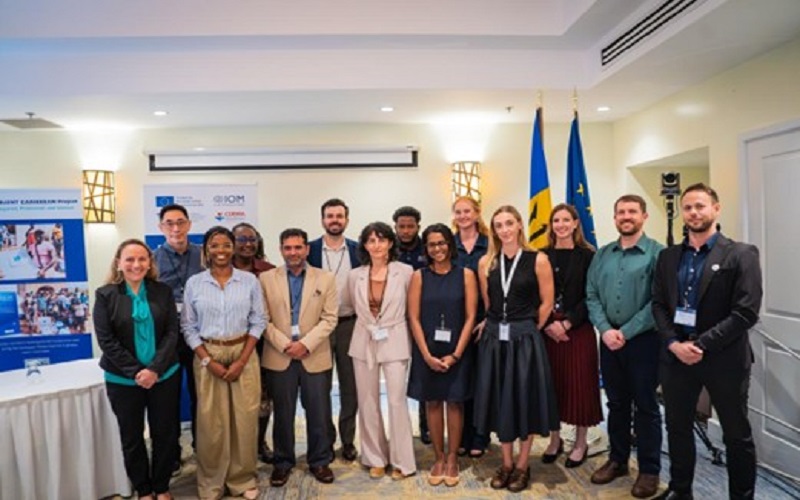
The International Organization for Migration (IOM), the Internal Displacement Monitoring Centre (IDMC) and the Caribbean Disaster Emergency Management Agency (CDEMA) brought together national disaster offices from 13 CDEMA-participating states and regional partners at a two-and-a-half-day workshop in Barbados on 21–23 April to close critical data gaps that can hinder emergency response and longer-term recovery.
Barbados’ Minister of Home Affairs and Information, Gregory Nicholls, urged that the approach should remain people-focused. “For Barbados, the guiding principle is simple: families first. Good data helps responders locate families faster, match assistance with real needs, and protect dignity when systems are under stress. Displacement data must serve people, not processes,” he said.
Funded by EU Humanitarian Aid under IOM’s Resilient Caribbean project, the workshop marks a significant step towards strengthening data-driven disaster management systems in the Caribbean. “Bringing systems together to track displacement after a hurricane really matters,” said Daniela D’Urso, Caribbean Coordinator and Regional Policy Expert for European Civil Protection and Humanitarian Aid. “It turns fragmented, often anecdotal information into clear, usable data, helping responders act faster, support people more fairly, and plan for long‑term recovery. When there is no common approach, governments and humanitarian partners are left without a clear picture of who has been displaced, where they are, and what they need,” she explained.
Participants developed a regionally harmonized Standard Operating Procedures (SOPs) for displacement data, aligned with CDEMA’s Damage Assessment and Needs Analysis (DANA) framework. The SOPs set out common activation triggers, roles and minimum datasets to help countries generate timely, comparable information that can guide immediate operations and longer-term recovery and risk reduction.
“Preparedness is about learning from experience,” said Patrice Quesada, IOM Coordination Officer for the Caribbean and Chief of Mission for Barbados. “It is really about anticipating the next storm, not just responding to the last one. For that, we need to share experience with teams of experts who can trust and support each other when the time comes.” Daniela D’Urso reinforced that “Better data enables better protection – by improving evacuation planning, strengthening shelter management, and ensuring that assistance reaches those most at risk, including women, children, elderlies and persons with disabilities”.
The workshop included practical sessions on displacement data tools (DTM, IOM Shelter Portal, KoboToolbox), geospatial and mapping services (Copernicus, MapAction), and expert inputs from the Internal Displacement Monitoring Centre (IDMC) and CIMA Research Foundation on monitoring displacement and integrating risk analysis into planning.
Lessons from CDEMA’s After Action Reviews following Hurricane Beryl and Hurricane Melissa informed the SOPs, with participants calling for clearer activation triggers, stronger data protection and ethics safeguards, and better-defined institutional responsibilities.
The procedure is intended to improve information flows between shelters, emergency operations centres and national systems so responders can identify needs sooner and coordinate support more effectively. A harmonized approach will also make it easier to compare information across countries during large-scale emergencies and clarify reporting lines when multiple hazards affect the region at once.
Sashagaye Vassell, Planning Analyst at Jamaica’s Office of Disaster Preparedness and Emergency Management, said the region’s exposure to multiple hazards makes speed and consistency essential. “We are very prone to multiple hazards and have many vulnerable people. This SOP will help us capture and share consistent information faster, so decision-makers can direct support where it is needed most,” Vassell said.
In the coming months, activities will focus on building the capacity of National Disaster Offices through data collection and analysis training, vulnerability assessments, simulation exercises and targeted trainings in Camp Coordination and Camp Management (CCCM) and other key areas of disaster preparedness.
These efforts aim to support a Caribbean that is more coordinated, prepared and resilient in the face of future disasters.