

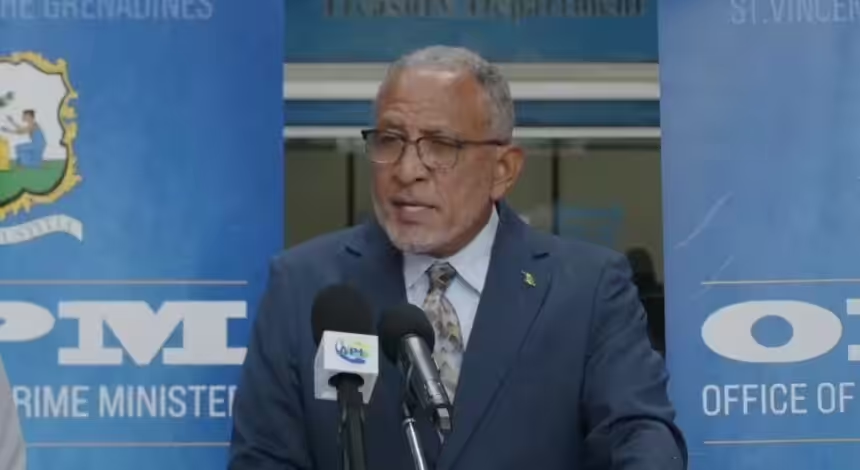
PM Friday Unveils 90-Day Emergency Relief Package to Combat Rising Cost of Living
Prime Minister Dr. Godwin Friday has announced a comprehensive “90-day emergency package” designed to shield the citizens of St. Vincent and the Grenadines from the severe impacts of global inflation. The targeted interventions focus strictly on suppressing the soaring costs of fuel, electricity, cooking gas, and imported goods to provide immediate relief to households and businesses.

To combat global oil market pressures, the government is implementing a three-month intervention to reduce excise taxes and slash the customs service charge by 50% on imported petroleum products. Without this intervention, gasoline would have risen to approximately $18.82 per gallon. Instead, the government is absorbing roughly $1.90 per gallon, capping the price of gasoline at $16.92. Similarly, diesel prices will be held at $16.26 per gallon, saving consumers from a projected spike to nearly $17.71.
Recognizing the steady rise in electricity generation costs, the government is completely removing the customs service charge and excise taxes on diesel purchased specifically for electricity generation. This measure alone represents an estimated $1.65 million in foregone government revenue over the next three months, with the savings intended to be passed directly to consumers.
Furthermore, the government has established a two-pronged partnership with Vinlec to provide additional utility relief. If the fuel surcharge exceeds 71 cents per kilowatt-hour, Vinlec will provide a 50% matching discount on the fuel cost formula. If the surcharge rises above 77 cents, Vinlec will provide a full 100% matching contribution to protect households from runaway electricity bills.
Describing cooking gas as an absolute necessity, Prime Minister Friday announced the 100% removal of the customs service charge on all liquefied petroleum gas (LPG). Over the 90-day period, the government will absorb approximately $54,368 in lost revenue to stabilize LPG prices, ensuring that families do not have to compromise on basic groceries or school expenses to afford to cook their meals.
To mitigate imported inflation caused by volatile international shipping rates, the government is introducing two crucial measures to lower the landing costs of imported goods. First, shipping surcharges—including fuel and congestion fees—will be completely removed from tax calculations. Second, freight rates used to calculate government taxes will be benchmarked to January 2026 levels. This ensures that even if a shipping company currently charges $4,800 for a container, taxes will be calculated as if freight rates had remained at their lower January prices.
To bolster local food production and reduce reliance on imported food, the government is providing subsidized seeds and a 30% discount on fertilizers for local farmers. The administration is also maintaining a 100% tax waiver on solar photovoltaic systems to encourage a long-term transition to renewable energy. Additionally, the government is closely monitoring construction costs and is prepared to introduce a VAT waiver on cement if prices cross a critical threshold.
To ensure these interventions successfully ease the financial burden on the public, Prime Minister Friday has directed the National Cost of Living Task Force to monitor prices on a weekly basis. This oversight aims to guarantee that tax reductions directly benefit everyday consumers rather than simply inflating business profit margins.
