
CARIBBEAN LEADERS MUST ADDRESS THE GAP BETWEEN CLIMATE COMMITMENTS AND DELIVERY
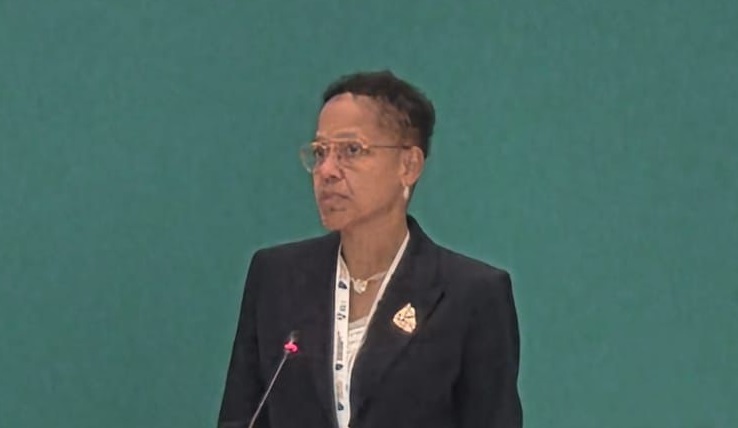
The challenge facing Caribbean small island developing states is not a lack of commitment to environmental protection. It is a system that was not designed with them in mind. That was the central message delivered by Deputy Prime Minister and Minister of Environment, National Beautification and Fisheries of Barbados, H.E. Santia J.O. Bradshaw, as she addressed world leaders at the High Level Session of the Eighth Global Environment Facility Assembly in Samarkand, Uzbekistan on World Environment Day.
Minister Bradshaw gave voice to a reality shared across the Caribbean. From Jamaica to Grenada, from Barbados to St. Vincent, small island states are managing the consequences of climate change with limited fiscal space, overstretched administrations and a global financing architecture that too often moves too slowly to matter. Complex application procedures, lengthy approval timelines and delayed disbursements have meant that resources intended to protect coastlines, restore ecosystems and strengthen food security frequently arrive after the window to act has already passed.
“Finance that arrives too late cannot deliver the impact that is urgently needed,” Minister Bradshaw told the Assembly, calling for simplified access procedures, faster disbursement mechanisms and financing modalities designed around the realities of small states rather than large ones.
The human capacity challenge was equally direct. Across the Caribbean, small administrations are being asked to manage multiple projects, reporting obligations and procurement requirements under several multilateral environmental agreements at the same time. Minister Bradshaw made clear that capacity support must be treated not as an optional addition but as a fundamental investment in effective implementation. Barbados experienced this directly when delayed funding disbursement affected the preparation of its Seventh National Report under the Convention on Biological Diversity, a gap that has contributed to the broader underrepresentation of Caribbean perspectives in global biodiversity assessments.
The Minister also spoke to the compounding effect of extreme weather events across the region. Hurricane Beryl, which devastated communities across multiple Caribbean islands in 2024, left Barbados with between seventy five and ninety percent of its active fishing fleet destroyed, placing the livelihoods of over two thousand five hundred fisherfolk, vendors and processors immediately at risk. The fishing industry forms the social and economic backbone of coastal communities across the Caribbean, and its vulnerability to climate events reflects a regional exposure that no single island can address alone.
Minister Bradshaw was also candid about the gaps in current GEF policy processes. She noted that small island state concerns and priorities do not appear to be sufficiently reflected in the current draft council papers, and encouraged greater consideration of the unique circumstances of Caribbean and Pacific SIDS as discussions continue.
Her closing appeal was not for special treatment but for fairness. “Our call is for equity, effectiveness and fairness,” she said, urging that the next GEF replenishment be built around the ability to respond to vulnerability, deliver resources in time and remain genuinely accessible to those most in need. “Barbados remains ready to partner, to lead and to deliver, but to do so effectively, the global environment financing mechanism must be accessible, timely, responsive, equitable and, above all, fit for purpose in a climate constrained world.”
Barbados was among delegations from one hundred and eighty six member countries at the GEF Assembly, convening under the theme “Last Sprint Towards 2030.”