


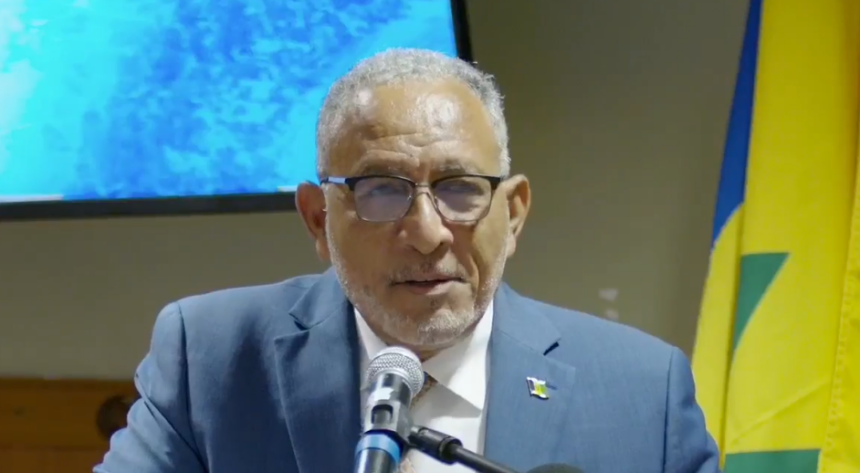
Speaking at the Government of St. Vincent and the Grenadines United Nations Development Partners roundtable, Prime Minister Godwin Friday outlined an ambitious vision to transition the nation from a state of disaster recovery toward long-term structural transformation and resilience.
Addressing local officials, foreign diplomats, and international development partners, PM Friday highlighted the profound impact of recent back-to-back crises, including the COVID-19 pandemic, volcanic eruptions, Hurricane Beryl, and the inflationary fallout from ongoing conflicts in the Middle East. These compounding disasters forced the government to expand public investment to protect citizen welfare and rebuild lost infrastructure.
However, Friday cautioned that this necessary spending, coupled with ineffective debt management, has driven the national debt to over 113% of the gross domestic product (GDP).
“Our response cannot simply be a matter of surviving from one fiscal year to the next,” Friday stated, stressing the necessity of structurally altering the country’s economic foundations.
To build a durable and resilient economy, the Prime Minister laid out a medium-term plan focused on three primary transformative areas:
Accelerating the Green Energy Transition: Citing the exorbitant utility costs driven by a heavy reliance on imported diesel, Friday announced plans to replace aging generators with solar power and battery storage. He reaffirmed the nation’s fierce commitment to a national energy strategy that targets a 60% renewable energy share by 2030.
Bridging the Skills Mismatch: Noting that economic growth must be inclusive, Friday pointed out that local workers—particularly young men and women—face systemic employment gaps despite large-scale construction activity. The government is actively reorganizing technical and vocational education to align human capital with the needs of the private sector.
Upholding Fiscal Discipline: To ensure transparent and effective spending, the government is working with technical partners to reactivate a modernized fiscal responsibility framework. Friday emphasized that the government intends to place this framework on a statutory footing, supported by comprehensive public expenditure reviews, enhanced tax compliance, and automated social protection delivery.
A major component of Friday’s address was a strong critique of the global financial architecture, which he described as “fundamentally misaligned with the realities of small island developing states”. He noted that it is unconscionable that Caribbean nations, which contribute less than 1% to global emissions, are penalized with double-digit commercial interest rates to rebuild after climate shocks, while developed nations pay a fraction of the cost.
In response, the Prime Minister called on the UN development system and international partners to aggressively champion the multi-dimensional vulnerability index as the new standard for accessing concessional financing. He argued that access to affordable lending should not be dictated by arbitrary income metrics that completely ignore a nation’s acute exposure to climate devastation and geographic isolation.
PM Friday concluded his address by reminding development partners that a single storm has the potential to wipe out a decade of hard work and progress. Stressing the urgent necessity of international collaboration, he declared that St. Vincent and the Grenadines “cannot do this alone,” and called for robust, continued partnerships to help the nation adapt to crises and build a more prosperous society.