


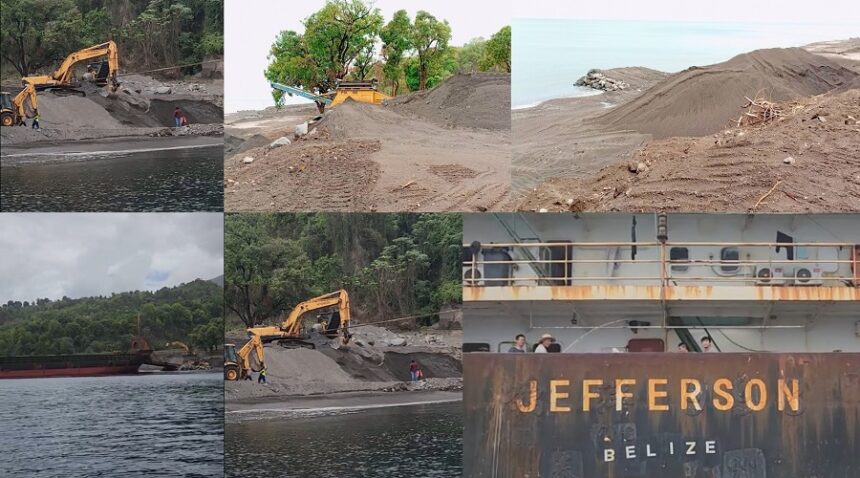
Opposition Leader Ralph Gonsalves is demanding urgent transparency and accountability from the government and the Roads, Buildings, and General Services Authority (BRAGSA) regarding the ongoing sand mining operations at the Wallilabou and Roseau rivers in North Leeward.
While noting that he does not inherently oppose mining, Gonsalves has raised serious legal, environmental, and financial questions following a recent community meeting held by government and BRAGSA officials in Chateaubelair.
A major point of contention for Gonsalves is whether BRAGSA legally began its mining operations before securing the necessary final approvals. According to Gonsalves, BRAGSA’s CEO, Kemba Thwaites, stated that the agency received “approval in principle” from the Physical Planning Board, contingent on conditions such as an environmental and social impact assessment (ESIA) conducted by Dr. Murray. However, Gonsalves claims his own inquiries at the physical planning office revealed that only an approval in principle currently exists, not a final approval.
“You can’t get final approval… Approval in principle don’t allow you to go and mine,” Gonsalves stated, questioning if the Cabinet or the Minister of Infrastructure improperly bypassed the physical planning board to authorize the work. He is formally calling on authorities to publish the final approval documents and the ESIA online. Gonsalves warned that he is prepared to use the Physical Planning Act to request these documents, and if ignored, he is willing to pursue court action, including a mandatory injunction or a writ of mandamus, to force their release.
Gonsalves strongly criticized the government for seemingly treating the operations in North Leeward the same as the dry-river mining at Rabacca. He emphasized that Wallilabou is a “live river” that poses vastly different environmental and social challenges.
Gonsalves noted that the local community relies on the river for catching river lobster, crayfish, mullet, and suck stone, as well as for bathing and picnics. He is demanding answers on how the operations will accommodate these traditional activities, how far up the river the mining will extend, and what specific facilities or financial benefits are being directed back into the affected community.
The financial arrangements of the mining operation have also drawn heavy scrutiny. Gonsalves highlighted that 110,000 tons of sifted material are being mined for developers in Canouan reportedly for a golf course for $3.8 million EC. This equates to roughly $34.54 per ton.
To determine if the country is receiving a fair deal, Gonsalves compared this to the Rabacca operations, where sifted material is sold for $46 EC per cubic yard. However, because there is no physical weighing scale at the North Leeward site, Gonsalves questioned how BRAGSA is accurately converting cubic yards to tons for billing. While his preliminary calculations suggest the price might not be entirely unreasonable if densities are comparable, he insists on full financial disclosure to ensure the government is not shortchanging the state.
“I don’t expect you to subsidize rich people in Canouan,” Gonsalves declared, demanding to know if the Canouan developers are receiving the same material subsidies typically reserved for local construction.
To force answers on these issues, Gonsalves and Senator Carlos James have both submitted formal questions to the Minister of Works and Infrastructure for the upcoming session of Parliament, probing the financial terms, environmental oversight, and overall management of the North Leeward mining operations.