


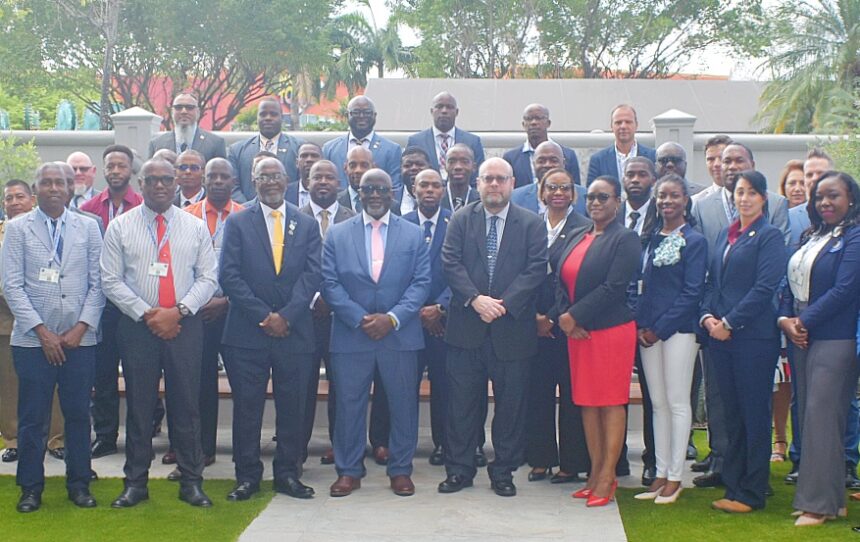
In a bid to disrupt the illicit flow of increasingly untraceable weapons, the Caribbean Community (CARICOM) Implementation Agency for Crime and Security (IMPACS) and the US Department of State’s Bureau of International Narcotics and Law Enforcement Affairs (INL) have officially opened a critical five-day regional Firearms Trafficking Workshop.
The workshop, taking place from June 8 to 12, 2026, at the Courtyard by Marriott in Port-of-Spain, brings together frontline law enforcement officials from across the Caribbean. The initiative is designed to strengthen cross-border investigations, standardise gun data collection, and enhance the technical skills required to dismantle modern trafficking networks.
Delivering the welcome remarks, Lt. Col. Michael Jones, Executive Director of CARICOM IMPACS, revealed a sobering reality: although the Caribbean does not manufacture these weapons, illicit firearms drive almost 90% of homicides in the region’s most impacted Member States. He warned that the landscape of crime is rapidly shifting. “Today, our law enforcement officers face an ecosystem of decentralised, tech-driven violence,” Jones stated, noting that illicit weapons are increasingly “untraceable, modular and digitally sourced”.
The Honourable Wayne Sturge, Trinidad and Tobago’s Minister of Defence, echoed this urgency in his keynote address, elevating the severity of the issue. “The Caribbean is not facing a firearms problem. It is facing a firearms crisis,” Sturge asserted. He emphasized that criminal networks are moving faster and exploiting operational gaps through the use of ghost guns, 3D-printed weapons, and encrypted logistics networks.
Recognizing that many illegal firearms originate from international hubs, including the United States, Mr. Michael Fitzpatrick, Chargé d’Affaires a.i. at the US Embassy in Trinidad and Tobago, reaffirmed Washington’s unwavering commitment to its Caribbean partners. He highlighted the importance of sustained intelligence sharing and trust, citing major operational successes. Notably, this collaboration led to the 2021 interception of a syndicate smuggling over 200 firearms hidden inside punching bags from Florida to a Trinidadian airport, as well as the June 2025 federal sentencing of a dual citizen involved in weapons smuggling.
To build hard operational capabilities, the intensive training is facilitated by a distinguished cohort of experts from US agencies, including the Bureau of Alcohol, Tobacco, Firearms and Explosives (ATF), Homeland Security Investigations (HSI), Bureau of Industry and Security (BIS), and US Customs and Border Protection (CBP). Rather than focusing on theoretical exercises, participants will learn advanced techniques such as leveraging dark web intelligence, identifying smuggled firearm components within commercial cargo, and analyzing import patterns of parts and polymers that feed the rise of 3D-printed weapons.
Dr. Simone Titus, Deputy Permanent Secretary of Trinidad and Tobago’s Ministry of Homeland Security, reminded attendees of the ultimate goal behind the high-level training. Urging participants to fully leverage the workshop, she noted, “A secure Caribbean Region will lead to safer communities for the people we serve and love”