


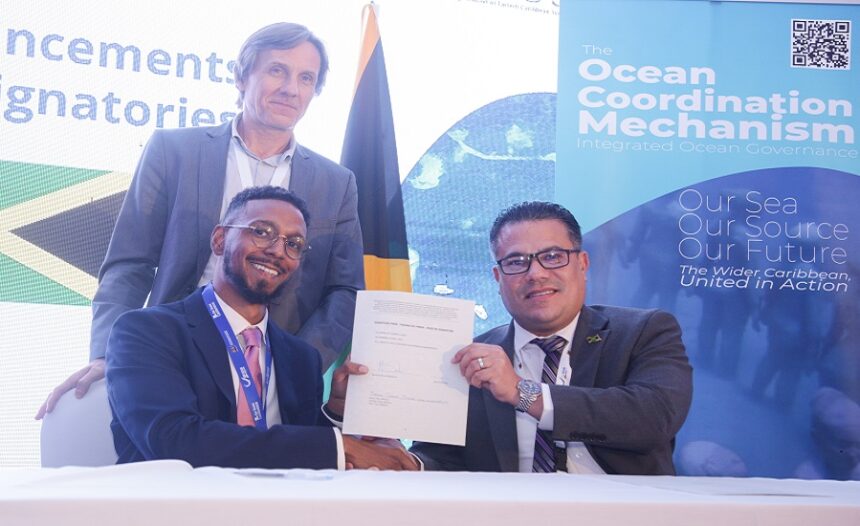
In a historic advancement for regional collaboration, the governments of Jamaica and Barbados have officially signed a Memorandum of Understanding (MoU) to join the Wider Caribbean Ocean Coordination Mechanism (OCM). The official signing took place on June 18, 2026, during a side event hosted by the Government of Jamaica, the OCM, the Caribbean Biodiversity Fund, and other partners at the ‘Our Ocean’ Conference in Mombasa, Kenya.
With the addition of Jamaica and Barbados, the OCM now comprises 22 countries and 9 Intergovernmental Organizations. The mechanism was designed to overcome historical challenges in the Wider Caribbean, such as fragmented governance, climate change, and environmental degradation, which have previously hindered sustainable development across the region’s deeply interconnected marine ecosystems. By improving institutional efficiency and fostering collaboration, the OCM aims to address these critical environmental challenges while unlocking the economic, environmental, and social potential of a healthy ocean.
The Hon. Mathew Samuda, Minister of Water, Environment, and Climate Change, signed the agreement on behalf of Jamaica, while H.E. William Alexander McDonald, High Commissioner of Barbados to the Republic of Kenya, represented Barbados.
Speaking at the event, Minister Samuda emphasized the strategic importance of the agreement: “Jamaica has recognized the OCM as an important regional coordinating mechanism on ocean-related matters, it is for this reason we have decided to become a member of the OCM”. He added that Jamaica “looks forward to a constructive partnership with the OCM in advancing the global, regional and national ocean agenda”.
Amidst shifting overseas development assistance funding, the OCM provides a strategic framework to utilize marine resources more effectively. The mechanism is financially supported by the $15 million GEF/UNDP/UNOPS PROCARIBE+ initiative.
Moving forward, the OCM plans to execute several key initiatives to support its member states, particularly prioritizing the needs of the region’s Small Island Developing States (SIDS). These initiatives include strengthening climate-resilient ocean-based economies, developing a holistic Ocean Action Programme, and launching a periodic reporting mechanism on the “State of the Marine Environment and Associated Economies”. By pioneering this unique mechanism, the Wider Caribbean region continues to position itself as a global leader in cooperative marine resource management.