


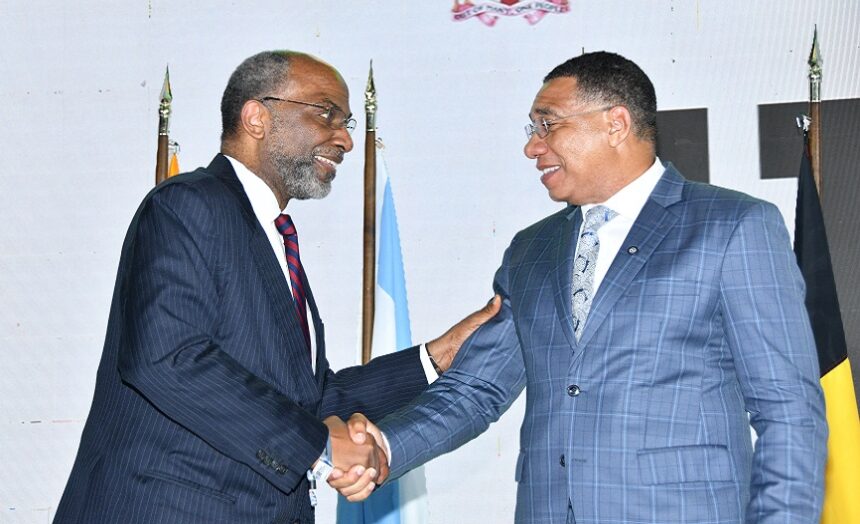
Prime Minister Andrew Holness says Jamaica is reinforcing its financial credibility on the global stage, with stable inflation, record foreign exchange reserves and improved sovereign ratings which has positioned the country for stronger access to capital, even as it continues post-hurricane recovery.
Prime Minister Dr. Holness was delivering the keynote address at the opening of the 11th Jamaica Diaspora Conference. He said the country achieved these milestones despite several challenges. Dr Holness pointed to the COVID-19 pandemic, global and logistic supply chain issues, the war in Ukraine, Hurricanes, Beryl in 2024 and Melissa in 2025, as well as the war in the Middle East. He acknowledged that more work needed to be done despite these achievements.
“Inflation is back within our target band of four to six percent, and we have kept within that band, except for the COVID period, for the last decade,” Holness said. “That is exceptional for a small island developing state, where inflation has traditionally been a real challenge.”
Dr Holness emphasised that maintaining fiscal discipline has been central to building confidence in Jamaica’s economic management framework.
“For a small, open economy like Jamaica, we exist in a very brutal space,” he said. “We face increasing, overlapping events of greater intensity, but yet Jamaica has held, and we have held up very well.”
The Prime Minister explained that a major pillar of that resilience is Jamaica’s external position is the country’s foreign exchange reserves which have reached record levels, significantly strengthening its capacity to withstand external pressures.
“There were times when we did not have even 13 weeks of foreign exchange reserves, which is a benchmark of whether a country can survive,” Holness said. “We now have the highest levels of reserves ever.”
He added that these reserves function as a financial safeguard for the economy. “That is what guarantees that we are able to truly run Jamaica,” he said, underscoring their role in maintaining stability during periods of uncertainty.
Dr Holness said Jamaica’s improved macroeconomic performance has been recognized by international credit rating agencies, further boosting investor sentiment.
“When Hurricane Melissa struck, all three major international credit rating agencies reaffirmed Jamaica’s standing, and Moody’s even upgraded us,” Holness noted. “That is a major achievement.”
He stressed that these ratings go beyond fiscal metrics. “The rating agencies do not only look at our financial situation. They take a comprehensive view, including governance, social stability and democracy.”
The Prime Minister described the country’s improved standing as a strategic advantage in global capital markets. “The credibility of performance is an asset,” he said. “Jamaica did not always have this asset. For many decades, we were viewed as a basket case. Today, we are viewed as a case study.”
He said that credibility has translated directly into financing outcomes. He said the country has secured approximately US$6 billion in funding to support reconstruction and resilience efforts following Hurricane Melissa.
“We were never able to mobilize that level of financing before,” Holness said. “That is what credibility buys. It buys trust, it buys time, and it buys speed.”
Beyond macroeconomic gains, private sector leaders emphasised the increasing importance of diaspora engagement as a driver of investment, entrepreneurship and knowledge transfer.
Earl Jarrett, Chief Executive Officer of The Jamaica National Group and chair of the conference, said the large turnout of more than 1,000 participants from over 15 countries underscores growing international interest in Jamaica’s economic prospects.
“The level of attendance sends a loud and clear message to the world that Jamaica and its diaspora are committed to the development of our country,” Jarrett said.
Mr Jarrett pointed to the conference’s “Jamaica Marketplace” as a key platform linking diaspora participants with investment opportunities, noting that roughly 80 exhibitors, including government agencies and private sector firms, are offering access to financing and business partnerships.
“These engagements are not just about financial capital, but also intellectual capital,” Mr. Jarrett said, highlighting the role of diaspora expertise in scaling innovation and supporting entrepreneurship.
Mr Jarrett said the event has already facilitated the creation of new business relationships, with entrepreneurs, investors and institutions connecting across sectors.
“A new business opportunity is being birthed,” he said, describing the conference as a catalyst for both local and cross-border ventures.
He added that diaspora engagement has evolved beyond remittances to include direct investment, skills transfer and market access, strengthening Jamaica’s long-term growth potential.
In emphasizing the need for further skills, Dr Holness said economic gains have also been reflected in the labour market, with unemployment falling to approximately 3.5 per cent, down from about 13 percent a decade ago.
“Believe it or not, we are now practically at full employment,” Holness said. “Businesspeople will tell you that we now have a different problem. We just cannot find enough skilled labour to carry through the growth agenda.”
He described this as “a good problem to have, but a problem nonetheless,” pointing to emerging capacity constraints that could impact future growth if not addressed.
Despite strong macroeconomic indicators, Holness acknowledged that the benefits have not yet been fully translated to all households, particularly those affected by Hurricane Melissa.
“Whilst we celebrate the ratings, we acknowledge without fear of admitting that we still have a lot of work to do,” he said.
He emphasised that recovery must remain people centred. “We must focus on getting the families who are still in distress back on their feet, regaining their economic independence so they can pursue their well-being and prosperity.”
Dr Holness said Jamaica is now operating from a position of relative strength but must accelerate implementation.
“We now have the financing to pursue our recovery and resilience building,” he said. “Now we must push forward quickly.