

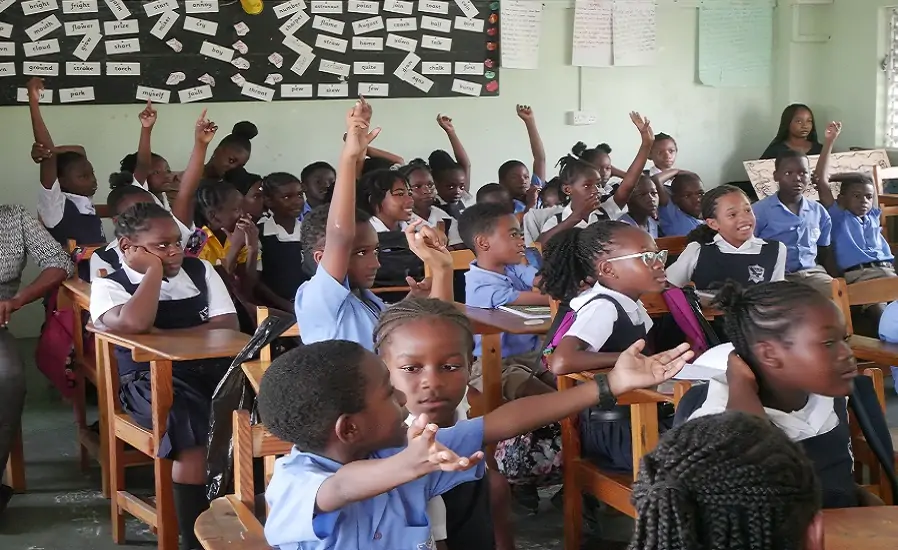
Following the release of the 2026 Caribbean Primary Exit Assessment (CPEA) results, the Ministry of Education has unveiled a comprehensive Educational Action Plan designed to address persistent gender achievement gaps, low numeracy scores, and rural inclusion. While the national pass rate improved to 88.47% this year, the government has committed to a series of strategic interventions to ensure “every single child succeeds”.
A primary pillar of the new plan is a gender-targeted literacy and engagement program. Analyzing registration and achievement data revealed a continuing performance gap between genders, with 825 females meeting the standard compared to 732 males. To address this, the Ministry will implement a localized boys’ education initiative, which will prioritize male-centric literacy resources and interactive learning styles intended to lift the median performance of male students closer to that of their female peers.
Despite students achieving perfect scores in several subjects, the Ministry highlighted a significant “numeracy problem,” noting that only 50.63% of students passed the mathematics portion of the assessment. In response, the Action Plan introduces a Primary Math Enhancement Program. This initiative will shift the focus of instruction toward conceptual problem-solving rather than rote memorization, aiming to stabilize the mathematical standard and minimize low-end performance variance.
To ensure consistency between classroom performance and external exam readiness, the government will launch SBA standardization workshops. These sessions will provide continuous professional training for teachers to align school-based assessment (SBA) grading methodologies more tightly with CXC frameworks.
Inspired by the success of Faith Grant a visually impaired scholar from the Fair Hall Government School who placed 43rd nationally the Ministry plans to expand institutional inclusion support. The government intends to allocate increased corporate and public funds to scale up assistive technologies, including braille literacy and sensory tools, specifically across more rural centers. This move is intended to ensure that students in rural areas are not “forgotten” and have equitable access to educational resources.
The Ministry emphasized that while current successes are being celebrated, records showing schools with pass rates as low as 57.6% cannot be allowed to stand. “The transformation of a better education service will be achieved,” the Ministry stated, reaffirming its duty to do right by the nation’s “promising children”.
The plan also calls for increased corporate social responsibility.