

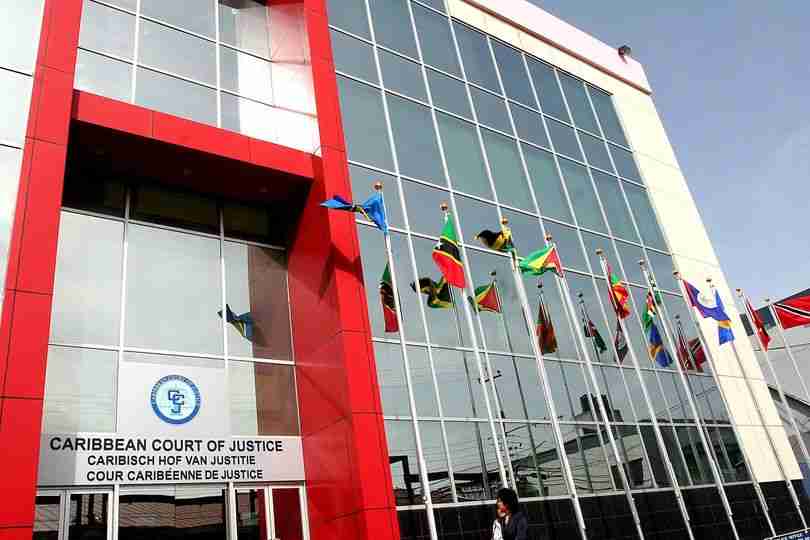
On Friday, 3 July 2026, in its first-ever referral matter, the Caribbean Court of Justice (CCJ), sitting in its Original Jurisdiction, answered the question referred to the Court in the Belizean matter of G. Anwar Barrow and others v Financial Services Commission and the Attorney General of Belize CCJ Referral No. RFOJ2026/001 concerning the interpretation of Article 177* of the Revised Treaty of Chaguaramas (RTC). The Court ruled that Article 177 does not prohibit a Member State from implementing local regulations that require the use of agents in that country to maintain and file documents for companies incorporated in, or with shareholders or directors from, other Caribbean Community (CARICOM) States.
This matter arose from constitutional proceedings before the High Court of Belize in which the Claimants, a Belizean businessman and seven Belizean registered companies, challenged statutory requirements relating to companies with connections to other CARICOM Member States. The challenged provisions included the need for these companies to maintain a registered agent in Belize, to file documents only through that agent, and to pay fees in United States dollars.
The Claimants contended that these requirements imposed unequal conditions when compared to purely domestic companies engaged in equivalent transactions which were not required to meet these requirements. This, in turn, they alleged, placed them at a competitive disadvantage in breach of Article 177 of the RTC.
The High Court in Belize referred the following question to the CCJ:
Does the requirement that (a) local companies with shareholders or directors from CARICOM jurisdictions and (b) companies incorporated within CARICOM countries maintain and file documents through local registered agents breach the Caribbean Community Act, which incorporates the Treaty of Chaguaramas into Belize law in that the requirement amounts to the application of unequal conditions to parties undertaking equivalent engagements in commercial transactions thereby causing a competitive disadvantage as prohibited by Article 177 of the Treaty of Chaguaramas?
Considerations:
The Court first considered whether it had the jurisdiction or legal authority to answer the referred question. It emphasised three benchmarks in establishing its referral jurisdiction. First, the Court must be satisfied that the criteria outlined in Article 214 of the RTC are met, namely, that a national court or tribunal of a Member State of the Community is hearing an issue whose resolution involves a question concerning the interpretation or application of the Treaty. Second, it is for the national court or tribunal to decide whether a referral of the issue to the CCJ is necessary to resolve the dispute before it. Where the referral is found to be necessary, the CCJ is generally bound to provide the requested assistance. Third, the CCJ retains the residual power, to decline to answer a referral but that power is only to be exercised in exceptional circumstances.
In this case, the Court held that the existence of overlapping constitutional issues in the domestic litigation did not affect the need for the referral. The Court reiterated that domestic law, including constitutional provisions, cannot be used as justification for a Member State’s failure to perform its obligations under a treaty.
The Ruling:
In its decision, the Court noted that, in its Original Jurisdiction, while it could not provide guidance on whether Belizean domestic legislation had been breached, it was competent to interpret Article 177 of the RTC. To do so, the Court applied a contextual interpretation of Article 177 within Chapter Eight of the RTC, which establishes the Community Competition Policy. The Court noted that the goal of the Policy is to prevent anti-competitive business conduct that would frustrate the benefits of the CARICOM Single Market and Economy.
The Court then explained that Article 177 is directed at the “business conduct of enterprises” and not regulatory measures of the State. Applying this interpretation, the Court concluded that the requirements highlighted in the referral question were regulatory measures enacted by the State and did not arise from the business conduct of enterprises. While the Court acknowledged that State measures capable of distorting competition may be examined under other provisions of the RTC, it pointed out that the referred question did not cover those provisions.
Accordingly, the CCJ answered the referred question by holding that Article 177 of the RTC does not prohibit countries from implementing regulations requiring local companies with shareholders or directors from CARICOM jurisdictions, and companies incorporated within CARICOM countries, maintain and file documents through local registered agents. The Court held that Article 177 essentially is concerned with the anti-competitive business conduct of companies, and not with the regulatory measures of a Member State.
The members of the CCJ panel were CCJ President, the Honourable Mr Justice Anderson, and the Honourable Justices Jamadar, Ononaiwu, Eboe-Osuji, and Bulkan. The Claimants were represented by Mr Godfrey P. Smith, SC, Mr Hector D. Guerra, and Mr Edgar G Lord. The Financial Services Commission was represented by Mr Eamon H. Courtenay, SC, Ms Pricilla J. Banner, SC and Ms Stacey Castille Ysaguirre. The Attorney General of Belize was represented by Ms Samantha Matute and Ms Alea Gomez. Ms Carissa Rodulfo appeared before the Court as an Amicus Curiae, assisted by co-counsel Mr Mikhail Charles.