


On a June night in Houston, a nation of 156,000 people walked onto a World Cup field to face Germany. Curaçao — an island you can drive across in an afternoon, smaller than any country ever to reach the tournament — lost that match 7-1. It hardly mattered. By the time the Blue Wave drew Ecuador, earned a point, and bowed out, something larger had happened: the smallest nation in World Cup history had stood on the biggest stage in sport, and the whole Caribbean had watched one of its own get there.
- The big stage pays downstream
- It wasn’t luck. It was a system.
- The contenders: who’s got next seat at the top table
- The next Curaçao: who runs the playbook?
- This is bigger than the football association
- A growth lever hiding in plain sight
- The bigger prize: a league of our own
- Following the money
- A question worth asking out loud
The scoreline will fade. The question it leaves behind will not: if Curaçao can do this, why not the rest of us? And beneath it sits a second question, quieter but more interesting to anyone who thinks about money: reaching a World Cup is not only a sporting achievement. For a small island, it may be the single largest economic and branding event it will ever stage.
The big stage pays downstream
Start with what the exposure is worth. A World Cup appearance places a country before billions of viewers
— the kind of global advertising a small island’s tourist board could never afford to buy. And Curaçao caught that spotlight at the perfect moment. Its tourism is already booming: some 700,000 stayover visitors in 2024, up 20 percent in a year, and 1.57 million arrivals in all, for an economic impact around US$2.7 billion. Tourism now accounts for 30% of Curaçao’s GDP, and that number is likely to reach close to 50% by the end of 2027 tourism season, with more than 20,000 jobs, and helped drive growth of about 5 percent. More telling still: for the first time, North American visitors have overtaken Europeans as the island’s largest source of guests — and Curaçao’s World Cup matches were played in Houston and Philadelphia, in front of the very audience it is trying to win.
The dividend does not stop at the beach. When visitors and investors follow the exposure, the money moves through the whole economy — into hotels and holiday homes, the construction that builds them, the mortgages that finance them, and so into the banks; Curaçao and St Maarten even share a central bank, the CBCS. A fortnight on the world’s screens is not a sporting footnote. It is an economic input.
It wasn’t luck. It was a system.
Here is the part that should interest every small Caribbean nation: Curaçao did not stumble into this. It built it. Three things came together. First, a deliberate plan to assemble a squad: tied to the Netherlands, Curaçao recruited the professional talent it had a claim to — players raised in Dutch academies, with roots on the island. Whether a player was born in Willemstad or Rotterdam is beside the point; a federation set out to build a team good enough to win, and did. And it was no fluke: Suriname, running the same playbook, reached the intercontinental play-off the same cycle and came within a game of joining Curaçao. The model works — and it worked twice.
Second, investment and belief from the top: a federation that backed the project for years, and a World-Cup-experienced coach to finish it. And third, an open door: the tournament expanded from 32 teams to 48, and with the United States, Canada and Mexico automatically in as hosts, more places opened to the region than ever before. That door will not stay this wide — but it was wide enough.
The contenders: who’s got next seat at the top table
So, who follows? Among the region’s established sides, five names stand out for 2030. Jamaica came closest of anyone: a scoreless draw away to Curaçao, then a play-off, were all that stood between the Reggae Boyz and a first World Cup since 1998, and they carry the region’s deepest talent pool. Suriname, Curaçao’s Dutch-model twin, reached its first-ever play-off and will fancy its chances again. Curaçao itself has the proven system, but an ageing core to refresh. Haiti, back among the elite for the first time since 1974, has genuine talent but must overcome instability at home. And Trinidad and Tobago are rebuilding toward a return they last made in 2006.
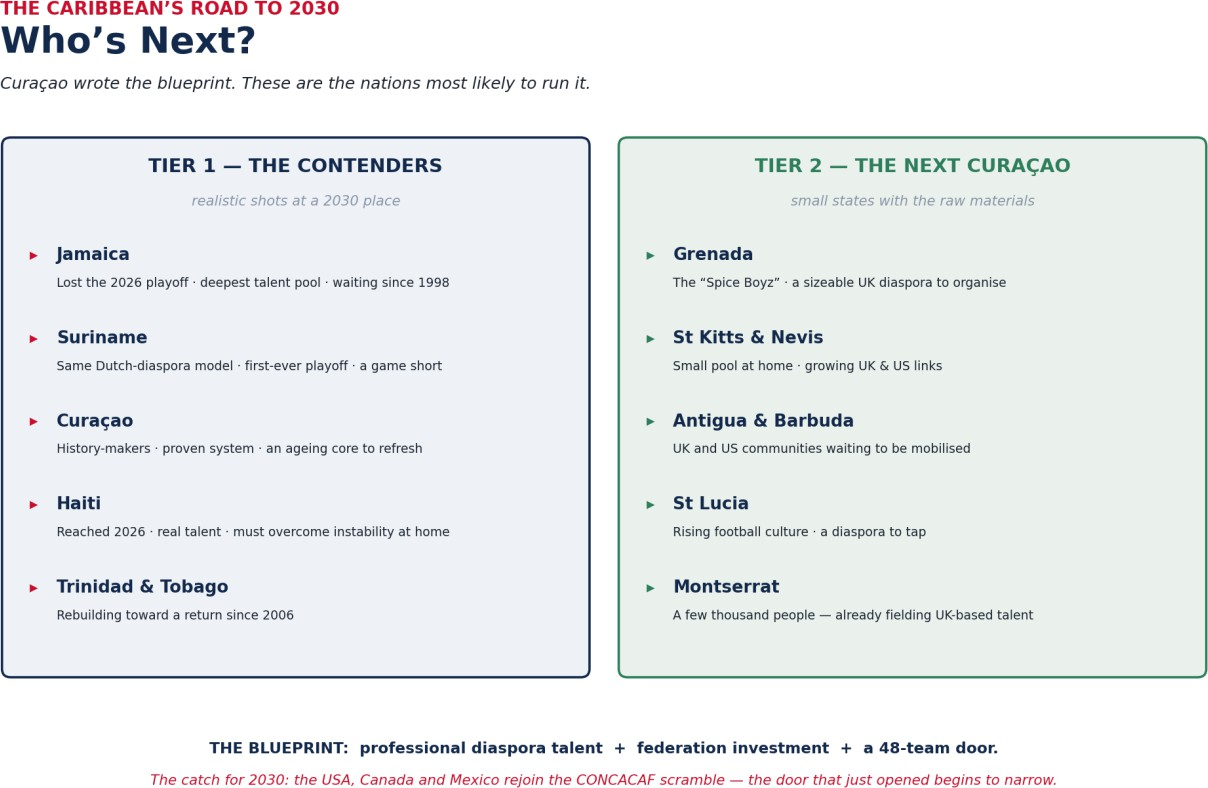
One caution belongs on every one of those names: the path to 2030 will be harder, not easier. The United States, Canada and Mexico sat out qualifying this time as hosts; next cycle they rejoin the CONCACAF scramble, and three strong teams re-entering the pool will tighten the very slots that just opened. The window Curaçao climbed through is beginning to close.
The next Curaçao: who runs the playbook?
Which brings us to the more romantic question — the one that should light up every group chat from Basseterre to St George’s. The blueprint Curaçao wrote is not patented; any small nation with a diaspora and the will to organize it can run the same play. The raw material is talent abroad, and several Eastern Caribbean states have more of it than they use. Grenada’s “Spice Boyz” have a sizeable British community to draw on; St Kitts and Nevis, Antigua and Barbuda, and St Lucia all have growing pools of UK- and US-based players with roots at home; and Montserrat — a few thousand people — has long punched above its weight by fielding British-based talent of Montserratian descent.
None of these islands is close to Curaçao’s level today, and that is not the point. The point is that the ceiling just moved. What stands between a St Kitts, a Grenada, an Antigua or a St Lucia and a shot at history is not
fate, and not size. It is a choice — whether a federation invests in the model, chases down its diaspora, and treats the national team as something worth building rather than merely fielding.
This is bigger than the football association
Here is the strategic leap Curaçao really points to. In a small Island, qualifying for a World Cup is too big — and too economically valuable — to be left to the football association alone. A federation can recruit players and hire a coach; it cannot fund a four-year campaign, build facilities, market the destination to the audiences the team reaches, and capture the tourism and investment that follow. That takes the arms of the government pulling together.
And the case for doing so is not sentiment; it is arithmetic. Set the cost of a serious, sustained program — professional coaching, diaspora scouting, competitive fixtures, and the qualifying campaign across a four-year cycle — against the return Curaçao is now demonstrating: a global stage worth far more than any marketing budget could buy, landing on the exact source markets an island is trying to grow. Few public investments offer that leverage. So, the recommendation is concrete: a small Island serious about this should convene its finance ministry, its ministry of tourism, and its football association around one table, under a single mandate — a four-year World Cup Investment Compact that treats the national team as economic infrastructure, budgets for it as an investment rather than a subsidy, and plans in advance to capture the dividend. Curaçao stumbled onto that dividend. The nations that follow can plan for it.
A growth lever hiding in plain sight
And this is where a football idea becomes an economic-strategy one, because the region’s own institutions are searching for exactly this kind of lever. The Caribbean Development Bank calls the years ahead the region’s “decade of decision,” and warns it cannot be financed or governed at yesterday’s scale, estimating a financing need of some US$65.2 billion between 2024 and 2033 simply to prevent stagnation. The Eastern Caribbean Central Bank’s “Big Push” aims to double the currency union’s economy within a decade. Both frameworks are hungry for credible, home-grown, low-cost drivers of growth and visibility. A coordinated diaspora-football-economy program is precisely that addition to the framework: a lever built on an asset the region already owns — its people abroad — that costs a fraction of a single infrastructure project and returns tourism, investment, and soft power in exchange.
That is thinking a little outside the usual box, and the kind of connection the region will need to make more often. The frameworks exist; the model now exists too, proven by Curaçao and nearly matched by Suriname. What sits between them is design and coordination — turning a sporting possibility into a costed, four-year plan a finance ministry can budget, and a development bank can back. That is advisory work in the truest sense. The frameworks are in place; the proof is on the field; what the region needs now are the hands to connect them.
The bigger prize: a league of our own
There is a still larger prize here, and it is a permanent one. Qualifying for a World Cup is episodic — once every four years, and only for those who reach it. A domestic football industry works every week of every year. And the Caribbean has already built the template, in another sport. Since 2013 the Caribbean Premier League has turned franchise cricket into a regional institution: six franchises carrying the names of their territories, direct investment from owners as far afield as the United States and India, broadcasts watched by hundreds of millions, and — by the league’s own accounting — more than US$200 million a season, now above US$225 million a year, injected into the regional economy. It fills hotel rooms, hires local staff, sells the islands to the world, and builds a pathway for young players at home — culture turned into value.
Football is the world’s largest sport, and the canvas is bigger still. Imagine the same logic applied to the game the whole region already plays: a Caribbean professional football league, built on franchises, with at least one club carrying the flag of each island. Structured well, it would draw direct investment from franchise owners, broadcasters, and diaspora capital; generate year-round activity in jobs, match-day tourism, and media rights; and — most valuable of all — build a home-grown talent pathway, so the next generation of Caribbean players is developed in the region rather than discovered only after it has left. The national teams capture the episodic spotlight; a club league would build the permanent industry beneath it, and grow the game in every territory at once.
None of this is simple — the CPL itself is a lesson in the commercial discipline a small home market demands
— but it is proof that a Caribbean league can be built, sustained, and grown. And it is exactly the investable, privately funded, region-integrating asset the Caribbean’s growth agenda is calling for, applied to the most popular game on earth. Curaçao’s World Cup run lit the spark. A league of the region’s own would keep the fire burning — and paying — long after the last whistle in North America has faded.
Following the money
How would such a league pay — for itself, and for the islands? Begin with where the impact lands. Cricket concentrates its matches in a few host nations each season; a football league with a club in every territory would spread the benefit across all of them, every year. The CPL’s 2025 season was worth close to US$20 million to St Kitts and Nevis alone, from a handful of matches. Picture that recurring in every island, season after season — home fixtures filling hotels, hiring stewards and vendors, drawing travelling supporters — the benefit landing not in one or two capitals but across the whole region at once.
The larger revenue, though, lives in the broadcast. Football is the most-watched sport on earth, and the Caribbean has a ready-made global audience for it: the millions of its own people in the United States, the United Kingdom, and the Netherlands who follow the game and their islands with equal passion. Carried on a major United States network and across European broadcasters, a Caribbean league would reach that diaspora directly — and the sponsors who want to reach them with it. Media rights and sponsorship are what turn a regional competition into a commercial one, and football’s global reach offers a far higher ceiling than any other sport can. Those rights fees flow back to the clubs, and through them to the islands.
And one marquee idea could light the whole thing up. Each year, the league champion could earn a showcase match against an established professional club from England or the United States — a genuine test on a global stage, played for a substantial purse and beamed to both markets. For the Caribbean champion it is the ultimate proving ground; for the host island, an event that fills every room and puts its name before the visiting club’s worldwide following — selling a destination better than any advertisement could, and turning a league final into an annual international event.
Put the pieces together and the model compounds. Franchise owners bring direct investment; broadcasters and sponsors bring revenue; traveling fans bring tourism; and the exposure brings the harder-to-measure prize — the foreign investment and attention that follows a region visibly on the rise. Each island gains a recurring economic asset it part-owns, a showcase for its brand, and a pathway for its young players. The World Cup lifted one nation for a summer. A league, built and broadcast this way, could lift the whole region for a generation.
A question worth asking out loud
Which brings us back to the money. For an Island of a few hundred thousand people — or a few thousand
— a World Cup run is not merely sport. It is the largest single act of nation-branding, tourism marketing, and diaspora mobilization that country could ever undertake, at a fraction of what it would cost to buy the
same attention. Curaçao has just shown the Caribbean what that looks like, and roughly what it can be worth.
So here is the question, and it is a serious one for finance ministers and football federations alike: should the small nations of this region treat an elite national football program not as a sporting indulgence, but as an economic-development investment — with a measurable return in visitors, capital, and standing in the world? Curaçao did not set out to answer that question. But by getting there, it asked it for all of us.
Curaçao, we salute you. Now — who’s next?
About the author
Fletcher St. Jean, MBA, is a Caribbean financial services leader and strategist with over two decades in the sector, and a participant in the Wharton Executive Leadership Program. He advises on financial and economic strategy across the region through St. Jean & Company, and writes on Caribbean economics, finance, and identity through The Caribbean Ledger.