

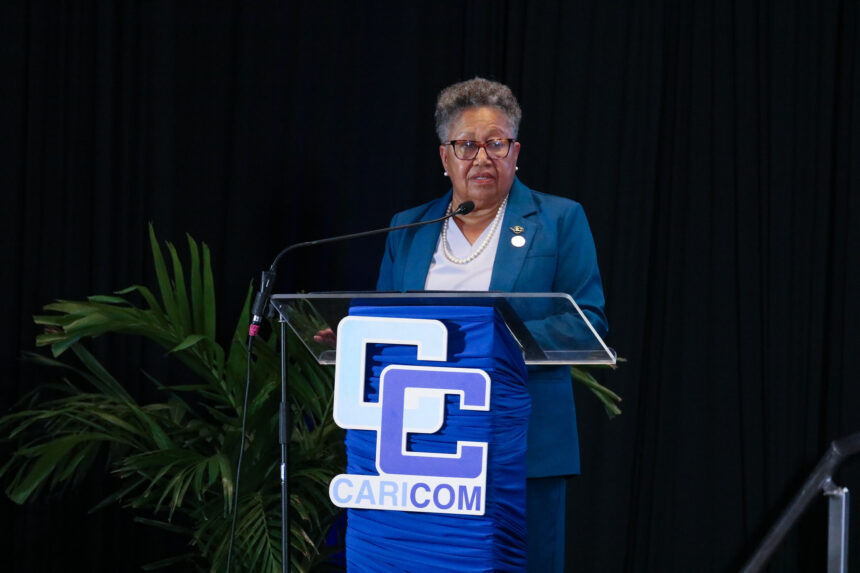
Secretary-General of the Caribbean Community (CARICOM) Dr Carla Barnett urged leaders of the Region to seize the current period of global volatility as an opportunity for “decisive action” to reaffirm commitment to the regional integration movement. She was addressing the opening ceremony of the 51st Regular Meeting of the Conference of Heads of Government in Gros Islet, Saint Lucia, on Sunday (5 July).
“In the interest of the people we serve now, and for future generations, we should see the prevailing volatility and disruption not as a barrier to progress, but as an opportunity to reaffirm, through decisive action, our commitment to the ideals and aspirations of the Revised Treaty of Chaguaramas,” she said, referencing the agreement that established the Caribbean Community, including the CARICOM single Market and Economy (CSME).
Reflecting on the Community’s progress, Dr Barnett pointed to the strengthened operations of the CARICOM Single Market and Economy, including the commencement of full Free Movement among four Member States in October 2025, and continued increased agriculture production under the 25 by 2025+5 strategy, now extended to 2030. She also highlighted CARICOM’s work with Haiti, the expansion of associate membership and deepening partnerships with Africa, the Middle East, Europe, Asia and Latin America.
Dr Barnett also saluted the national football teams of Haiti and Curaçao for their “dynamic representation” at the FIFA World Cup 2026.
Acknowledging the challenges before the Region, the Secretary-General recalled that 53 years ago when CARICOM was established, a global fuel crisis, the Cold War and limited markets demanded that “collective action be employed towards the greater good”. “Then, as now, external factors and influences put at risk the vision of regional integration. However, the expected benefits to our economies and wider societies at that time, as now, far outweigh the risks,” she said. The Secretary-General cautioned that these challenges “call us to redouble our efforts”, pointing to outstanding aspects of the CSME such as capital market institutions and payments and settlement systems.
“To move ‘from resilience to renewal’, as this Meeting’s theme urges, requires active recognition that as architects of this Region’s future, we should work, in unison, to shape our own destiny, on our own terms,” said Dr Barnett, who reminded leaders that “this sense of purpose is what our people expect, require and deserve, if they are to see a positive difference in their lives from the work that we do here.”