
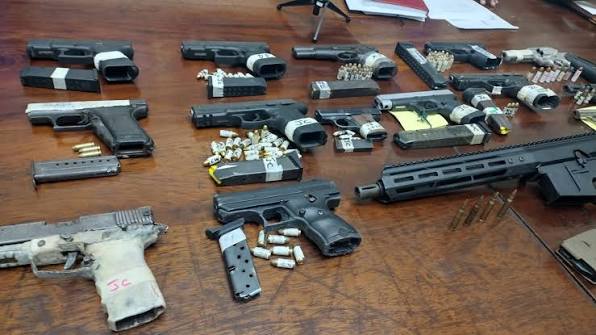
Deputy Commissioner of Police Trevor Bailey has raised an alarm regarding the influx of illegal firearms into St. Vincent and the Grenadines, asserting that the weapons fueling local violence are arriving from multiple international sources.
During a recent broadcast of the radio program Voices, Bailey emphasized that because St. Vincent does not possess a domestic firearm factory, every illegal weapon recovered by law enforcement has been brought in from outside of the nation’s shores.
According to Bailey, intelligence and physical evidence suggest that smugglers are using increasingly creative methods to bypass security at ports of entry. He noted that firearms are frequently imported in pieces rather than as whole units to avoid detection.
“We have had instances where we discover firearms in barrels,” Bailey revealed. He further detailed finding components hidden in everyday items, stating, “A part of the firearm may be in a cereal box. Another part may be in the bottom of a shoe”.
The Deputy Commissioner specifically acknowledged the role of the United States as a primary source for these weapons. Responding to concerns that the majority of guns found in the hands of Caribbean youth originate in the U.S., Bailey stated that he and the police high command are “on the same page” regarding the issue of firearms flowing out of North America into the region.
Beyond traditional shipping ports, Bailey highlighted the “guns-for-drugs” trade occurring at sea. He explained that criminals often exploit the region’s many cays and islands to exchange locally grown marijuana for illegal firearms, making the nation’s coastline a significant point of entry.
Bailey stressed that stopping the flow of international weapons requires more than just police intervention; it demands a unified national response. He pointed to the critical roles of the Customs department, the Port Authority, and the Coast Guard in securing the borders.
“The response has to be a national one,” Bailey insisted, arguing that Customs officers must see themselves not just as revenue collectors, but as frontline partners in the fight against the “heinous crimes” committed with these imported weapons.