

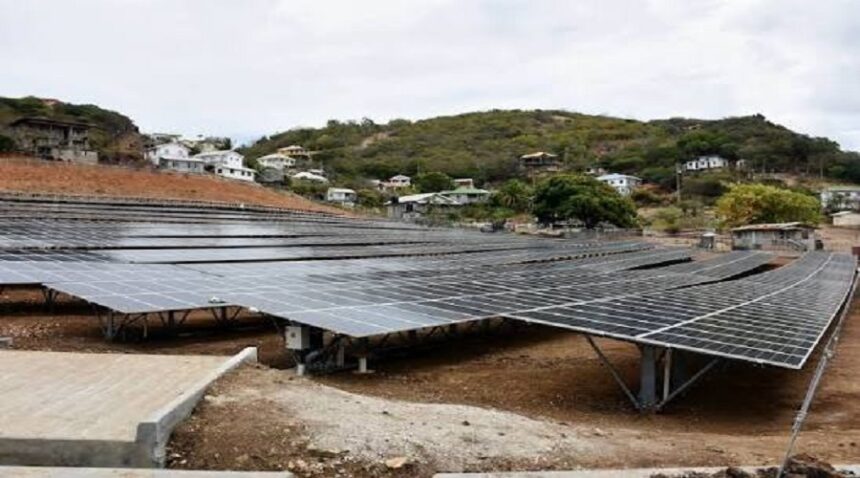
Vaughn Lewis, the CEO of St. Vincent Electricity Services Limited (Vinlec), recently addressed the growing public conversation surrounding solar energy and the utility’s role in its integration.
Lewis told St Vincent Times that contrary to popular belief, Vinlec is not resisting solar energy to protect its revenue; rather, the primary obstacles are an outdated legal framework and a rate structure that has not been modified since the 1970s.
Lewis pointed out that the current Electricity Supply Act, which dates back to 1973, does not provide for “distributed generation”, the process where private solar systems feed power back into the national grid.
Under the existing law, any generator on the system technically requires a license from Vinlec. While Vinlec decided around 2010 to allow solar systems despite these legal omissions to encourage growth, the lack of modern legislation has created a financial “squeeze”.
The CEO explained that because the rate structure is not set up to accommodate renewables, the cost of “netting off” solar energy which totaled $2.7 million last year must be absorbed by the utility’s base rate. This base rate is the fund used to maintain engines and service the national infrastructure.
“We will reach the point where we as a utility can’t run because… we will reach a position where we will lose money,” Lewis warned, noting that such losses would eventually compromise the reliability of the entire system.
Lewis highlighted neighboring islands like Barbados, Grenada, and Jamaica as models for success. These nations have modernized their laws to include renewable energy tariffs or independent power producer tariffs. For example, in Grenada, as more solar energy is purchased at a lower rate than fuel, the fuel surcharge drops, resulting in cheaper electricity for everyone while protecting the utility’s ability to invest in infrastructure.
Lewis described this modernized approach as a “win-win situation” because it accommodates more solar while trending overall electricity costs downward.
A significant technical challenge of solar is its intermittency; a passing cloud can cause a 1-megawatt system to drop from 900 kW to 50 kW in seconds. To manage this variability and ensure customers don’t experience flickers or outages, Vinlec currently has to run extra diesel capacity.
To address this, Vinlec is proactively investing in infrastructure:
- An $18 million battery storage system is being installed at Keen Hall to stabilize variable generation.
- The solar farm at Lman’s Bay is being upgraded to a larger, more efficient system, expected to come online in November.
Despite these efforts, Lewis noted that solar currently only generates about 3% of the nation’s electricity. Combined with hydroelectric power, renewables account for roughly 16% to 17% of the total energy mix. While Vinlec continues to allow small residential connections, they are currently cautious about large-scale 500 kW or 1,000 kW installations until the law catches up.
“Every young engineer who comes into Vinlec has a dream of increasing renewable energy,” Lewis stated, emphasizing that he is hopeful for a future defined by public-private partnerships once the foundational legislative elements are in place.
Lewis said that Vinlec is doing its best to prepare for this transition, having already conducted studies to determine the optimum balance of solar and battery storage to produce the lowest rates for customers.
