

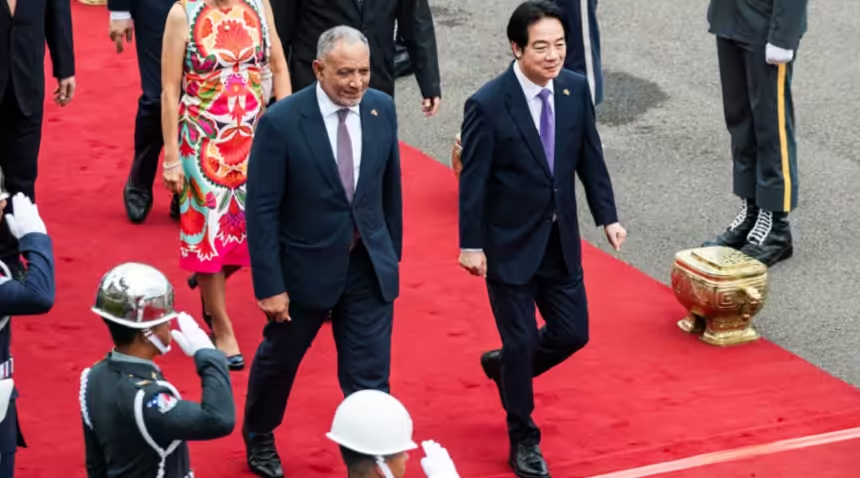
The government of St. Vincent and the Grenadines (SVG) has formally reaffirmed its “unwavering commitment” to its 45-year diplomatic partnership with Taiwan, dismissively rejecting any shift toward a “One-China” policy.
This high-level reassurance comes from Prime Minister Godwin Friday as the nation navigates a new political landscape following the 2025 election and faces reported advice from international powers regarding its foreign and economic policies.
In a press conference on Tuesday, the Prime Minister described the bilateral bond as one of “continuity” and mutual benefit, emphasizing that the relationship is “very much supported” by public discourse.
Looking ahead, preliminary discussions have already begun for a “grand and mega” celebration of the 50th anniversary of diplomatic ties. The Prime Minister noted that this milestone will serve as a definitive statement that the two nations are “5 years deeper” in their connection.
While the partnership remains firm, the Prime Minister outlined a transition in how development projects will be handled. Although Taiwan has been “very generous” in financing major infrastructure, the SVG government is now seeking to incorporate private capital to reduce government borrowing. A primary example is the Marriott hotel project, which the government aims to see financed independently.
The Prime Minister expressed a desire to “beef up” exchanges beyond the provision of “surplus vehicles,” calling for assistance that fits into a “strategic plan” for national security.
Taiwan has reportedly expressed a willingness to support long-term resolutions to SVG’s security challenges, building on recent contributions of equipment and “close protection training” for police officers.
The stability of the alliance was a point of international focus following the election of the New Democratic Party (NDP) last year, with Godwin Friday succeeding Ralph Gonsalves as Prime Minister.
Historically, the NDP under previous leadership had explored adopting a “One-China” policy, arguing that switching relations to Beijing would be in the “economic interest” of the country. Former NDP president Arnhim Eustace once defended this potential shift as a necessary step to aid a “very, very poor” economy.
However, since taking office, the new administration has engaged warmly with Taipei. Taiwan’s Foreign Ministry remains “vigilant but confident,” with Deputy Foreign Minister Chen Ming-chi highlighting 44 years of collaborative achievements in agriculture, healthcare, and information technology.
Prime Minister Friday reportedly expressed appreciation for Taiwan’s continued support immediately following his election.
Opposition Leader Ralph Gonsalves had raised alarms regarding the consequences of any potential diplomatic or economic pivot. During the 2026 budget debate, Gonsalves claimed the United States government has advised the SVG administration against switching to China and against engaging in Citizenship by Investment (CBI) programs.
Gonsalves warned that Western powers now view CBI programs as a “fundamental threat” and a “security risk”.
He further cautioned that a shift to Beijing could trigger “material change in circumstances” clauses in existing loan agreements, potentially forcing SVG to immediately repay all remaining debt to Taiwan.
Gonsalves noted the reliance on Chinese financing as a “hook in your gill” that could compromise national sovereignty, calling any attempt to court Beijing while maintaining U.S. relations “reckless business”.
For now, the consensus in Kingstown and Taipei remains one of “mutual trust, mutual benefit, and democratic principles”.
While legislative voices in Taiwan acknowledge potential strategic maneuvers by Beijing, the official stance remains optimistic about preserving the long-standing Caribbean alliance as both nations look toward their golden jubilee of cooperation.
