

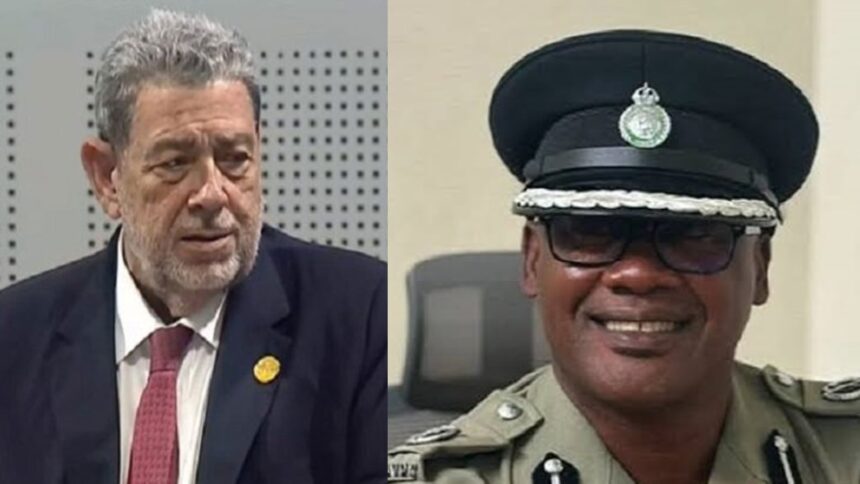
Former Prime Minister and Minister of National Security Dr. Ralph Gonsalves has launched a blistering critique against the promotion of Brenton Smith within the Royal St. Vincent and the Grenadines Police Force, characterizing it as a “nasty politicization” and a “corrupting influence” that threatens the integrity of national security and regional intelligence sharing.
Speaking during his Wednesday afternoon broadcast, Gonsalves announced plans to formally write to CARICOM and the Commonwealth to complain about what he describes as a highly partisan manipulation of the police force’s leadership hierarchy.
At the heart of Gonsalves’ criticism is the rapid advancement of Brenton Smith, who was promoted to the rank of Assistant Commissioner of Police (ACP). Gonsalves detailed Smith’s career timeline, noting that just five years ago, Smith held the rank of Station Sergeant. According to Gonsalves, Smith left active duty after refusing to take the COVID-19 vaccine. Gonsalves alleged that instead of returning sooner, Smith waited out the political climate to see if the Unity Labour Party (ULP) government would be replaced.
Upon his return under the current New Democratic Party (NDP) administration, Smith was “catapulted” straight to Assistant Commissioner, bypasssing several intermediary ranks including Assistant Inspector, Assistant Superintendent, and Superintendent.
Gonsalves argued that this promotion leapfrogs over numerous highly qualified and long-serving Assistant Superintendents and Superintendents who were substantively inline for the role. Gonsalves stated that Smith’s elevation was made “only on the basis of his political allegiances,” rendering him a “politician in uniform” in the eyes of his subordinates, the Commissioner, and the Deputy Commissioner.
The Royal St. Vincent and the Grenadines Police Force’s top brass is structured with one Commissioner, one budgeted Deputy Commissioner, and three Assistant Commissioners. Smith’s promotion places him in one of these top five leadership spots, with responsibilities reportedly focused on human resources and promotions.
Gonsalves predicted this would inevitably lead to internal friction, specifically forecasting a clash between Smith and Acting Police Commissioner Trevor “Buju” Bailey. Gonsalves expressed concern that Smith would seek to influence future promotions based on political favoritism, advising on who gets elevated and who is left behind, which he says is already causing widespread “grumbles” and discontent within the ranks.
Gonsalves directed sharp criticism toward his “dear friend” Laura Anthony Brown, the Chairperson of the Police Service Commission. He expressed disbelief and disappointment that a respected public servant like Brown would preside over a decision that allowed Smith to skip multiple ranks, calling the move “wrong” and structurally damaging.
Gonsalves drew a parallel to the judiciary, stating that putting a known political actor into a high-ranking police position is equivalent to placing a politician in judicial robes, which instantly destroys public confidence in the institution.
Despite his fierce institutional critique, Gonsalves emphasized that he harbors no personal animosity toward Brenton Smith. He shared a brief personal anecdote from the previous day, noting that while leaving the Anglican Cathedral after the funeral of Lennox John, he and Smith smiled and nodded at one another respectfully.
“I have nothing against him personally, and I like him,” Gonsalves remarked, while reiterating that Smith remains, systematically, a political figure in a professional uniform.
Gonsalves also made a clear distinction between Smith and other recently elevated senior officers. He stated he has no objections to the promotions of Acting Commissioner Trevor Bailey or Junior Simmons, describing them as professional officers who, whatever their individual weaknesses, are “not politicians in police uniform” and pledged to work with and assist them in their duties.
Gonsalves warned that the politicization of the local police force would have serious ramifications beyond the borders of St. Vincent and the Grenadines. He asserted that international law enforcement and intelligence agencies—including the U.S. Drug Enforcement Administration (DEA), the Federal Bureau of Investigation (FBI), British intelligence, and French authorities—would find it increasingly difficult to cooperate and share highly sensitive, confidential intelligence with a force led by “police politicians.”
By placing what he calls “loose-lipped” political actors in charge of national security and human resources, Gonsalves warned that the current administration is actively undermining the trust required for vital global security partnerships.
