

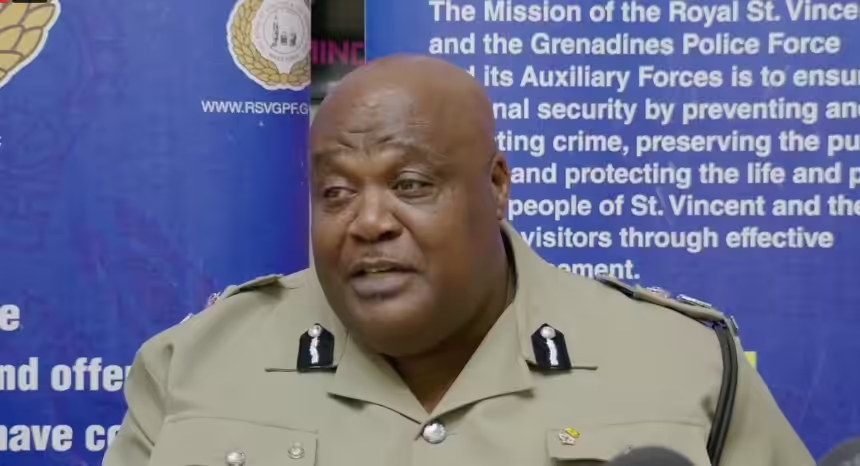
St Vincent Acting Commissioner of Police Trevor Bailey has declared a state of strategic urgency for the Royal St. Vincent and the Grenadines Police Force (RSVGPF).
Speaking from the police conference room at the central police station, Bailey issued a definitive refusal to allow the current wave of gun violence to become the “norm” for the nation. This press conference signals a pivotal evolution for the RSVGPF, marking an aggressive pivot toward restoring order as Bailey transitions from a member of the rank-and-file to the head of the command structure.

Commissioner Bailey synthesized the heavy toll of recent violence, noting that the consequences of every shooting extend far beyond the immediate victim.
He highlighted the devastation of families, the pervasive fear in local communities, and the direct economic threat to the business sector in Kingstown. This erosion of security, Bailey argued, undermines the fundamental right of every citizen to live in peace.
The “So What?” of this crisis is clear: by destabilizing public safety, criminal elements threaten the very socio-economic fabric of the nation, disrupting the lives of law-abiding citizens and the safety of the tourism product upon which the country depends.
To combat this, the Acting Commissioner announced a strategic reorientation of the force. The new approach will be multi-pronged, emphasizing intelligence-driven operations, targeted visible patrolling, and aggressive firearms interdiction.
Central to this strategy is the formal appointment of Acting Assistant Commissioner Brenton Smith to the crime portfolio. Bailey described this as a strategic centralization of leadership designed to ensure greater coordination across specialized units, including the Criminal Investigation Department (CID) and the Major Crimes Unit.
Internal reform is equally central to Bailey’s mandate. Following the recent promotions of Junior O. Simmons to Acting Deputy Commissioner and Brenton Smith to Acting Assistant Commissioner, Bailey issued a call for a “rededication” of the force.
He emphasized the weight of his new role, noting that while he previously reported “up the chain,” the chain now reports to him, and he expects a renewed vigor in every officer’s policing life.
Turning his focus outward, the Acting Commissioner delivered a visceral warning to those possessing illegal firearms.
Vowing to pursue them with every lawful means, Bailey was blunt: “If you participate in shooting or you assist those who do, expect the police to come knocking and looking.”
While the force intends to be proactive and visible, Bailey made an appeal for a unified front, urging parents, churches, and community organizations to ensure that the battle against crime is not a conflict between the police and the public, but a collective stand against terror.
While Bailey’s mandate sets the strategic altitude, the gravity of the mission now shifts to the tactical frontline overseen by his Deputy.
