
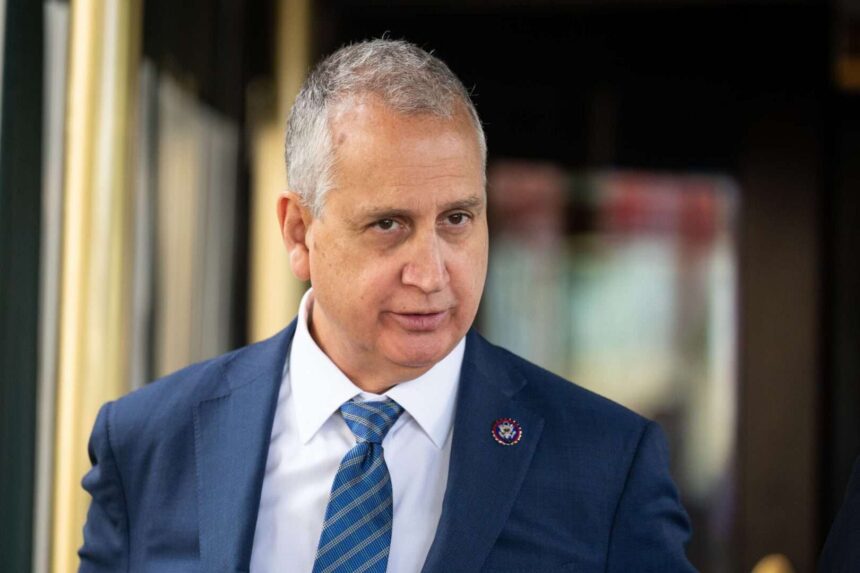
There are moments in international affairs when governments, officials and diplomats all appear to be speaking amongst themselves while the people who are actually affected by all of it are left trying to work out what any of it means for them. That has been the peculiar position of Trinidad and Tobago in recent months as the relationship between Port of Spain and Washington has taken on a new importance, particularly around security, investment, migration and the changing strategic landscape of the Caribbean. We have heard a great deal about what the United States is doing, and plenty about what our own government thinks about it, but very little directly from someone in Washington who could explain how these decisions are being viewed inside the American political establishment. That is why my conversation with Congressman Mario Díaz-Balart was important, especially as this is, as far as I am aware, the first time a serving United States official has sat down to speak directly to the people of Trinidad and Tobago about these questions, and he did so with a candor that was both refreshing and, at times, rather disarming.
The Congressman joined our Zoom conversation with the usual apology that accompanies a Washington politician’s schedule. “My schedule is horrible,” he told me at the beginning, before quickly settling into a conversation that was remarkably relaxed for someone discussing subjects as serious as terrorism, China, American investment, visas and the future of the hemisphere. He called me “my friend” more than once and there was a genuine warmth to the exchange that made the conversation feel considerably less like a formal interview and more like two people trying to make sense of a relationship that has suddenly become much more consequential.
People in our country have become accustomed to hearing Washington through official statements, press releases and diplomatic language, and while those things do have their place, there is something different about hearing an elected American official explain, in his own words, what he thinks the United States is trying to accomplish and why Trinidad and Tobago figures into that calculation.
Congressman Díaz-Balart began the interview with something that was surprisingly personal, as he thanked me for the work I have been doing in examining American legislation and trying to understand what it means for this country. The legislation he is referring to are the Appropriations Bills he had helped shepherd through Congress, which intended to change the way American foreign assistance is used.
His argument was uncomplicated, saying that American money should achieve something. “I want to be helpful,” he said, explaining his view of America’s relationship with its allies. “If you’re an ally and a friend of the United States, I want to be helpful.”
And that sentence probably tells us more about Washington’s current thinking than a dozen diplomatic communiqués.
Congressman Díaz-Balart believes American foreign assistance should be effective and efficient, but he also believes it should serve American national security interests and strengthen countries that Washington regards as partners. He was quite explicit about where he draws the line. “If you’re not, if you’re an adversary, or you’re in cahoots with the adversaries of the United States,” he said, “then, frankly, you’re not going to like the legislation I’ve been fortunate enough to pass over the last number of years.”
It is a distinctly Trump-era way of looking at foreign policy, although the Congressman presented it as something broader than the politics of any single administration. For him, alliances have to carry obligations in both directions and the United States has to support countries that stand with it, and those countries have to recognize that being an ally means something too.
The Congressman acknowledged that our relationship with the United States has had its ups and downs. What he believes has changed is the willingness of countries in this hemisphere to accept certain problems as permanent.
“We don’t have to accept dictatorships in this hemisphere,” he said. “We don’t have to accept narco-terrorism as a given that we can’t fight against.”
That was perhaps the strongest theme running through our conversation as Congressman Díaz-Balart sees the fight against organized drug trafficking as part of a much larger struggle over the security and political character of the Western Hemisphere, and he believes the United States is now taking a much more forceful approach.
He spoke approvingly of the emerging cooperation among countries in the region and of the American effort to build a more coordinated response to criminal organizations involved in drug trafficking. He described those groups as “the great corrupter” and “the great cancer” of the hemisphere, particularly where they operate in cooperation with authoritarian governments.
The language is deliberately strong, but Congressman Díaz-Balart’s underlying argument is simply that the United States is no longer willing to treat the drug trade as an unfortunate fact of geography that governments simply have to manage, and this has obvious implications for Trinidad and Tobago.
Our location has always made us strategically important as the same waters that connect us to our neighbors also connect us to the routes used by criminal networks. The Caribbean does not get to choose where it sits on the map, and there is no diplomatic wording clever enough to change that.
I asked the Congressman about the apparent reduction in American strikes against suspected narco-traffickers in the Caribbean over the past two months. Had the pressure worked? Had the traffickers retreated? Or had they simply become more creative? And his answer was unequivocal.
“No, they haven’t gone away,” he said.
What has happened, in his view, is that traffickers have realized the United States and its allies are serious. When the open sea becomes more difficult to use, the routes begin to change. Congressman Díaz-Balart believes some of that activity is now being pushed onto land, where regional authorities can have a better chance of tracking and apprehending those involved.
It should be noted that only a couple hours after the interview had ended, the U.S. Southern Command issued a statement regarding a strike carried out against a vessel in the Caribbean earlier that very day.
Congressman Díaz-Balart went on to defend the Trump administration’s decision to designate narco-terrorist organizations as terrorist organizations, arguing that the destruction caused by the drug trade has reached a scale that should no longer be treated as an ordinary law enforcement problem.
“These narco-terrorist organizations,” he said, “are responsible for the death of more Americans, but not only Americans, around the world.”
His point was not limited to the United States. He spoke about the destruction of families and societies across countries affected by the drug trade, while also acknowledging America’s own role as a huge consumer market.
That admission is important because it recognizes something that is sometimes lost in discussions about the Caribbean. The problem does not simply travel north on boats. There is demand waiting for it when it gets there.
For Trinidad and Tobago, the larger question is what this new American approach means for countries that have chosen to cooperate with Washington.
Congressman Díaz-Balart’s answer was consistent throughout the interview. “I want to make sure that if you’re an ally, I want to be helpful,” he repeated.
He pointed specifically to Trinidad and Tobago’s role in regional security and said Washington recognizes that the country is operating in a difficult environment, including the continuing instability in Haiti and the wider pressures facing the Caribbean.
“It’s important that the United States,” he said, “show that not only do we care, but it’s not only just caring in words, it’s in deeds.”
That brings us to perhaps the most tangible sign of this evolving relationship, the flow of American investment into Trinidad and Tobago.
In recent months there have been announcements involving data centres, artificial intelligence, natural gas and the reopening of a steel mill that could eventually supply a significant portion of the vanadium consumed in the United States. These are not simply business announcements. They sit within a larger American effort to reduce dependence on China for critical resources and supply chains. Congressman Díaz-Balart made no secret of where he stands. “I’m very glad to see the U.S. investment in Trinidad and Tobago,” he said.
He believes the hemisphere should become more economically self-reliant, particularly when it comes to strategic materials and infrastructure. He acknowledged that President Trump would obviously prefer more production to take place inside the United States, but he also conceded something that is often missing from political rhetoric.
“It’s not realistic.” The alternative, he argued, is for the countries of the hemisphere to depend more heavily on one another rather than on China. “Not just because we’re neighbors,” he said, “but because we have the same, frankly, principles, we have the same values.”
There is a larger strategic message in that as Washington is beginning to look at Trinidad and Tobago not merely as a friendly Caribbean country, but as part of a wider network of countries whose economic and security interests overlap with those of the United States.
That does not mean every American investment will automatically be good for Trinidad and Tobago. Díaz-Balart was particularly clear about that when I raised concerns surrounding the proposed data centres and the impact they could have on surrounding communities.
He acknowledged that these facilities consume large quantities of electricity and water and said local residents must have a meaningful role in determining how such projects proceed.
“I’m a firm believer that people are the ones who should be in control of their destiny,” he said.
That may be one of the more important things he said during the interview.
The debate over data centres can easily become a debate about geopolitics, artificial intelligence and America’s competition with China. For the people living near these projects, however, the question can be much simpler. What happens to my community? What happens to my water? What happens to my electricity? What happens to my quality of life?
Díaz-Balart’s answer was that those questions should be asked before the decisions are made, not after.
“If the local communities have a legitimate say, then it can be a very positive thing,” he said. “If they don’t have a say, then it could just be another nightmare that is imposed on the people.”
That was not the answer of someone suggesting that every American-backed project should simply be welcomed because it carries an American flag, but rather, it was the answer of someone saying that investment has to work for the people who live where the investment takes place.
Our final subject was more sensitive.
The Trump administration’s increasingly aggressive approach to visas has generated concern in Trinidad and Tobago, particularly among those who believe the revocation of visas could be used to target individuals for political reasons. I put that concern directly to Congressman Díaz-Balart and asked whether people here should view the policy in those terms.
He began with the position repeatedly stated by Secretary of State Marco Rubio, that a visa is not a constitutional right for someone outside the United States.
“It’s a privilege,” Díaz-Balart said. “It’s basically like inviting somebody into your house.”
He argued that the United States has a legitimate interest in preventing people from entering the country if they intend to cause harm or assist America’s adversaries. At the same time, he did something that many politicians are reluctant to do.
He admitted the administration has not handled everything perfectly.
“Has it been done perfectly by this administration?” he asked rhetorically. “No, of course not.”
Instead, he said, the administration is trying to send a message that the United States remains open to people who come in good faith, while taking a harder line against those it believes intend to cause harm.
Whether that policy ultimately achieves what Washington intends remains to be seen. Díaz-Balart said he would be watching closely.
“So will we,” I told him, and that exchange, in some ways, captured the spirit of the entire conversation.
Congressman Díaz-Balart was plainly supportive of the Trump administration’s broader direction, particularly on security, China and the strengthening of American alliances in the hemisphere. But he did not suggest that every policy decision was beyond criticism or that every implementation had been flawless.
His central message to Trinidad and Tobago was simpler as he believes Trinidad and Tobago is an ally of the United States, and he believes allies should be treated as allies. And he also believes that partnership comes with responsibilities on both sides.
“My goal,” he told me near the end of our conversation, “is to make sure that democracies who are doing the right thing are respected by the United States, and that we show, if I can use a colloquialism, show some love to our allies.”
It was a fitting place to end.
Foreign policy is usually discussed in grand terms, but it can also make international relations sound as though countries themselves are the ones having the conversation.
That is why I believe this conversation with Congressman Díaz-Balart was worth having, because even though it did not answer every question, it did something that has been missing from the conversation.
It allowed Trinidad and Tobago to hear directly from Washington, not through a press release or through someone explaining what an American official supposedly meant. But it came directly from the horse’s mouth, and for that, whatever one’s politics may be, Congressman Díaz-Balart deserves credit.
Because he gave the people of Trinidad and Tobago something that is surprisingly rare in foreign affairs, which is an American voice that was willing to speak to them directly.