
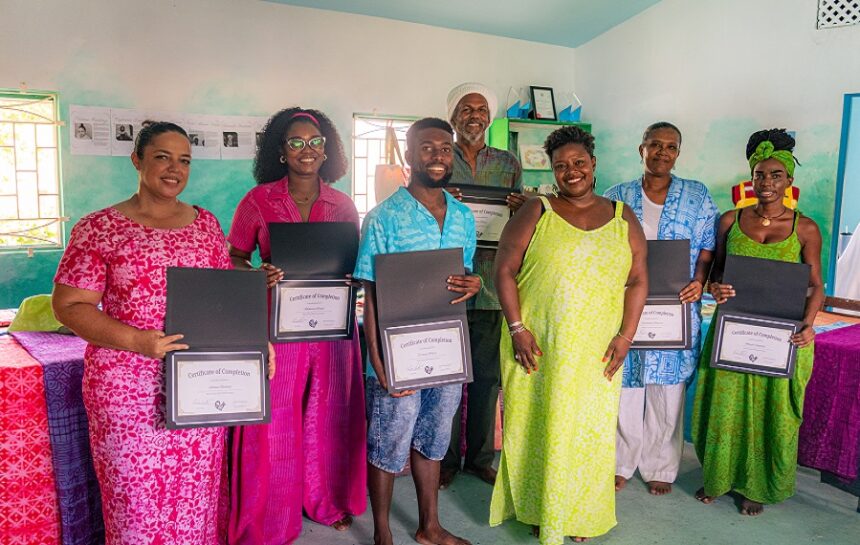
The first Bequia African Batik Intensive Program, known as BABI, has officially wrapped up, closing five weeks of hands-on training with a graduation and open house that brought together batikers, mentors, and community members at The Hub Collective’s Creative Arts Centre.
For the six graduates, Cassandra Ollivierre, Colin Peters, Dravin Peters, Kaymarie “Shaki” Daniel, Rhonelle Simmons, and Solana Gooding, the program was as much about process as product. In a feedback session held shortly after graduation, batikers spoke to the depth of what they took away: not just technique, but the spiritual and cultural weight the art form carries. “The value of batik is spiritual, economic and life-changing,” one participant shared, while others pointed to the satisfaction of learning every stage, from wax to stamp to final wash, and to the experience of watching each other work. “Observing everyone in their element” was named more than once as a highlight of the five weeks.
That satisfaction came with real challenges. Batikers named the technical learning curve, judging wax pressure, managing the stamping process, and washing pieces multiple times to get the colour right, as the hardest parts of the program. But they also credited each other for working through it. “Batikers were able to problem-solve when challenges arose,” was a common thread in the feedback, and several noted the program’s biggest win may be the community it built along the way, one with real economic potential attached. Asked whether they felt supported throughout, the group’s response was unanimous: yes, without reservation.
Structured reflection has been part of BABI’s design from the start. Program lead Dr Nadia Richards, founder of Owia House, built the feedback session into the program’s closing days, bringing together batikers, Amanda Richards, the other half of Owia House, and The Hub Collective’s leadership to talk candidly about what worked and what to change. This approach aligns with the Empowerment Assessment Tool that shaped the curriculum throughout, treating reflection as part of the craft, not an afterthought.
Richards called the overall experience “very fulfilling,” noting how much she learned from the batikers in turn. She was candid that five weeks proved too short for the curriculum’s ambitions. Multi-colour and pictorial batik work, techniques the group is eager to grow into, did not make it into this first cohort. “The outcomes were remarkable,” Richards said, “but the program required more time.”
That honesty is shaping what comes next. Owia House and The Hub Collective are now looking at funding sources that could support future iterations of BABI, with plans to work more closely with graduates of this first cohort to expand into multi-colour and pictorial techniques and open up the offering to those in the African and Caribbean diaspora who would want to visit to Bequia to learn this ancestral practice. There is also a shared ambition to root the next phase of the program more deeply in place, drawing on Bequia’s natural landscape as a source of design and symbol, and building toward what several described as a genuine fusion of Bequia and African artistic traditions.
“This was a community-building experience with real economic potential,” said Holly Bynoe, Director of Strategic Growth at The Hub Collective. “The batikers didn’t just learn a craft; they built something together, and that’s exactly the foundation we want to keep building on.”
Graduates leave the program with options. Several plan to continue batiking independently, while others are exploring closer collaboration with Owia House as the organisation works toward a permanent studio and gallery in Bequia. Both pathways remain open, and both are welcome.
What is emerging and taking shape at this stage is less about welcoming a new cohort than deepening this one: more time with the same hands, more complexity in the designs, and more of Bequia itself finding its way into the work. That is the quieter ambition behind BABI: not just teaching a craft once, but watching it take root, generation by generation, in the place it has returned to.
‘An ancestral art form doesn’t finish arriving in mere weeks,’ Richards said. ‘It keeps arriving, through the people who choose to keep working it, in their dreams, awakened by a newly found practice and forged in the possibility of gathering again to continue the journey.’