
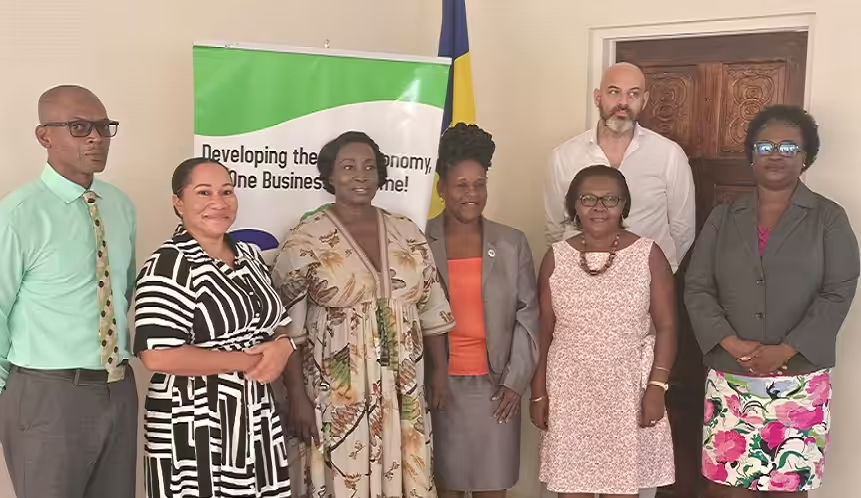
The Centre for Enterprise Development Inc. (CED) has entered a new phase of development with the implementation of a five-year Strategic Plan aimed at strengthening its operations, improving support for businesses, and playing a greater role in advancing private sector development in St. Vincent and the Grenadines.
The new strategic framework is the outcome of a year-long strategic planning project funded by the Caribbean Development Bank (CDB) and provides CED with a clear roadmap to guide its work over the next five years.

The plan is expected to enhance the organisation’s capacity to deliver more effective and responsive services to entrepreneurs and businesses while ensuring that its programmes and initiatives are aligned with the evolving needs of the local private sector.
CED formally highlighted the new strategic direction during a Closing Ceremony for the Strategic Plan Project held at Sunset Shores Hotel Conference Room in Villa on Thursday. The event marked the conclusion of the planning initiative and the beginning of a new chapter focused on implementing the priorities outlined in the five-year plan.
Miss Keisha Phillips, Officer in Charge of CED, presented an overview of the Strategic Plan, describing it as a “pivotal moment for enterprises in St. Vincent and the Grenadines”. She noted that it positions CED as “the connective tissue between new capital, new regional partnerships, and the thousands of Vincentian entrepreneurs who need both money and the know-how to use it well”.
The plan, she outlined, is built on four strategic pillars: Pillar 1 – Entrepreneurship Development and Business Support Services; Pillar 2 – Access to Finance and Investment Readiness; Pillar 3 – Ecosystem Strengthening, Partnerships and Policy Advocacy; and Institutional Strengthening for Sustainability. The five-year investment plan carries a total programmatic budget of US$4.64 million over the period 2026 to 2030, with Pillar One, Entrepreneurship Development, carrying the largest share at US$3.3 million.
Phillips highlighted the plan’s alignment with the government’s announcement of the soon-to-be-established National Development Bank, noting that CED sees itself as the bank’s “natural referral partner and readiness pipeline, not a competitor”. She also shared the organisation’s new vision: “To be one of the leading drivers of innovation, entrepreneurship, and economic resilience in the Eastern Caribbean.”
“Our vision is to be one of the leading drivers of innovation, entrepreneurship and economic resilience in the Eastern Caribbean. 2026 gives us a genuine tailwind to make that real — a new National Development Bank opening up capital, renewed regional technical assistance through CDB, strong tourism momentum, and a government firmly committed to private-sector-led growth. This Strategic Plan is CED’s commitment to make sure that momentum reaches every entrepreneur it should,” Phillips concluded.
The new Strategic Plan was strongly endorsed by Minister of State in the Office of the Prime Minister, the Honourable Senator Chieftain Neptune, as he delivered the Feature Address. He commended CED for its continued commitment to private sector development, describing its evolution from a business support agency into a powerhouse of MSMEs, innovation, and entrepreneurship in the Eastern Caribbean.
The Senator noted that CED’s Strategic Plan aligns with the broader goals of the Ministry of Finance, Ecomonic Planning and Private Sector Developmnet, under which CED is a unit.
“A diversified, data-driven, opportunity-rich, Vincentian economy where MSMEs are the core of our growth and resilience. At the national level, we are actively shaping a brighter future with initiatives like the upcoming National Development Plan 2027-2042 complete with a clear step for implementation, budgeting and governance; strengthening public investment management through modern project appraisal systems and real-time project database; overhauling our national statistical system because in today’s world, you can’t manage what you don’t measure,” he stated “In the context of CED’s plan, it is not to isolate efforts, it is a vital part of our national symphony.”
He also issued three challenges to the Business Support Organisation (BSO): “own this plan, measure relentlessly, push goals higher, train more entrepreneurs, and improve survival rates”, and called on the private sector to see CED as a partner, not just a government office. “Mentor, collaborate, co-invest and let’s prove that working together creates a competitive edge.
Senator Neptune urged development partners, especially CDB, to remain committed.
“The next phase is about executing at scale, making sure that every dollar and every hour of support translate into real change.”
Reflecting on CED’s motto of “Developing the local economy one business at a time,” he expressed confidence that when that promise is honoured, “in five years, we’ll see a flourishing landscape of new businesses, new jobs, stronger communities and an economy more resilient, inclusive and confident.”
The Caribbean Development Bank, as the primary funder of the project, reaffirmed its commitment to CED’s success. Miss Allyson Francis, Operations Officer for MSMEs in the Private Sector Division at the CDB, expressed confidence that the new Strategic Plan would position CED to better serve the MSME sector.
“The support is intended to strengthen CED’s capacity to assess its operating environment, engage stakeholders, define strategic priorities, develop an implementation framework, and put in place important monitoring and evaluation learning systems that can track results over time. Institutional strengthening is at the heart of the effort. A strong MSME sector requires a strong business support institution,” Francis emphasised. “For CED, this means having clearer systems, stronger governance, better use of data, improved client relationships, management, enhanced staff capacity, strong partnerships, and a more sustainable resource base. It also means being able to design services that respond to the real needs of entrepreneurs, rather than relying only on one-off training or isolated projects. Importantly, the support also included practical training for CED staff, strengthening their ability to deliver consistent, high-quality business development services.”
Francis described the project as being of “significant importance” and noted that the intervention comes “at a very critical time” for St. Vincent and the Grenadines. She emphasized that the support for CED’s strategic plan is aimed at helping the organisation “move beyond short-term, ad-hoc interventions towards a more structured, programmatic, and resource-focused approach to enterprise development”.
Stressing that “a strong MSME sector requires a strong business support institution”, she noted that the assistance included practical training for CED staff and the development of tools to support day-to-day operations.
“We are helping St. Vincent and Grenadines to build a more diversifying, inclusive, and resilient economy, driven in part by a stronger and more competitive MSME sector. However, the success of the strategy will depend on its implementation. The plan must be treated as a living management tool. It will require prioritization, adequate resourcing, committed leadership, active, broad oversight, strong partnerships with all persons here, regular measurement of results. It also requires CED and its partners to remain responsive to changing conditions, including climate events, shifts in market, financing constraints, and evolving needs of our entrepreneurs. The relationships developed in the consultative process must be maintained.”
She concluded by reaffirming the CDB’s commitment.
“Caribbean Development Bank is really pleased to have developed this strategy and we look forward to its implementation and success.”
The CED Board of Directors also pledged its full support for the plan’s execution, and Chairman Mr. Luke Boyea, reaffirmed their commitment to guiding the organisation’s implementation of the new plan. He assured MSMEs that CED’s role is to help remove bureaucratic roadblocks, not create them.
“We must continue to advocate for the advancement of MSMEs, including both at the policy and the legislative levels. We must also communicate the crucial role that MSMEs play in society. The days of entrepreneurship as being the fallback option to being a doctor, lawyer or the like should be vanquished to history,” he said. “We have to make owning businesses and conducting business as significant as having the same stature. If we don’t do that, we’re always going to have maybe not the best people involved in the business.
Boyea emphasized that the strategic plan does not exist in a vacuum.
“It requires the active participation and partnership of the MSME community with CED and other government entities. This isn’t just a CED thing. The government must play their role. The other enabling mechanisms must be there, including the National Development Bank, as we just heard. This only works if entrepreneurs step up and use the opportunities and the skillsets provided. It is of critical importance that our communities are knowledgeable of the services provided to MSMEs and that we deliver best in class. Success will breed success.”
Boyea concluded with a call to action, urging all stakeholders to embrace the continuous improvement cycle of action, measure, refine, and repeat, reminding the audience, “If CED is successful, SVG will be successful.”
The ceremony concluded with a video presentation capturing stakeholder perspectives on how the Strategic Plan will help improve the organisation over the coming years.
The CED five-year Strategic Plan Project was funded in the sum of US$62,480, with the Caribbean Development Bank contributing US$44,200 and CED contributing US18,280.