

The National Tuition Scholarship Program in St. Vincent and the Grenadines has seen a substantial decline in approvals for the upcoming 2026/2027 academic year.
Prime Minister Dr. Godwin Friday officially announced in a recent parliamentary sitting that his government has approved 2,466 tuition scholarships. This represents a significant contraction from the peak of the scholarship program under the previous administration of former Prime Minister Dr. Ralph Gonsalves, as well as a direct drop from the previous year’s intake.
The decline is stark when compared to the expansive educational policies of 2025. Under former Prime Minister Gonsalves, the government celebrated distributing over 3,000 university scholarships to Vincentian students in a single year.
Gonsalves had championed a philosophy that education is the cornerstone of national development, pushing for holistic access for all youths.
Under the transition to Prime Minister Friday’s administration, the total number of approved national tuition scholarships has fallen from that 2025 peak of over 3,000 down to 2,466—a decrease of more than 500 scholarships.
Prime Minister Friday defended the reduced numbers, framing them as a necessary correction and a shift toward greater fiscal responsibility. He criticized the previous Gonsalves administration for expanding the scholarship program rapidly without establishing realistic or accurate budgets to support it.
To illustrate this, Friday pointed to previous administrative estimates where the personnel department’s training vote was initially budgeted at $30 million Eastern Caribbean Dollars (EC$). Due to the rapid, unbudgeted opening of the scholarship program, the previous government was forced to significantly increase the revised estimates for that vote to $50 million EC$ to cover the actual costs.
The Friday administration has opted for a different approach, prioritizing administrative accuracy over what the Prime Minister termed “premature guesswork”. Rather than announcing a final funding figure immediately, the current government is waiting for the personnel department to submit its official estimates.
Prime Minister Friday emphasized that the final figures must more accurately reflect the true cost of meeting the program’s needs.
Under the existing framework, individual national tuition scholarships remain subject to a maximum cap of $25,000 EC$, with the exact value awarded to each recipient decided on a case-by-case basis by specialists in the personnel department.
However, rather than focusing solely on increasing the volume of scholarships, the Friday administration is shifting its focus toward program refinement and economic alignment. Discussions are currently underway with both internal and external experts in education planning, programming, and local economic development.
The administration’s goal is to establish stricter guidelines that steer students toward academic programs that align with local labor market needs, thereby enhancing their employability.
Prime Minister Friday linked this strategic shift directly to structural challenges within the local economy. He highlighted a persistent youth unemployment rate of 20% to 25% that coexists with a shortage of local skills, forcing St. Vincent to import skilled labor.
Friday argued that rather than simply focusing on boosting Caribbean Examinations Council (CXC) and Caribbean Advanced Proficiency Examination (CAPE) results within an outdated educational framework, the entire education system must be retooled and reorganized to prepare students for the future economy.
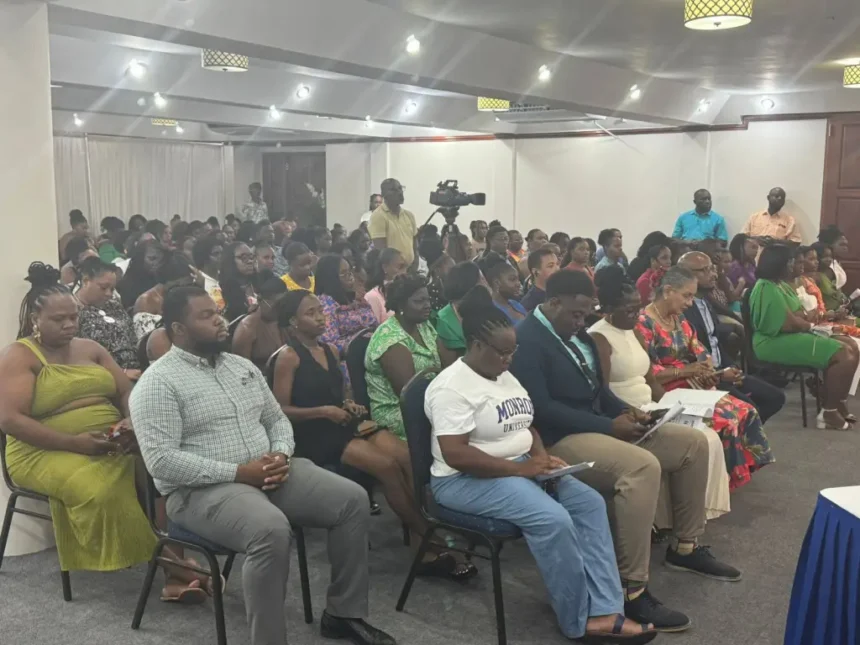
While the core National Tuition Scholarship Program has contracted, some specific institutional partnerships have seen adjustments. In line with a pre-existing agreement with the school’s administration, the government noted that Monroe University scholarships have increased from 50 to 75 this year.
Prime Minister Friday also urged Vincentian students to widen their academic horizons by exploring international educational pathways.
He observed that many reputable international scholarships go unused because local applicants limit themselves to familiar routes. He encouraged students to consult with the personnel department to pursue successful alternative exchange avenues, comparing it to the past when studying in countries like Cuba, Taiwan, or Mexico was once unfamiliar to local students.
Senator Peters has requested that the detailed funding figures for the scholarship program be shared with the House of Assembly as soon as the personnel department completes its analysis, a request the Prime Minister has agreed to fulfill.
