

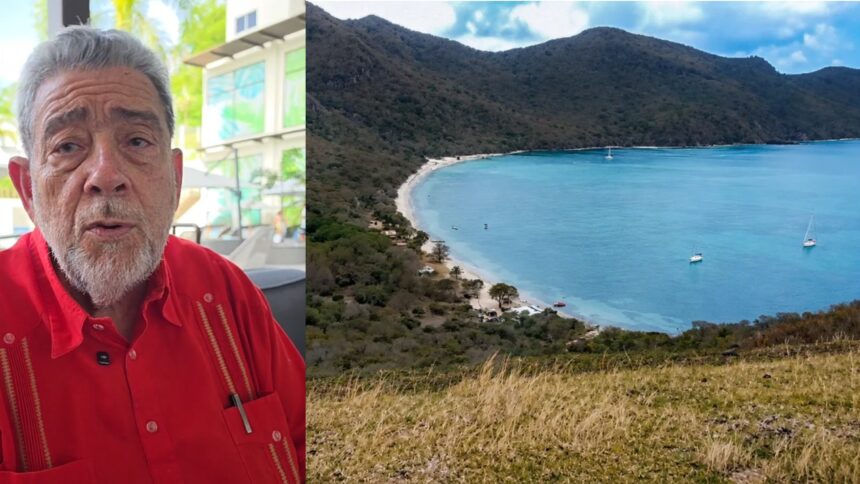
Dr. Ralph Gonsalves, leader of the Unity Labour Party (ULP) and former Prime Minister, has launched a blistering critique against the New Democratic Party (NDP) government, dismantling what he characterizes as a campaign of misinformation surrounding the recent sale of 100 acres of prime beachfront land at Chatham Bay on Union Island.
Responding to statements from the current NDP administration led by Prime Minister Dr. Godwin Friday, Gonsalves exposed the historical and financial realities of the transaction, calling the government’s celebration of the EC$54 million (US$20 million) sale “laughable” and labeling the deal “absolute misbehavior.”
A central pillar of the NDP’s narrative is that the land represents a “substantial capital gain” for the public because the previous ULP government allegedly reacquired the Chatham Bay property for “less than EC$700,000.” The NDP has used this figure to suggest a massive return on investment.
Gonsalves thoroughly rejected this characterization, explaining that the EC$700,000 figure was never an open-market purchase price, but rather a legally mandated compensation resulting from a successful government forfeiture lawsuit.
The history of the parcel dates back to the James Mitchell NDP administration, which originally granted an alien landholding license to American investors who purchased the land from a private vendor for less than US$200,000. Gonsalves noted that this original sale was executed “way below market value” to allow the investors to evade stamp duty.
However, the investors breached their license by failing to conduct any development on the land for approximately 15 years, despite a strict five-to-seven-year development requirement. Consequently, Gonsalves directed the Attorney General’s office to initiate forfeiture proceedings under St. Vincent’s 1922 legislation.
The ULP government defeated the foreign investors in both the High Court and the Court of Appeal. Two days before the case was scheduled to be heard by the Privy Council, the investors capitulated. Gonsalves, determined not to appear as though the state was unfairly confiscating private property, offered the investors a “take-it-or-leave-it” settlement. The government agreed to return the exact purchase price listed on their deed, plus five percent interest calculated from their purchase date to January 2006, when the lawsuit was filed.
This legal settlement—prepared by then-Senior Counsel Camilo Gonsalves and argued by Senior Counsel Anthony Astaphan—resulted in the EC$700,000 figure. It was a court-secured penalty for a defaulted license, not a reflection of the land’s actual value. In fact, Gonsalves revealed that the defaulting investors were so aware of the land’s true worth that they had offered to settle the lawsuit in 2006 for US$20 million (EC$54 million)—an offer Gonsalves flatly and colorfully rejected on the phone.
Gonsalves expressed shock that the current NDP government is celebrating selling Chatham Bay for EC$54 million, pointing out that this represents a severe undervaluation of what he calls the country’s “crown jewel.”
According to Gonsalves, more than 15 years ago, the chief surveyor valued the Chatham Bay property at approximately US$42 million—equivalent to over EC$110 million. Given subsequent infrastructure and property developments on Union Island, the land’s market value is substantially higher today.
By selling the 100-acre estate for EC$54 million, the NDP government has sold the land for less than half of its valued price from 15 years ago. Furthermore, Gonsalves noted the irony that the government accepted the exact US$20 million figure that the defaulting American investors tried to get the government to pay them twenty years ago.
To illustrate the poor financial management of the sale, Gonsalves contrasted Chatham Bay with the ULP’s transaction at Mount Wynne. Under the ULP administration, the government sold just over 30 acres of land at Mount Wynne for over EC$40 million. By comparison, the NDP has sold 100 acres of prime, pristine beachfront land at Chatham Bay—more than triple the size of the Mount Wynne parcel—for just EC$54 million. This represents a per-acre sale price that is less than half of what the ULP secured at Mount Wynne.
The NDP has defended the transaction by asserting that the land will be held by a private company for biodiversity conservation, featuring covenants to protect local wildlife like the endangered Union Island Gecko.
Gonsalves dismissed the conservation justification as “pure foolishness trying to hoodwink people.” He argued that if the state genuinely wanted to preserve the area’s biodiversity, it did not need to sell the land to a private corporation. “If we are having a conservation park, it’s in the hands of the state. We can have a conservation park ourselves,” Gonsalves stated.
Furthermore, Gonsalves revealed that during his tenure, a registered Vincentian citizen who owned a home in Mustique approached him to buy the 100 acres to keep as a national park. Gonsalves turned down the offer, explaining that prime land must be leveraged for resort development to create jobs, employ Vincentians, and boost the economy of Union Island and the Southern Grenadines. He told the Mustique homeowner that while they could use a portion of the land for conservation, the bulk of it had to be used for genuine resort development.
Gonsalves emphasized that his administration never had any intention of selling the crown jewel for conservation or any other non-development purpose, choosing instead to hold the land until serious investors with real resources came forward.
In his critique, Gonsalves also reflected on the immense international pressure his administration faced during the forfeiture battle. In his book, The Time of Respite, Gonsalves detailed how the United States government and the US Ambassador sent a special representative to pressure him into backing down from the lawsuit against the American investors.
“Why should I buckle?” Gonsalves remarked, noting that his refusal to bend to foreign pressure preserved the land for the state—only for the current administration to sell it off at a massive discount under the guise of national debt relief.
As public debate intensifies, Gonsalves’ detailed breakdown exposes a stark contrast between the ULP’s aggressive legal defense of national assets and the current NDP government’s decision to liquidate the nation’s “crown jewel” for a fraction of its historical value.
