
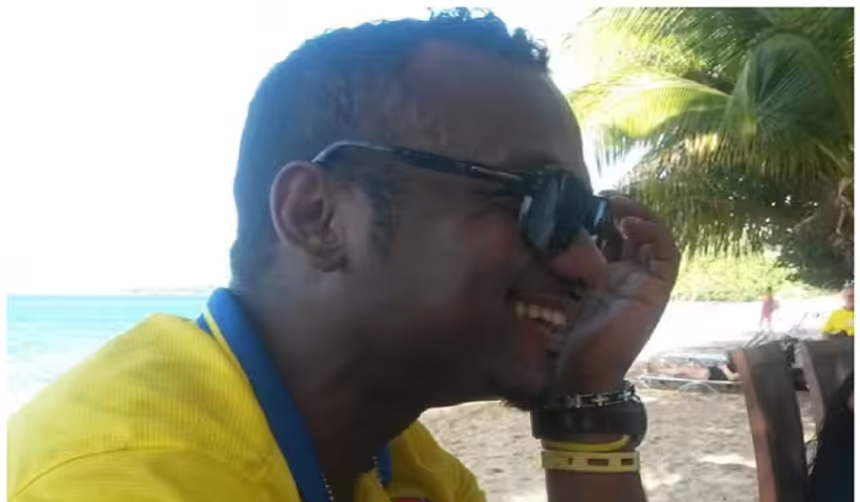
Andrew Frederick’s Family Fights for Justice
A formal investigation has been launched by the Metropolitan Police into the death of 47-year-old British national Andrew Donald Frederick, who was allegedly tortured to death at his Caribbean holiday home in Grenada. The UK police intervention comes despite Grenada authorities initially ruling the death as accidental, sparking a bitter conflict between Frederick’s family and the British government over a lack of specialist support.
Andrew Donald Frederick, a married father-of-two, experienced swimmer, and triathlete, was discovered deceased in Grenada on January 4, 2026. Following an investigation, local authorities in Grenada classified the tragedy as an “accidental death.”
However, this verdict stood in stark contrast to medical evidence. A pathologist approved by the Royal Grenada Police Force (RGPF) found that Frederick had been tortured and concluded that his death was a homicide. This determination was supported by a separate private family post-mortem conducted by forensic pathologist Professor Daisley, which also ruled the death a homicide.
Following the pathologist’s findings, Frederick’s family referred the case to the UK Foreign, Commonwealth and Development Office (FCDO), providing them with the post-mortem report establishing that he had been tortured and killed.
Despite this evidence, the FCDO refused to refer the case to its specialized murder and manslaughter team—a dedicated unit established in 2015 to support the families of British nationals who fall victim to homicide abroad. According to the family, the FCDO chose instead to defer to the Grenadian local police force’s classification of the death as “suspicious” rather than a homicide. The family stated that the department acted on “pure discretion” without guidance to underpin its position.
In a poignant joint statement, the family expressed the immense emotional and logistical toll of the FCDO’s refusal to step in:
“We have been unable to grieve properly for Andrew because grief requires a degree of resolution or at least the belief that those with the power to act are acting. Instead, nearly five months have been spent driving a campaign for justice while carrying the weight of what was done to him. This includes examining horrific pictures and the knowledge that the organisations that exist precisely to help families in these circumstances have, at every turn, forced us to fight for the most basic engagement. This is not what grief should look like. It is what institutional failure looks like.”
The bureaucratic hurdles faced by the Frederick family have drawn sharp criticism from political figures and advocacy groups.
Dr. Rupa Huq, the Member of Parliament for Ealing Central and Acton, took up the family’s case and tabled a formal question in Parliament. She questioned the legal basis under which the FCDO would defer to a foreign police force’s classification over the official determination of a qualified pathologist and a death certificate, especially in circumstances that would immediately trigger a homicide investigation in England and Wales.
In response, FCDO Undersecretary Hamish Falconer stated he was aware of the case but conceded that there was no “guidance on the specific circumstances” governing such decisions.
Eve Henderson, who co-founded the charity Murdered Abroad in 2001, expressed deep bafflement at the government’s stance. Henderson, whose organization was instrumental in campaigning for the creation of the FCDO’s murder and manslaughter team, noted that between 60 and 80 British nationals are victims of homicide abroad each year. She criticized the discretionary nature of UK support, pointing out that families are often left to navigate a “maze of complications” because these services are not backed by statutory law.
Bernie Kinsella, a retired UK police chief superintendent and adviser to the charity, echoed these frustrations, stating that there has been a notable lack of meaningful progress in support systems for families since he first worked on an overseas homicide investigation 25 years ago.
In Grenada, Howard Pinnock, the Director of Public Prosecutions, reviewed Frederick’s case file and advised local police to refer the matter to the coroner for an inquest.
Back in the UK, Senior Coroner Lydia Brown confirmed at the West London Coroner’s Court that the Metropolitan Police have officially launched an investigation into Frederick’s death. The UK cause of death is currently listed as “unascertained” amid ongoing diplomatic discussions with Grenada authorities.
Coroner Lydia Brown has suspended the UK inquest pending the outcome of the Metropolitan Police’s active investigation, offering a glimmer of hope to a family still fighting to uncover the truth of what happened to Andrew Frederick.