
The SeaMoss Association of St. Vincent and the Grenadines (SMASVG), with funding from the St. Vincent and the Grenadines Conservation Fund (SVGCF), successfully implemented the Roots to Reef Youth Camp 2026 from August 19–21 on Union Island, with 32 young people participating in the three-day programme.
Implemented under the project Empowering Youth for Coastal Resilience: Cultural and Environmental Education through Seamoss Farming, Roots to Reef introduced participants to seamoss cultivation, ocean and coastal conservation, food safety, value-added production, entrepreneurship and cultural heritage.
The programme was intentionally designed to connect young people with the knowledge, people and resources already within their community, while helping them understand that the future of the seamoss sector depends not only on production, but also on conservation, collaboration, innovation and the transfer of knowledge from one generation to the next.
“Throughout the three days, we wanted the young people to connect what they were learning to real people, businesses and experiences within their own community,” said Shavorn Stephens, Executive Director of SMASVG “It was important for them to hear different perspectives, ask questions and understand that there are many roles they can play in the future of this industry.”A major part of Roots to Reef was creating space for people already involved in the local seamoss industry to share their experiences and knowledge with the next generation. Participants heard from Leopold and Hulda Tash, Falco Martin, Phillisica Dember, Ann Harvey, Troy Gellizeau, Mark Bracken, and Kathlyn Weekes, who shared different perspectives on cultivation, entrepreneurship, perseverance, family involvement and theand the evolution of the local seamoss industry.
The environmental component of Roots to Reef was equally important. Falco worked with participants on coral reef restoration, ocean conservation and coastal protection, helping them understand that seamoss cultivation cannot be separated from the health of the wider marine environment. Young people were encouraged to recognise that protecting reefs, coastlines and water quality is also about protecting livelihoods, food systems and the future of the blue economy. A central message of the programme was that they too can become champions for the environment and play an active role in protecting the natural resources their communities depend on.
The cultural component was led by Anthony Alexander, teacher at Union Island Secondary School, who worked with the youth on Big Drum and helped connect the programme to another important part of Union Island’s heritage. This collaboration, along with the support of Mr. Alex Smith, Principal of Union Island Secondary School, was particularly important to SMASVG.
Mr. Smith permitted the use of the school’s classroom and Home Economics Centre for the programme, while the relationship developed with the school has also created an opportunity for the work started through Roots to Reef to continue through the proposed Union Island Secondary School Environmental Club.
For SMASVG, that continuity is essential. “We are intentionally trying to bridge the generational gap,” said Ronita Ollivierre, Project Lead for Roots to Reef. “We want our young people to understand where this industry came from, but we also want them to see how they can innovate and take it forward. We are not trying to build isolated businesses or individual entities. We are working toward building an entire industry that can create sustainable livelihoods, while protecting the culture and environment that the industry depends on.” She added, “That requires collaboration across the sector; with cultivators, businesses, schools, community leaders, environmental practitioners and our young people. If the knowledge stays with one generation or one business, we have not built something sustainable.”
The programme also introduced participants to food hygiene, safe preparation, entrepreneurship and value-added seamoss products. During Day Two, participants developed and tested a dairy-free seamoss ice cream as part of the value-added preparation activities. The exercise allowed them to explore how a locally grown raw material could be transformed into a new product while considering preparation, taste, improvement and marketability.
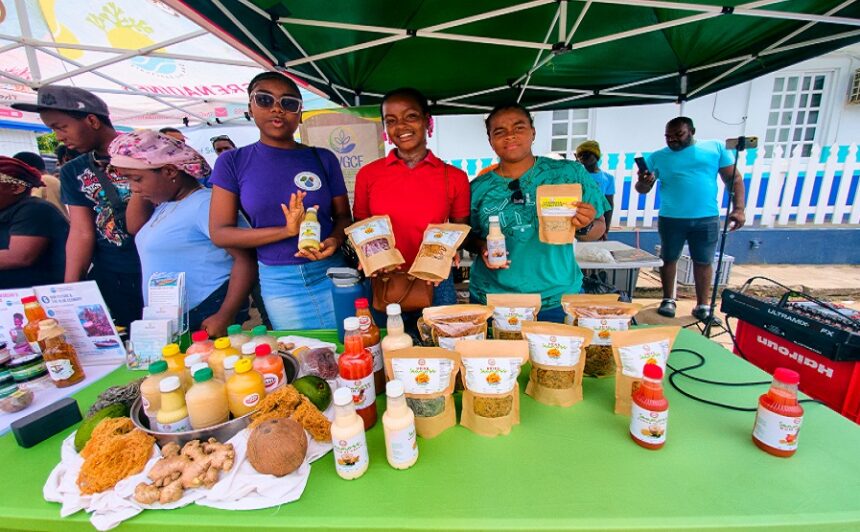
The ice cream was then introduced for sale during the Community SeaMoss Showcase on Day Three, where it was well received and completely sold out. The activity provided participants with a simple but practical lesson in entrepreneurship: developing an idea, testing it, improving it, taking it to market and seeing how customers respond. Proceeds from the ice cream were donated to the Union Island Secondary School to assist with the launch of its Environmental Club, creating a direct link between the camp and continued youth involvement in environmental education.
The programme concluded on August 21 with the Community SeaMoss Showcase at Mulzac Square, taking Roots to Reef out of the learning space and into the wider community. Local seamoss vendors and entrepreneurs participated in the event, allowing the youth to see different seamoss products and businesses operating within their own community and to interact directly with the people behind them. The showcase also featured the youth Big Drum cultural performance, bringing together the programme’s themes of seamoss, conservation, culture, livelihoods and community.
“If even one of them walks away wanting to protect the ocean, continue the seamoss tradition, start a business or simply look at what we have here a little differently, then Roots to Reef has meant something,” Stephens said.
Roots to Reef may have been delivered over three days, but the goal is much longer-term. Through collaboration with Union Island Secondary School and its proposed Environmental Club, SMASVG hopes to continue youth engagement in seamoss, marine conservation and environmental stewardship; while strengthening collaboration across sectors so that knowledge, opportunities and resources are shared rather than developed in isolation.
SMASVG extends sincere appreciation to all of the presenters, facilitators, parents, guardians, vendors, service providers and community members who contributed to the success of the programme. We are especially grateful to the St. Vincent and the Grenadines Conservation Fund for providing the funding that made Roots to Reef possible.