

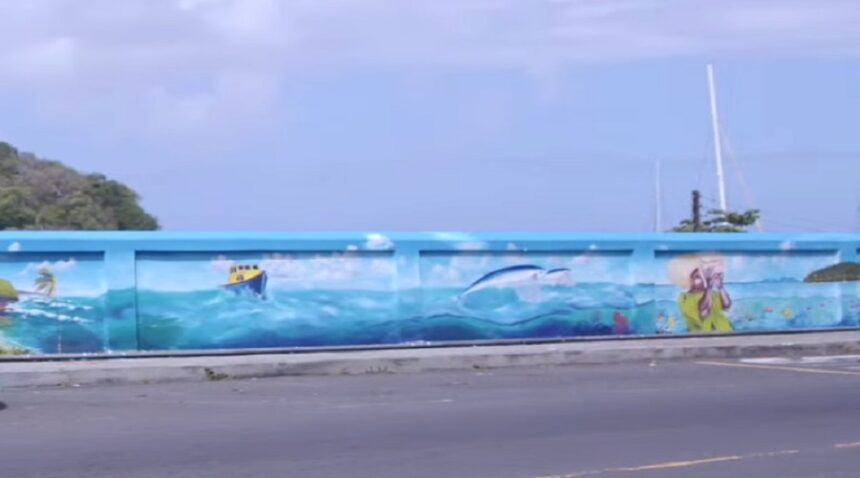
In the salt-etched air of Villa, a horizontal concrete expanse has been reborn as a vibrant visual tapestry, weaving together the disparate yet deeply intertwined threads of Barbadian and Vincentian identity.
This ambitious cross-border mural is not merely a decorative endeavor; it is a regional manifesto, a shared effort by artists from both nations to articulate a collective Caribbean narrative.
The genesis of this vision was born of a serendipitous encounter: a chance meeting between artist Ronnie Eiffel and his colleagues following a previous project. That moment of creative friction sparked a proposal that successfully bridged the waters between the islands, bringing a collaborative team together to paint their shared history onto the landscape.
The mural unfolds as a linear journey through time, inviting the viewer to walk alongside the ghosts and giants of the region’s past. The narrative begins long before the arrival of the colonial gaze, honoring an Amerindian presence that stretches back over 3,000 years.
Here, the artists pay tribute to the Taínos and the Garifuna (the “gapuna” people), the foundational keepers of the land. The wall anchors itself in the indigenous nomenclature of the islands—Hyuna (St. Vincent) and Ishibani (Barbados)—establishing a historical depth that predates the 1625 arrival of Africans.
As the timeline creeps forward, the imagery shifts into the stark realities of the Plantation Era. The visual language becomes one of resilience and survival, depicting the iconic “chattel houses” born from the discourse of slavery.
For the Barbadian contingent, this history is etched in the rendering of the more than 510 sugar mills that once defined the island’s geography and economy. By placing these symbols side-by-side, the mural transforms a painful history into a shared understanding of Caribbean endurance.
As the narrative reaches the shoreline of the present, the palette shifts to reflect the sun-drenched modernity of the Caribbean coast. The mural celebrates the regional fishing industry, focusing on uniquely identified fishing boats whose specific designs remain a hallmark of the Caribbean experience. Central to this segment is the flying fish—a symbol of the “land of cou-cou and flying fish”—which serves as a primary marker of Barbadian national identity.
The transition continues through the lens of Vincentian artist Peter Providence, who rendered the breathtaking vista of Young Island. His contribution captures the “beautiful scenery” that defines the local horizon, punctuated by the figure of the conch shell blower. This image is more than a postcard; it is a cultural heartbeat, representing the traditional call to the community that a fresh catch has arrived. In Providence’s work, the shell’s echo announces the day’s haul—not just robin and sprat, but also balahu—linking the natural world to the lived culture of the islands.
The visual journey reaches its terminus in a powerful homage to the spiritual currents that flow beneath the surface of Caribbean life. The mural concludes by centering on Yemaya, the sea goddess, whose presence serves as a spiritual anchor for the entire project. This depiction is a deliberate nod to the “Caribbean aesthetic”—a recognition that the region’s identity is inextricably linked to the sea and the spiritual elements that have crossed oceans. By ending the wall with this homage, the artists elevate the mural from a historical record to a soulful expression of shared regional divinity.
Beyond the final brushstroke, the project functioned as a vital laboratory for professional development and cross-border synergy. The artists identified several transformative takeaways from their time together:
Administrative Proficiency: Participants gained critical insights into the “admin stuff” required for regional collaboration, learning how to manage complex projects and navigate logistics across different island jurisdictions.
Technical Synthesis: The exchange allowed for a deep dive into varying brushwork techniques, operational timelines, and diverse artistic styles, fostering a collaborative environment where every generation could learn from the others.
The Responsibility of the “Gift”: Mentorship emerged as a core theme, with artists emphasizing that their talent is a gift that must be utilized to create paths for others. The project became a vehicle for guiding emerging artists, ensuring they have the space and opportunities to express their own creative voices.
The mural has transformed the Villa thoroughfare into an emotional resonance chamber. The artists aimed for an “emotional direction” akin to a love song or R&B track—an art that viewers can “feel.” A beach scene on the wall is intended to trigger the “culture of life,” invoking childhood memories of floating on old tires in the sea. This connection was validated by the public; residents and motorists frequently stopped their vehicles to express appreciation, providing the artists with the motivation that only community recognition can offer.
For Peter Providence, the project was a professional milestone—his first actual mural. After years of smaller-scale work, the experience provided a transformative “taste” of his own capabilities. The confidence gained from successfully executing a large-scale public work has repositioned him to pursue more ambitious commercial and artistic projects in the future.
The collaboration at Villa serves as a blueprint for a more robust and commercially viable visual arts sector in the Caribbean. Speaking from the perspective of a Visual Arts Development Officer, the project organizers underscored the need to expand the “commercial space” for visual arts. The ultimate goal is to move beyond art as a hobby, carving out a path where emerging artists can view their craft as a sustainable, full-time profession.
Looking forward, the vision is to expand this model of regional unity into a total cultural package. There is a profound desire for future collaborations to transcend the canvas, integrating “backstage” arts, acting, and dance into a collective showcase of Caribbean life.
