

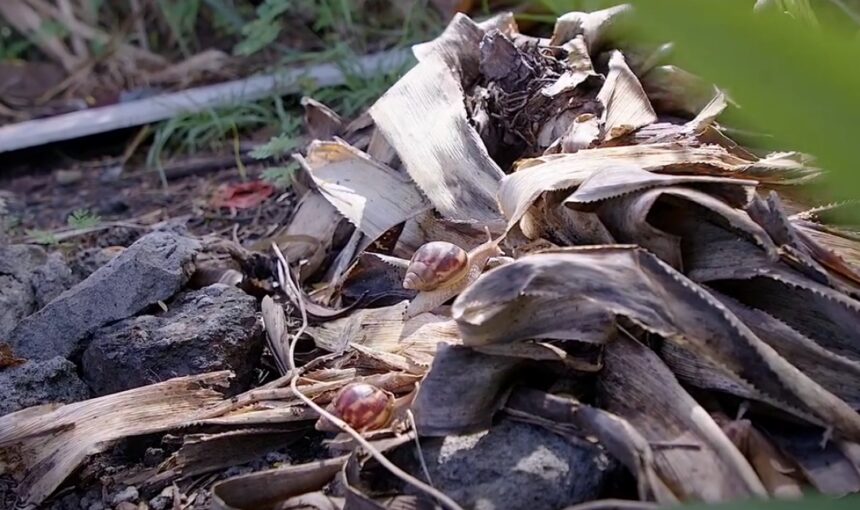
Human activity fuels Giant African Snail outbreak in SVG
The detection of the Giant African Snail (Achatina fulica) in St. Vincent and the Grenadines has escalated from a localized agricultural concern into national biosecurity mandate. Initially identified in June 2023 at ” Top Questelles” on Bonadie Hill, this invasive species represents a catastrophic threat to both the nation’s food security and public health.
As Dr. Bailey and the Plant Protection and Quarantine department intensify containment efforts, the outbreak is being managed as a strategic defense against a biological invader capable of dismantling the local agricultural economy. What began at a single epicenter has rapidly evolved into a complex geographic challenge that threatens the very heart of the nation’s lush interior.
In the discipline of invasive species management, geographic tracking is the primary defensive strategy. By establishing the precise boundaries of an infestation, authorities can implement cordons and direct baiting resources to “hot spots” before the pest migrates into high-value agricultural zones.
According to data reported by the Agricultural Public Information (API) service, the snail has established a firm foothold along the “Western Corridor.” This zone of infestation encompasses a string of geographically connected communities, including Top and Lower Questelles, Camden Park, Chauncey, Clare Valley, Lowmans Bay, Otley Hall, and Edinboro.
However, the discovery of the snail in several non-contiguous sites indicates a critical breach of containment driven by human activity:
- Belle Isle and Diamond Landfills: The infestation at the Bell Landfill is a primary cause for concern. Officials have confirmed this resulted from the movement of contaminated materials from infected zones. Its proximity to active agricultural lands poses a direct and immediate threat to local food production.
- National Athletic Stadium: The detection of the snail in this high-traffic public area increases the risk of accidental spread by visitors and athletes.
- Diamond Low-Income Housing: The migration into residential developments signifies that the pest is no longer confined to the “wild,” bringing the biological threat directly into the domestic sphere of Vincentian citizens.
This expansion demonstrates a shift from natural migration through the terrain to human-assisted dispersal, necessitating a shift in containment tactics.
The Giant African Snail is the “perfect invader” in a tropical ecosystem, possessing biological advantages that allow for exponential population growth. Mr. Osborne Laban, Head of Plant Protection and Quarantine, emphasizes that the species’ reproductive potential is a formidable obstacle to eradication.
The biological profile of Achatina fulica highlights its invasive efficiency:
- Hermaphroditic Capability: Each individual possesses both male and female reproductive organs. Following a single mating event, a snail can continue to fertilize eggs for the remainder of its 8-to-10-year lifespan.
- Massive Proliferation: A single snail can produce approximately 1,000 to 1,200 eggs annually, typically laying batches of 250 eggs up to four times a year.
This reproductive surge is a direct assault on the agricultural sector. The snail is known to consume over 500 plant species, with a particular appetite for staples like bananas and plantains. For local farmers, whose livelihoods are inextricably linked to these crops, an uncontained outbreak represents a total economic emergency.
Natural geographic barriers are easily bypassed by the movement of commerce. The Ministry of Agriculture has identified specific high-risk vectors, notably unwashed vehicles and building supplies—such as tiles, tires, and discarded materials—as the primary vehicles for recent containment breaches. To mitigate these risks, the Ministry has issued a series of mandatory best practices for those operating within or moving through infected zones:
- Vehicle Inspections: All motorists must inspect their vehicles, paying specific attention to tire treads and the interior of fenders where snails frequently attach.
- Material Treatment: No building supplies, soil, or debris should be moved out of an infected zone without prior inspection and treatment by Ministry of Agriculture staff.
- Landfill Protocols: Management at the Belle Isle and Diamond landfills are urged to implement power-washing stations and rigorous inspection protocols for all trucks to prevent these facilities from serving as hubs for national distribution.
Management of the outbreak has transitioned into a sophisticated operation combining traditional baiting with advanced surveillance. In areas like Otley Hall, field teams are currently deployed to conduct baiting with metaldehyde. Because this chemical is toxic, workers must utilize full protective gear, including gloves, water boots, and dust masks.
To address the “physically impossible” task of baiting the island’s steep, forested ridges, the Ministry is deploying high-tech solutions:
- Agricultural Drones: These units are used to disperse bait across inaccessible terrain where manual labor is unfeasible.
- GIS Mapping: Teams are utilizing Geographic Information System mapping to identify “hot spots” and provide the public with transparent data regarding the snail’s proximity to their communities.
Central to this mission is a Four-Pronged Approach: monitoring, surveillance, baiting, and collection. While this strategy proved effective during the initial detection, resource constraints previously hindered its consistency. However, a new “Snail Management Program” recently approved by the Cabinet has provided the necessary funding to re-energize these operations and scale the national response.
The Giant African Snail is more than an agricultural pest; it is a vector for zoonotic disease. The snail’s mucus can carry the “rat lungworm” parasite (Angiostrongylus cantonensis), which, if contracted by humans, leads to eosinophilic meningitis. This condition affects the brain and can be fatal.
It is vital to distinguish the situation in St. Vincent from regions where the snail is treated as a delicacy. Here, the snails exist “in the wild” rather than in a controlled, hygienic environment, which drastically increases the risk of parasitic transmission. Consequently, the Ministry of Agriculture has established a Strict Public Protocol: under no circumstances should these snails be handled with bare hands. The risk of mortality makes public adherence to this warning a matter of urgent national safety.
The Giant African Snail outbreak represents a profound threat to the ecological and economic stability of St. Vincent and the Grenadines. As Barbin Oliver of the API has noted, the massive task ahead requires a unified front.
The success of the Cabinet-approved Snail Management Program depends not only on drones and chemical countermeasures but on the vigilance of every citizen in reporting sightings and adhering to containment protocols. This “perfect invader” requires a perfect defense—a long-term commitment to protecting the nation’s fields, families, and future.
