

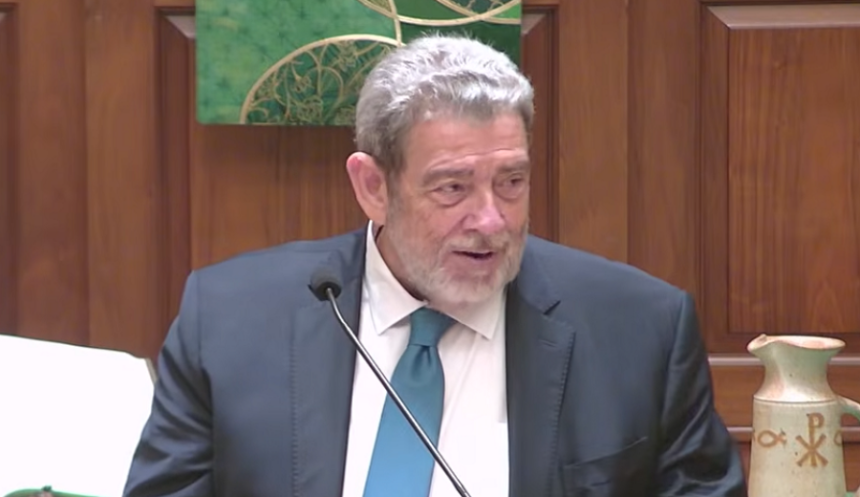
Speaking at a national forum convened by the Institute of the Black World 21st Century (IBW) and the Pan-African Unity Dialogue (PAUD), former Prime Minister of St. Vincent and the Grenadines Ralph Gonsalves delivered a sweeping keynote address dismantling the rationale behind the decades-long United States blockade against Cuba.
Addresssing community leaders, diplomats, and international delegates in the nation’s capital, Gonsalves characterized Washington’s framing of Cuba as a national security threat as “entirely farcical” and urged an immediate shift toward diplomatic normalization.
The forum, titled “Resolving the U.S. Provoked Crisis in Cuba: Normalizing Relations with Our Neighbor,” brought together Caribbean statesmen, civil rights activists, and foreign policy experts to address the escalating humanitarian and economic challenges facing the island nation.
Gonsalves pushed back against long-standing U.S. policy declarations that brand the Cuban Revolution as an emergency threat to American national security. Pointing to the stark demographic and economic asymmetry between the two nations, he noted that Cuba, a country of under 11 million people with a GDP of roughly $200 billion poses no material or technological threat to a superpower of 350 million citizens with a $30 trillion economy and global military reach.
Instead, Gonsalves argued that current U.S. posture represents a modern resurrection of the Monroe Doctrine of 1823, updated with what he termed a “Trump corollary”. This framework, he explained, asserts an imperial policy demanding that all sovereign nations and peoples in the Western Hemisphere submit to U.S. hegemony.
Tracing the deep roots of U.S. hostility, Gonsalves explained that Washington’s impulse to dominate Cuba predates the 1959 Revolution. U.S. founding figures, including Thomas Jefferson, viewed Cuba as an ideal territorial addition, leading to three separate U.S. attempts to purchase the island in the 19th century. Gonsalves described an enduring urge within successive U.S. ruling elites to treat Cuba as personal domain.
The fundamental break occurred in 1959 when the Cuban Revolution, rooted in the anti-colonial, anti-racist, and anti-imperialist teachings of José Martí, asserted structured national independence under the principle that “Cuba is for Cubans”.
Gonsalves argued that contemporary U.S. policy remains trapped by domestic political considerations. Following early waves of political migration to South Florida, U.S. foreign policy toward Cuba effectively became a “prisoner of congressional and presidential politics of South Florida,” where Florida’s decisive Electoral College votes repeatedly dictated national policy outcomes.
Gonsalves recalled telling American officials that Caribbean nations cannot accept a foreign policy dictated by U.S. domestic electoral calculations, emphasizing that Cuba is an integral part of Caribbean civilization with unbreakable regional ties.
Highlighting the artificial nature of the impasse, Gonsalves cited a historical 1964 message sent by Fidel Castro to newly elected U.S. President Lyndon B. Johnson. In that communication, Castro affirmed that “hostility between Cuba and the United States is both unnatural and unnecessary and it can be eliminated,” expressing readiness to negotiate all differences under mutual respect.
Gonsalves emphasized that this willingness for open dialogue without preconditions has remained constant across successive Cuban administrations, including under Army General Raúl Castro and current President Miguel Díaz-Canel.
Characterizing the conflict as unnatural, Gonsalves highlighted that the two nations are neighbors separated by only 90 miles, sharing core Western civilizational traits, common linguistic roots, Judeo-Christian traditions, and a shared passion for sports like baseball.
While the Obama administration initiated a brief diplomatic thaw which received broad public support, hardline opposition led by U.S. Senators Bob Menendez, Marco Rubio, and Ted Cruz sought to stall progress. The subsequent Trump administration aggressively reversed those gains, re-listing Cuba as a state sponsor of terrorism and deepening financial sanctions and measures that have largely persisted under the Biden administration.
Drawing on his nearly 25 years as Prime Minister and extensive direct engagements with Cuban leadership, Gonsalves presented a concrete four-point international action plan to resolve the ongoing crisis:
CELAC Mobilization: The Community of Latin American and Caribbean States (CELAC) must directly engage both Havana and Washington, leveraging the region’s shared economic and security interest in regional stability.
United Nations Mediation: The UN Secretary-General, backed by the Security Council, should actively broker a structured resolution to end the dangerous standoff.
Congressional Action: The U.S. Senate and House of Representatives must press the executive branch to institute a formal framework for mature, unconditional dialogue with Cuba.
Global Grassroots Alliance: Civil society, movements, and nations across Africa, Asia (including China), and Latin America must unite in a coordinated international coalition to demand an end to the economic blockade.
Closing his address, Gonsalves urged the American public to move past historical anxieties and regional domination. “The American people have to understand that you have to let go those things so that we can have peace and justice and shared prosperity,” Gonsalves declared.
