

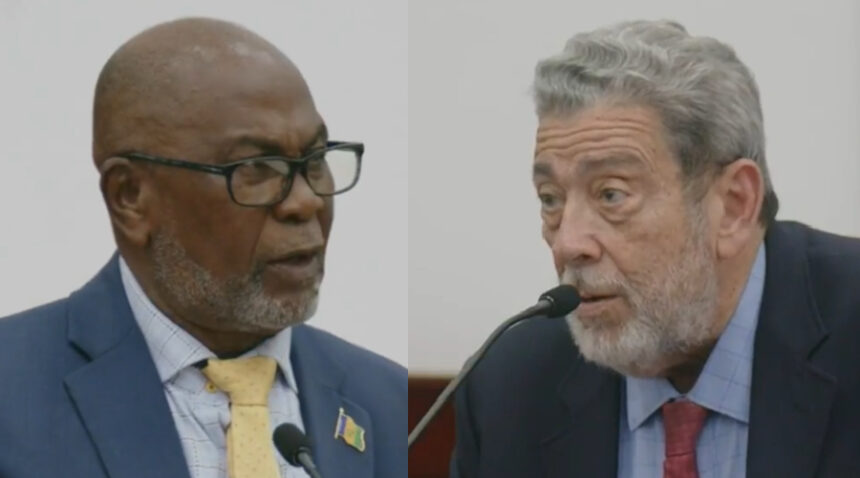
Opposition Leader Dr. Ralph Gonsalves has spoken out strongly on juvenile justice and rehabilitation, criticizing recent comments made by Minister of National Security Sinclair Leok regarding seven students facing criminal charges.
Addressing the matter during a national broadcast, Gonsalves warned against punitive “totalitarian impulses” when dealing with teenage offenders, calling instead for a balanced approach rooted in social context, legal discretion, and long-term rehabilitation.
The controversy stems from remarks delivered by Minister Leok to grammar school students during a church service. Leok publicly criticized authorities for delaying the prosecution of seven students aged 14 to 17 charged with using an imitation firearm to rob individuals of money and cellular phones, a delay allowed so the youths could sit for their national examinations. Leok reportedly argued that the students should have been prosecuted summarily for breaking the law.
Gonsalves sharply rejected Leok’s tone, arguing that the minister was essentially finding the youths guilty before they had their day in court. While acknowledging that those aggrieved by such alleged acts have every right to feel hurt if the charges are proven, Gonsalves stressed that the response of state leadership should not be driven by an “assertion of power” or premature condemnation.
“You cannot deal with the question of law breaking by young people without context, without an understanding,” Gonsalves stated. “How does that contribute to anything concerning rehabilitation of these young persons or proper understanding as to what takes place with young teenagers?”.
Gonsalves highlighted the social factors that often contribute to youth delinquency, pointing out that young people who display discipline typically benefit from quality parenting, effective school leadership, strong community ties, and state support. He urged the public and authorities to consider the lack of mentorship—such as the absence of a father or guide—and the economic hardships faced by single mothers trying to raise teenage boys.
He defended the decision by prosecuting authorities to let the students sit their examinations before proceeding with legal steps, describing it as a considerate and practical administrative choice.
“They still facing the music, but let them write the exams,” Gonsalves noted, criticizing Leok for attempting to act as minister, police commissioner, and Director of Public Prosecutions all at once.
To demonstrate that the legal system accounts for youth rehabilitation, Gonsalves cited Section 37 of the Criminal Code, which governs the discharge of offenders without punishment. He explained that the law explicitly allows courts to weigh an accused person’s age, antecedents, character, and mental condition. Where appropriate, judges or magistrates may dismiss charges or order counseling rather than impose a criminal conviction that could ruin a young person’s future prospects.
Gonsalves argued that society must demonstrate greater care and guidance for young people rather than resorting to harsh rhetoric that destroys their futures.
“We have to show greater love and consideration while saying that if in fact what they charged with that they did wrong… it doesn’t mean that the consequences mean you’re throwing the book at them,” Gonsalves emphasized.
