

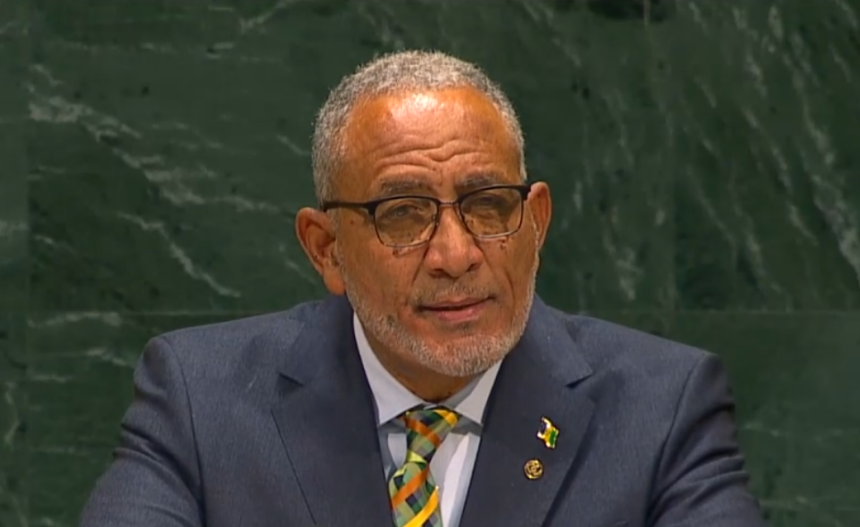
Speaking for the first time at the United Nations General Assembly, the Prime Minister of Saint Vincent and the Grenadines Godwin Friday, called on world leaders to address a broken multilateral system by reforming international governance, delivering climate justice for small island states, and taking decisive action on global security and reparatory justice.
Addressing the Assembly under the theme “Restoring Trust, Managing Transformation: a United Nations that delivers for all,” the Prime Minister stressed that while confidence in the multilateral order has retreated, small democratic nations remain committed to a rules-based international framework where every country’s voice is heard.
A central pillar of the address focused on the urgent necessity of structural reform within the United Nations. The Prime Minister argued that the UN governance architecture established in 1945 is no longer capable of handling modern economic and security crises, warning that failing to modernize the system proves it is driven by power rather than fairness.
Key governance proposals put forward include:
UN Security Council Reform: An explicit call to expand the Security Council to include a permanent member from the continent of Africa with full rights and privileges.
Secretary-General Selection: An endorsement of Her Excellency Carolyn Rodriguez Birkett of Guyana—supported by CARICOM members—to serve as the next UN Secretary-General.
Historic Gender Representation: Noting that all nine Secretary-Generals over the past eight decades have been men, the Prime Minister emphasized that after 80 years, the time has come for a capable woman to lead the global body.
Highlighting the existential threats facing Small Island Developing States (SIDS), the Prime Minister rejected the notion that climate change is a distant forecast, identifying it as a present financial and environmental emergency. The speech referenced the devastating impact of Hurricane Beryl in July 2024, which wiped out years of infrastructure in Saint Vincent and the Grenadines in a matter of hours.
The Prime Minister warned against forcing vulnerable nations into unsustainable debt cycles to rebuild from recurring disasters:
“Small states cannot continue borrowing merely to replace what climate-related disasters repeatedly destroy. We cannot continue to walk up the down escalator pretending it is development.”
To reform climate finance and development funding, the Prime Minister advocated for:
The Multidimensional Vulnerability Index (MVI): Demanding its full operationalization so concessional financing eligibility is determined by structural climate risk rather than per capita income.
The Bridgetown Initiative & SIDS Agendas: Calling for automatic debt service suspension clauses during natural disasters, expanded Special Drawing Rights (SDRs), and multilateral development banks that act as genuine development partners rather than commercial lenders.
Climate Equity: Reaffirming that affordable, patient concessional capital is not charity, but a matter of justice for nations that contributed the least to global emissions.
The address connected distant geopolitical conflicts to economic strains in the Caribbean, noting that wars in Ukraine and the Middle East continue to disrupt global supply chains, elevate shipping premiums, and drive up food and fuel costs.
On global and regional peace, the Prime Minister declared:
Ukraine & Middle East: Urged an immediate end to the war in Ukraine with full respect for state sovereignty, as well as a permanent ceasefire in the Middle East, civilian protection, and a two-state solution for Israel and Palestine.
Caribbean Zone of Peace: Reaffirmed that Latin America and the Caribbean must remain a zone of peace, calling for the peaceful resolution of the territorial dispute between Venezuela and Guyana under international law.
Haiti and Illicit Arms Trafficking: Expressed deep concern over gang violence terrorizing Haiti and the wider region. Pointing out that assault weapons are not manufactured in the Caribbean, the Prime Minister called on industrial nations to stem the illegal smuggling of firearms across borders.
Cuba, Venezuela, and Taiwan: Demanded an end to the decades-long US economic embargo against Cuba, highlighted regional relief solidarity extended to Venezuela following a devastating earthquake, and praised 45 years of diplomatic friendship with Taiwan, supporting its meaningful participation in specialized UN agencies.
Looking at historical and future transformations, the Prime Minister underscored CARICOM’s 10-point plan for reparatory justice to address African enslavement and indigenous genocide. The address commended the UN General Assembly’s March 2026 resolution—sponsored by Ghana and backed by CARICOM and the African Union—declaring chattel enslavement a grave crime against humanity.
In closing, the Prime Minister emphasized that global trust will only be restored when national debt restructuring is fair, hurricane relief arrives on time, historical atrocities are righted, and technological advances such as artificial intelligence are shared equitably across humanity rather than hoarded by wealthy nations.
