

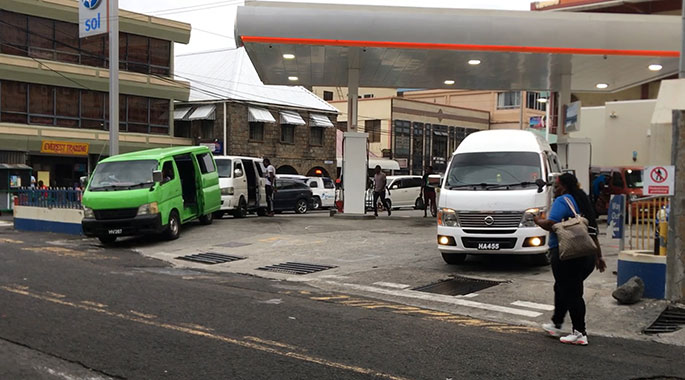
Opposition Leader Dr. Ralph Gonsalves has revealed that the government’s unpaid fuel debt to petroleum supplier SOL has surged to over $22.5 million, raising serious concerns over national fiscal management and the future cost of fuel for local consumers. The revelation comes after the Speaker of the House of Assembly ruled Gonsalves’ formal parliamentary question on the matter “inadmissible,” deeming the request for updated debt figures an “abuse of the right of questioning” and “frivolous”.
Gonsalves strongly rejected the Speaker’s ruling under Standing Order 20(2), arguing that seeking updated financial data for a new parliamentary sitting and time period is a fundamental duty of parliamentary oversight rather than a frivolous exercise.

According to figures disclosed by Gonsalves, the government’s liabilities to fuel suppliers have grown rapidly in recent months:
August Baseline: As of August 27, 2026, official parliamentary responses showed the government owed $17 million, an amount owed entirely to SOL.
Rubis Offset Balance: When the Unity Labour Party (ULP) left office, supplier Rubis owed the government $6.8 million, which was gradually drawn down to just over $3 million by late August to cover ongoing government fuel purchases.
Recent Debt Surge: Between mid-August and late September 2026, the government accumulated an additional $5 million-plus in fuel liabilities, bringing the current total debt to suppliers—principally SOL—to $22.5 million, with overall fuel-related liabilities reaching near $28 million.
Gonsalves explained that the mounting debt stems from the administration’s handling of the bonus-malus fuel pricing mechanism. Under this system, local prices for diesel and gasoline are regulated based on an international benchmark price, such as Shell West or Caribbean postings.
When global acquisition costs, freight, insurance, and wholesale margins exceed the government’s set benchmark or pump price, a deficit—or “malus”—is created. If the government chooses not to adjust pump prices upward to match these higher import costs, it effectively creates an unbudgeted government subsidy, resulting in debt directly owed to fuel importers SOL and Rubis.
Gonsalves warned that this accumulated debt will inevitably burden Vincentian motorists. He pointed out that consumers will be forced to pay artificially elevated prices at the pump for a prolonged period in the future—even when global oil prices drop—so the government can clear its back debts with SOL.
Gonsalves noted that the financial strain surrounding fuel supply is already manifesting in local operations. He cited an official notice from SOL regarding temporary changes to gas station operating hours in Canouan, where service was restricted to just two hours on specific weekdays and limited hours on weekends. Gonsalves questioned whether these service cutbacks were connected to ongoing payment delays between the government and the fuel provider.
Highlighting his previous administration’s record, Gonsalves contrasted current conditions with past global energy shocks. He recalled that during the 2008 global commodity boom, crude oil prices spiked to $148.50 per barrel—equivalent to over $210 to $224 in current monetary terms—and hit $139 per barrel following the outbreak of the Russia-Ukraine war in 2022.
Gonsalves argued that despite facing significantly higher real oil prices in 2008 and 2022 than today’s market price of around $103 per barrel, his government shielded citizens without accumulating hidden debts. Past measures included:
- Direct, transparent fuel subsidies for minibus operators using a receipt-reimbursement system.
- Direct price subsidies on staple food items like imported rice processed at the local mill.
- The implementation of Cost of Living Allowances (COLA) for public sector workers.
- Progressive increases in the minimum wage and raising the personal income tax threshold from $12,000 to $25,000 annually.
Gonsalves concluded that the current administration’s failure to transparently address its $22.5 million obligation to SOL reflects severe fiscal mismanagement that will ultimately leave consumers bearing the financial brunt.