

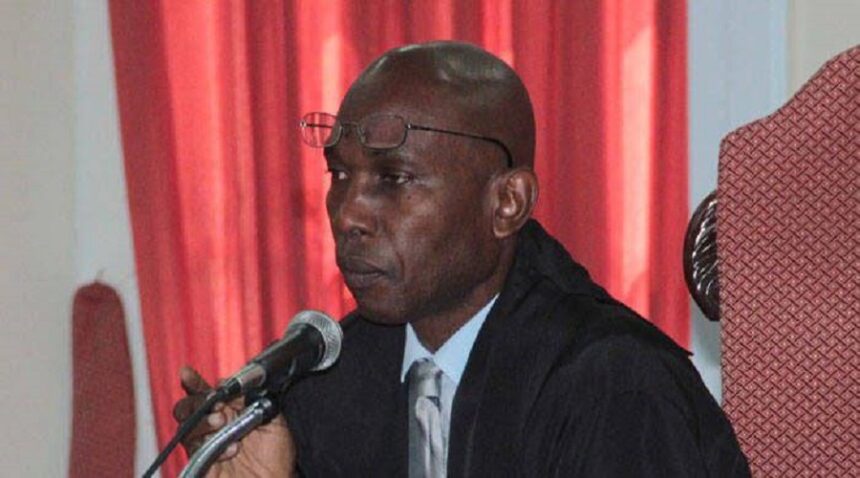
Former Speaker of the House of Assembly and legal counsel Jomo Thomas has delivered a detailed commentary on the election petition cases currently threatening to unseat Prime Minister Dr. Godwin Friday and Foreign Minister Fitz Bramble. Speaking on the radio broadcast Plain Talk on OMG, Thomas analyzed the ongoing court proceedings while calling on the governing New Democratic Party (NDP) to pass swift legislative amendments to resolve the dual-citizenship controversy once and for all.
The legal controversy arises from the November 27, 2025 general elections, in which the NDP achieved a decisive victory, winning 14 of the 15 parliamentary seats with over 36,000 votes. The petitions were brought by opposition Unity Labour Party (ULP) candidates Carlos Williams—who contested against Dr. Friday—and Luke Brown, who lost to Fitz Bramble in East Kingstown by just over 1,000 votes, while Williams received approximately 323 votes.

Both petitioners argue that Dr. Friday and Minister Bramble hold foreign (Canadian) citizenship, rendering them ineligible to be nominated or elected to Parliament under the St. Vincent and the Grenadines Constitution. Specifically, they cite Section 26, which disqualifies any individual who, by their own act, acknowledges allegiance, obedience, or adherence to a foreign power or state. The ULP petitioners are asking the court to declare the seats vacant and award them directly to Williams and Brown.
Thomas firmly rejected the claim that the petitioners could automatically assume the parliamentary seats if the court rules against Friday and Bramble. He explained that under the Constitution, a declared vacancy does not hand the seat to a runner-up; instead, the Governor-General is required by law to issue a writ for by-elections within 90 days.
In dissecting the legal arguments, Thomas highlighted several key constitutional provisions and precedents:
Section 25 Qualifications: Requires a representative to be a Commonwealth citizen of qualified age (20 or older) who has resided in St. Vincent for at least 12 months immediately preceding nomination.
Section 95 Interpretation: Defines an “alien” as any person who is not a Commonwealth citizen, a British protected person, or a citizen of the Republic of Ireland. Consequently, Commonwealth citizens are legally distinguished from aliens under Vincentian law.
Section 26 Disqualification: Disqualifies individuals who take deliberate acts acknowledging allegiance to a foreign power. The central issue before the court is whether acquiring citizenship in a Commonwealth country like Canada constitutes foreign allegiance under Section 26.
Regional & Global Precedents: Thomas noted that numerous dual-citizenship cases have been litigated across the Commonwealth, including the Dr. Denzel Douglas case in St. Kitts and Nevis regarding a Dominican passport, the Vance case in Jamaica involving U.S. citizenship, and rulings in Australia, the Falkland Islands, Trinidad and Tobago, and Antigua.
While Thomas initially considered the case an “open-and-shut” matter against the Ministers, he admitted that deeper study of the text and extensive legal debates with Vincentian scholars—including Dr. Linton Lewis and Dr. Jason Haynes—have shown the issue to be far more complex. He emphasized that the outcome will ultimately depend on how Justice Tom interprets the interaction between Sections 25 and 26, with any ruling expected to be appealed to the Court of Appeal.
Thomas strongly advised the governing NDP to take decisive action in Parliament rather than awaiting the final court ruling. He emphasized that Sections 25 and 26 are not entrenched clauses, meaning they do not require a public referendum or a two-thirds majority. Instead, Parliament can amend them with a simple majority vote (50% plus one) in a single session.
Recalling that Parliament previously used a simple majority during his tenure as Speaker in 2018 to amend the parliamentary oath from the British Crown to the people of St. Vincent and the Grenadines, Thomas outlined a clear strategic path:
Pass a Comprehensive Diaspora Amendment: Amend the law to state explicitly that any natural-born Vincentian, regardless of foreign citizenship acquired elsewhere in the world, is legally eligible to be nominated and elected to Parliament.
Gain Strategic Advantage: Enacting this change would present a political dilemma for the opposition ULP, as opposing diaspora rights would be politically damaging.
Ensure By-Election Protection: If Justice Tom or the Court of Appeal ultimately rules against Friday and Bramble, having this constitutional amendment in place beforehand would allow both men to immediately contest the resulting by-elections without legal hurdles.
Beyond the immediate election dispute, Thomas criticized the 1979 Constitution as an outdated colonial draft designed primarily to safeguard British interests. He argued that it grants excessive power to the Prime Minister while leaving the legislature weak. Thomas advocated for broader constitutional overhaul, including the establishment of an Independent Human Rights Commission, an Ombudsman, and legislative measures covering integrity in public life and anti-corruption practices.
Concluding his remarks, Thomas stated that while the legal challenge is a necessary constitutional exercise, permanently resolving candidate eligibility through legislative reform is vital for the country’s governance and the integration of the Vincentian diaspora
