

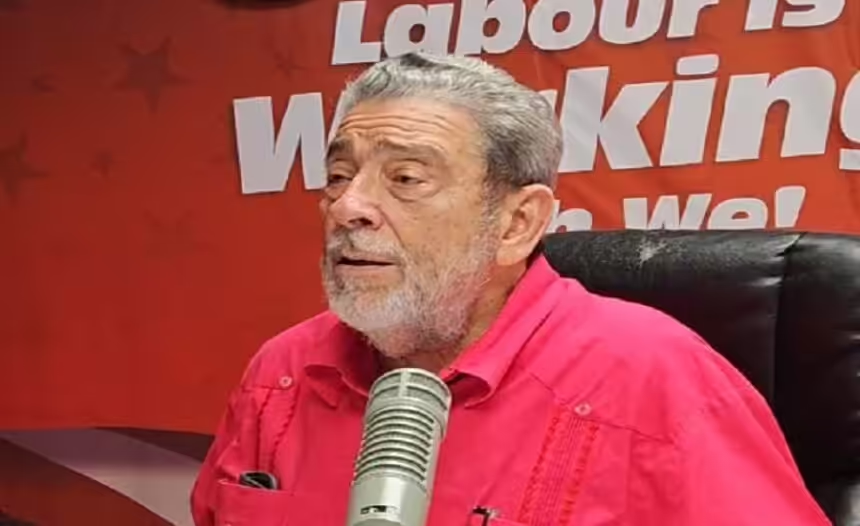
Opposition Leader and former Prime Minister Dr. Ralph Gonsalves has issued a comprehensive critique of the New Democratic Party (NDP) administration, asserting that St. Vincent and the Grenadines is currently engulfed by six interlocking crises: fiscal, economic, social, crime, governance, and leadership.
Speaking during a political radio broadcast, Gonsalves defined a national crisis as “a condition in which the principals are innocent of the extent of the condition and have no credible idea as to how to get out of it”. He argued that Prime Minister Dr. Godwin Friday and his Cabinet function without a coherent developmental framework or an understanding of state administration, leaving public institutions paralyzed.

Gonsalves noted that even Deputy Prime Minister St. Clair Leacock publicly acknowledged the depth of the situation, calling the state of government finances “broke” on radio and admitting that the government lacks funds even to purchase paint or erect signs at police stations.
The Fiscal & Financial Breakdown
At the center of Gonsalves’s indictment is an unprecedented liquidity and cash flow breakdown across state finances:
National Overdraft Breach: As of September 30, the national overdraft at the Bank of St. Vincent and the Grenadines (BOSVG) reached $243 million, standing at nearly three times the statutory $85 million limit approved by Parliament.
Frozen Treasury Vouchers: Over $210 million in approved Treasury vouchers for private vendors, contractors, and public suppliers remain frozen due to a complete lack of funds. Top private truckers have gone unpaid for five consecutive weeks.
Unlawful Contingency Fund Withdrawal: The administration drew $10 million from the national Contingency Fund to cover September public sector salaries. Gonsalves explained that under statutory regulations, accessing the fund for non-disaster purposes requires the balance to exceed 20% of average actual current revenue over the last three years—a threshold calculated at $149.5 million. Because post-Hurricane Beryl withdrawals left the fund at approximately $36 million, the drawdown violated statutory law. Furthermore, the government has ceased depositing the dedicated 1 percentage point VAT levy into the fund.
Widespread Institutional Debt: The government owes $25 million to the Eastern Caribbean Central Bank (ECCB), $22 million to fuel distributor SOL, $7.4 million in unremitted National Insurance Services (NIS) contributions for August and September, and $4.5 million owed by BRAGSA to private hot mix asphalt suppliers.
Sinking Fund Deficit: Nine months into the fiscal year, less than one-quarter of the budgeted $25 million Sinking Fund contribution has been deposited, creating default risks for maturing government bonds.
The Economic Crisis
Gonsalves argued that fiscal mismanagement has directly triggered a broader economic slump:
Falling Revenues: Current account revenues have fallen nearly 11% (10.6%) below budget estimates, creating an annualized revenue shortfall near $100 million.
Private Sector Stagnation: Private sector debt owed to local banks, building societies, and insurance companies stands at $2.6 billion. With commercial activity grinding to a halt, financial institutions have begun repossessing private trucks and minibuses while threatening residential mortgages.
Procurement Failures & Asset Sales: A proposed $13 million housing materials purchase from Jamaican supplier Tangwell stalled because the Treasury could not raise a 40% upfront deposit. Additionally, the administration conducted a fire sale of 100 acres at Chatham Bay for $54 million without obtaining a valuation from the Chief Surveyor.
The Social Crisis
The social fallout is manifesting across basic public services, health, and education:
Shredding of Safety Nets: Social safety nets built for the poor and vulnerable have been severely weakened.
University Exam Lockouts: Delinquent government payments to regional educational institutions have left Vincentian students, including preclinical medical students at the Mona campus of the University of the West Indies (UWI), facing lockouts from scheduled examinations.
Infrastructure Works Suspended: The Roads, Buildings and General Services Authority (BRAGSA) has received barely enough of its $26 million subvention to cover internal staff salaries, halting public infrastructure maintenance across the island.
The Crime & Security Crisis
Gonsalves highlighted rising violent crime and homicides as evidence of social breakdown. He criticized the government’s leadership for lacking strategic coordination, referencing public comments by Deputy Prime Minister Leacock who described the crime situation as a “nightmare” while posing basic, unanswered questions about who, what, when, where, and why.
The Governance Crisis
The administrative machinery of the state suffers from widespread dysfunction and legal non-compliance:
Statutory Breaches: Bypassing legal rules governing the Contingency Fund, exceeding parliamentary overdraft limits without legislative approval, and failing to secure required property valuations.
Bloated Cabinet Structure: Establishing 16 ministries plus the Attorney General—the largest government administration in national history—despite claiming the state was broke.
Political Victimization: Terminating 28 out of 30 mobilizers and coordinators in the YES employment program on political grounds and revoking school transportation contracts from minibus operators based on political affiliation.
Diplomatic Neglect: Failing to maintain attendance during key international proceedings, such as European Union addresses at the United Nations General Assembly.
The Leadership Crisis
Gonsalves saved his sharpest criticism for Prime Minister Dr. Godwin Friday, characterizing the administration as paralyzed and detached from financial reality.
He cited wasteful expenditure priorities—such as spending $22 million on election bonuses upfront, $135,000 on rebranding a plane tail, and over $2 million US for CPL cricket matches—while simultaneously freezing payments for basic office supplies like paper and ink. Furthermore, the government slashed capital spending in vital areas, placing negotiated low-cost funding (such as the $65 million Saudi Fund agreement) on hold while failing to secure new foreign direct investment or development capital.
Gonsalves warned that without an immediate shift in policy and administrative competence, the six interlocking crises will continue to compound, threatening the long-term economic stability and international standing of St. Vincent and the Grenadines.