

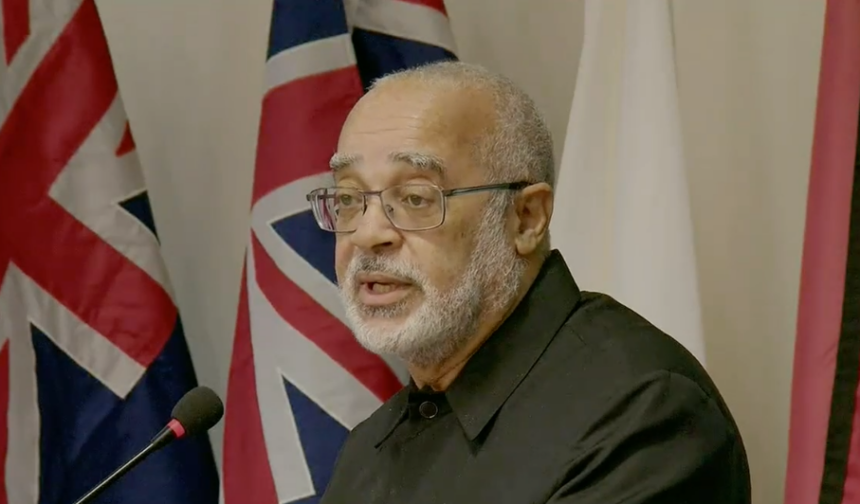
Characterizing the current global landscape as “entropic times,” OECS Director General Dr. Didacus Jules delivered a stirring keynote address at the 10th OECS Council of Ministers on Human and Social Development, declaring social protection to be the fundamental “infrastructure of sovereignty” for small island developing states.
Addressing ministers, international partners, and delegates, Dr. Jules drew on the scientific concept of entropy—where systems left alone naturally deteriorate into disorder—to describe the geopolitical, economic, and environmental pressures bearing down on the Caribbean.

“Look at the world around us,” Dr. Jules noted, pointing to a frayed rules-based global order, shrinking development assistance, power-driven trade arrangements, severe climate events, and artificial intelligence disrupting workforce structures faster than institutions can adapt.
Dr. Jules warned that while large continental economies can absorb external shocks over a single quarter, a single major disaster can set a small island nation back an entire decade. “In entropic times, social protection is not the soft side of government,” Dr. Jules asserted. “It is the energy a society puts in to hold itself together. A people who are not protected cannot be asked to be resilient.
To safeguard Caribbean citizens, Dr. Jules detailed five strategic transformations guiding the work of the OECS Human and Social Division:
From Welfare to Investment: Transforming traditional support programs into long-term economic drivers. Partnering with the World Food Program (WFP), school feeding initiatives are being structured as public health defenses against chronic non-communicable diseases while providing guaranteed local markets for women- and youth-led agricultural cooperatives.
From Silos to Systems: Reorganizing regional operations by consolidating health, social inclusion, and social protection into a single regenerative unit that addresses family vulnerabilities holistically rather than ministry by ministry.
From Reactive to Adaptive: Establishing disaster risk financing mechanisms, pre-tested digital payment channels, and vulnerability registries before storms hit. The OECS is launching specialized Communities of Practice alongside WFP, UNICEF, and the World Bank to pool technical expertise across member states.
From National to Regional Protection: Operationalizing the OECS Contingent Rights Policy so that citizens exercising their right to free movement carry social service access, healthcare, and legal protections across borders seamlessly.
From Beneficiaries to Participants: Placing children and young people at the center of regional governance through the newly submitted OECS Regional Child Policy and Strategic Plan (2026–2032), alongside the Youth Empowerment Strategy and a standing OECS Youth Assembly.
A central theme of Dr. Jules’s address was the urgent need for Caribbean nations to build self-reliant regional systems rather than remaining dependent on donor funding or external software subscriptions.
Highlighting local capability, Dr. Jules showcased a regional generative artificial intelligence learning platform developed by 24 young OECS innovators. Over the preceding five years, Anglophone Caribbean governments collectively spent an estimated $150 million USD on fragmented, disjointed educational software and e-books. In contrast, the custom-built OECS AI ecosystem costs just 24 EC cents per child annually to operate across regional school systems.
“When we talk about breaking the dependence on externalities and donor financing, we need to recognize our own capabilities,” Dr. Jules insisted, urging member states to sustainably fund core social protection personnel and embed regional agreements directly into national legislation and budgets.
Dr. Jules concluded with a call to action: “Entropy is a law of physics. It’s not a law of history. Societies hold together because people decide deliberately and repeatedly to hold them together.
