

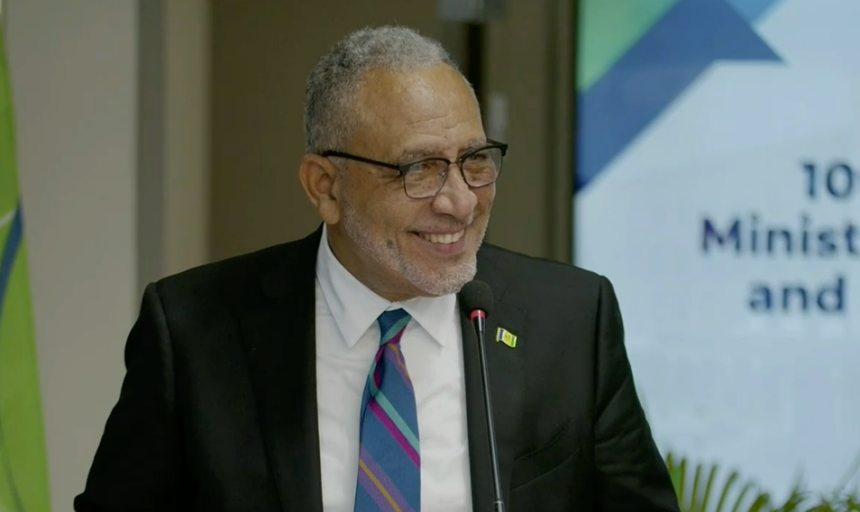
Prime Minister Dr. Godwin Friday opened the 10th Meeting of the OECS Council of Ministers on Human and Social Development with a passionate call for regional governments to translate social policies into immediate, tangible relief for the Caribbean’s most vulnerable citizens.
Speaking in St. Vincent and the Grenadines which hosted the ministerial assembly for the first time, Friday emphasized that while grand speeches and comprehensive policy documents are common at regional gatherings, the ultimate metric of success is how government actions alter daily lives.

“Having a program on paper is just one thing. Making sure that the help reaches the people who need it the most is quite another,” Friday stated, urging delegates to look beyond describing challenges and focus squarely on delivering concrete solutions.
The Prime Minister detailed the severe financial hurdles currently confronting his administration. Taking office inherited under steep fiscal pressures, St. Vincent and the Grenadines closed 2025 with a public debt of $3.5 billion, exceeding 113% of the nation’s Gross Domestic Product (GDP). Currently, close to 40 cents of every dollar of current revenue is diverted to debt servicing.
Despite these fiscal constraints, Friday insisted that financial hardship must never be passed down to those least equipped to bear it.
“The needs of our people do not diminish simply because government doesn’t have money,” Friday observed. “We cannot make the most vulnerable in our societies pay the price of our predicaments. When there is hardship, those are the people we look to first.
Highlighting targeted measures implemented in St. Vincent and the Grenadines to cushion citizens against global inflation and natural shocks, Friday outlined several key social intervention policies:
Increased Public Assistance: Monthly financial support for vulnerable individuals was raised from $360 to $500 per month.
VAT-Free Relief Days: The government introduced targeted Value Added Tax (VAT) exemption days, providing relief during the Christmas season and ahead of the school year to assist parents with essential purchases and supplies.
Pension Protection Legislation: Parliament passed new legislation addressing a critical gap for low-ranking public servants who lack entitlement to public pensions. Because the pensionable age under the National Insurance Scheme (NIS) was raised from 60 to 65, retired workers previously faced a five-year income gap or financial penalties of up to 40% for early drawdown. The new law grants non-pensionable officers the legal right to continue working until age 65.
Universal Basic Healthcare: The administration is examining a generalized public health insurance framework to guarantee a basic standard of healthcare for every citizen, arguing that health coverage should not be dictated by individual wealth.
Friday also pointed to upcoming World Bank meetings where regional leaders will demand that international disaster relief be delivered urgently, predictably, and without administrative delays. He maintained that domestic institutions must apply the same standard of speed and accessibility when citizens seek assistance at home.
The Prime Minister reaffirmed that social protection remains the moral cornerstone of economic planning and governance.
“We are our brothers’ and our sisters’ keepers,” Friday affirmed. “A good society is one that looks out not just for those persons who are doing well, but for those persons in our societies who from time-to-time struggle.
