

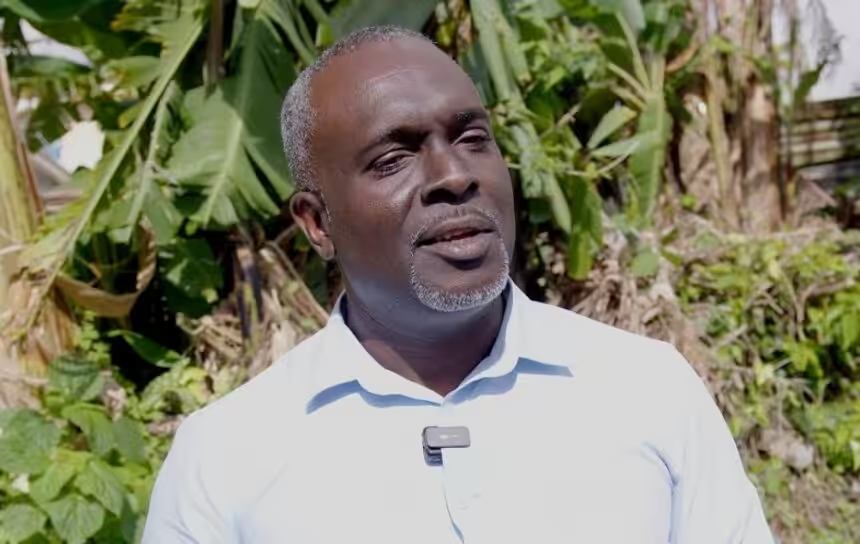
Minister of Education Philip Jackson has forcefully dismissed allegations from the St. Vincent and the Grenadines Teachers’ Union (SVGTU) accusing the ministry of systemic failure and poor consultation following post-storm school reopenings. Defending the executive decisions taken in the wake of heavy rainfall and flooding, Jackson stated that the government’s response was targeted, data-driven, and designed to prevent severe “learning loss” among vulnerable students.
Speaking on Hot 97.1 SVG, Jackson addressed public criticisms made by SVGTU President Fiona Charles-Williams, who claimed the Ministry of Education failed to consult stakeholders and ordered schools without running water to reopen following severe weather disruptions.

Charles-Williams pointed to public updates from the Central Water and Sewerage Authority (CWSA) indicating that key municipal systems—such as the Mayora water supply—remained closed. She accused the ministry of maintaining its “usual silence” despite union calls for collaborative emergency planning.
Rebuffing the union’s claims, Jackson clarified that an internal check with ministry staff revealed no incoming communications or outreach from the SVGTU. He further explained that during immediate weather disasters, emergency response decisions are made strictly through statutory state agencies rather than union consultations.
Jackson disclosed that emergency deliberations continued late into Tuesday night alongside technical heads from the CWSA, electricity provider VINLEC, road clearing agency BRAGSA, and the National Emergency Management Organisation (NEMO).
“We as we deliberated were crunching the numbers directly live from CWSA, and we made the wise decision of reopening school because… it was safe to do so,”
— Minister Philip Jackson, emphasizing that reopenings were strictly selective rather than nationwide.
Addressing sanitation and health concerns, the Minister confirmed that schools in areas where the CWSA could not guarantee continuous pipe-borne water remained closed.
For operational schools, the ministry established strict safety protocols:
- Selective Reopenings: Precise circulars were issued designating only schools with confirmed utility access.
- Emergency Drinking Water: In collaboration with NEMO, cases of bottled drinking water were delivered directly to open schools to complement running facilities.
- Sanitation Audits: CWSA chief engineers provided live confirmation regarding washroom and handwashing capacity before individual approvals were granted.
Explaining the imperative behind reopening, Jackson warned against blanket closures across the entire education system whenever disruptions occur. He stressed that extended closures disproportionately harm disadvantaged students who rely heavily on structured classroom instruction and school meal programs.
Jackson revealed that initial attendance data from Wednesday showed top-performing institutions recording attendance rates near 100% among both teachers and students. He noted that while anxiety over weather events is understandable, building an adaptive national mindset is critical for maintaining public services during minor disruptions.
To strengthen infrastructure ahead of future weather events, Jackson announced that he has instructed the ministry’s school inspection team to conduct a comprehensive nationwide audit of water storage tanks across all educational institutions.
The audit will identify operational and unconnected tanks to ensure every school is equipped with functional backup storage before the next hurricane season. In parallel, Jackson urged households across St. Vincent and the Grenadines to increase personal preparedness by maintaining two to three days of backup water reserves.
