
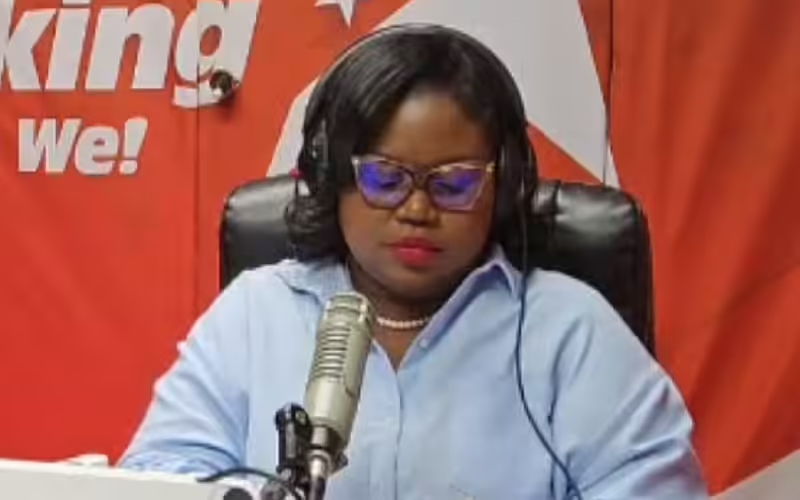
Opposition Senator Kesal Peters has strongly dismissed assertions by the New Democratic Party (NDP) government that St. Vincent and the Grenadines is bankrupt, countering that the nation experienced five consecutive years of economic expansion prior to the administration taking office.
Speaking on the radio program ‘On the Record,’ Senator Peters challenged the Deputy Prime Minister’s recent declaration that the country is ‘broke’ and that citizens must ‘ban their belly.’ Peters argued that official economic metrics from regional and international financial institutions—including the Eastern Caribbean Central Bank (ECCB), the International Monetary Fund (IMF), and the World Bank—directly contradict the government’s narrative.

Citing the October 2025 IMF World Economic Outlook report, Peters highlighted that the country recorded real economic growth of 2.2 percent in 2021, 5.0 percent in 2022, 5.5 percent in 2023, 5.2 percent in 2024, and 4.4 percent in 2025 under the previous Unity Labour Party (ULP) administration. She emphasized that this growth occurred despite severe external shocks, including the COVID-19 pandemic, the explosive eruption of La Soufrière volcano, and multiple tropical storms.
Peters also pointed to official financial summary estimates demonstrating consistent revenue gains across her tenure as a cabinet minister. According to the data presented, current state revenue rose steadily from $605.2 million in 2020 to $642.5 million in 2021, $682.8 million in 2022, $764.8 million in 2023, $799.8 million in 2024, and reached $855.6 million in 2025.
‘How do you reconcile these facts?’ Peters asked. ‘How can you blame what is happening now on the Unity Labour Party when you inherited an economy that was growing and generating record revenues? A government’s job is to steer the ship and generate revenue, not sit down and complain that you are broke.’
Attributing the current fiscal squeeze to government mismanagement and bloated administrative overhead, Peters outlined significant expenditure spikes under the 10-month-old government. Parliamentary records for the first quarter of 2026 show current expenditure rising to $220 million—exceeding the $211 million recorded in Q1 2025—while current revenue fell slightly by 0.6 percent. In the second quarter of 2026, current expenditure expanded to $344 million compared to $312 million in Q2 2025, alongside a drop in current revenue from $324.38 million to $290.1 million.
Peters attributed this spending growth to structural inefficiencies, including expanding the cabinet to 14 full ministries—requiring 14 sets of permanent secretaries, senior assistant secretaries, drivers, and luxury vehicles—paying high rental costs for the Prime Minister’s residence, granting double compensation for overseas executive recruits, dispersing $22 million in initial bonus payouts, and incurring heavy international travel expenses.