

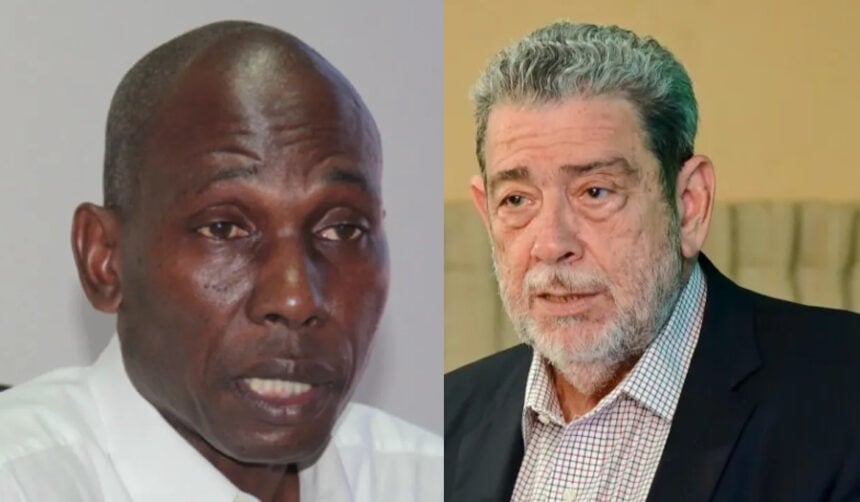
Lawyer and political commentator Jomo Thomas has publicly accused Opposition Leader and former Prime Minister Ralph Gonsalves of political hypocrisy. Speaking on his weekly broadcast Plain Talk, Thomas addressed recent public statements made by Gonsalves regarding the death of Bishop Johnny Jones, the former long-standing manager of the Kingstown Market.
The political friction emerged following the recent transition of power in St. Vincent and the Grenadines, which saw the New Democratic Party (NDP), led by Prime Minister Dr. Godwin Friday, assume office while Gonsalves’s Unity Labour Party (ULP) moved into opposition.

Gonsalves publicly linked Jones’s fatal stroke to the psychological distress caused by his administrative termination under the new administration. Thomas strongly rejected Gonsalves’s framing, arguing that the former prime minister is deploying a populist tactic to extract political mileage without medical or scientific proof.
Furthermore, Thomas asserted that Gonsalves’s present rhetoric stands in stark, self-serving contrast to his administration’s historical refusal to acknowledge state responsibility or psychological strain in tragic fatalities that occurred during his own 23-year tenure.
“He started talking about Johnny Jones… he talked about Johnny Jones had a minor stroke some years ago, but he was fully functional. He came back and he worked and then he was dismissed. And after the dismissal, Johnny Jones had another stroke and he died.”
Gonsalves argued that the psychological strain resulting from the abrupt termination led directly to the fatal cerebrovascular event, stating on public media:
“I make no statement other than the facts… and all right-thinking persons will draw the reasonable inference from the facts that I presented here.”
Thomas characterized Gonsalves’s deduction as an unscientific “populist appeal” designed for political maneuvering rather than factual analysis. He emphasized that establishing a causal chain between job termination and a fatal stroke requires rigorous medical evidence, which Gonsalves failed to provide:
“The former prime minister, being the person he is, spying an opportunity to make a populist appeal, went ahead and said that there’s a clear connection right between the termination and the death. One would think that that would need medical scientific evidence. But he doesn’t care about the medical scientific evidence; he cares about making or attempting to make political mileage.”
During his Plain Talk segment, Thomas argued that Gonsalves’s sudden sensitivity to state-induced administrative distress is selective, calculated, and politically opportunistic.
Thomas challenged the Vincentian public to evaluate Gonsalves’s logic with analytical consistency. He contended that if citizens are expected to draw a “reasonable inference” between administrative stress and fatal physiological collapse in the case of Johnny Jones, they must apply that exact analytical standard to high-profile fatalities linked to state actions under Gonsalves’s own government.
To demonstrate what he termed a severe double standard in executive accountability, Thomas cited two prominent historical cases involving extreme psychological distress and fatalities connected to state action during the ULP administration.
Thomas recalled the case of former police officer Michelle Andrews, who made allegations against Gonsalves. Gonsalves denied wrongdoing at the time, framing the incident as a “reassuring kiss.”
Thomas detailed the severe administrative pressures Andrews was subjected to following her allegations:
“She was assigned to night beat duties in Kingstown, where she was exposed to relentless public harassment, jeering, and abuse from ruling-party political supporters.
She was subjected to continuous, punitive transfers—described by Thomas as being sent “from pillar to post.”
She was ultimately reassigned to a remote posting on Union Island”.
While traveling back from Union Island aboard a vessel, Andrews suffered a fatal brain aneurysm. Thomas publicly contended at the time that the cumulative administrative pressure applied by the government and police leadership precipitated the chain of events leading to her death. Gonsalves rejected Thomas’s commentary and threatened defamation lawsuits, though no legal action was ever pursued, a fact Thomas attributed to his strict adherence to fair comment defenses under Caribbean defamation law.
Thomas also highlighted the death of Cjae Weeks, a young man who died after being pursued on a dirt bike by a police vehicle at Twenty Hill.
Key facts surrounding the incident include:
During the subsequent coroner’s inquest, eyewitnesses testified that the police vehicle maintained an extremely hazardous gap of approximately three feet (one yard) behind Weekes motorcycle.
Eyewitness testimony and physical evidence indicated a tire mark on Weekes white t-shirt, supporting Weeks’s statement to his mother prior to his death that the police vehicle had run over him.
Despite this testimony, the coroner’s inquest returned an official ruling of “misadventure.”
Thomas said the impact of the tragedy extended to Weekes mother, who was employed as a cook at the official prime minister’s residence.
“Badly shaken by her son’s death, she sought legal redress through Thomas’s law firm, which filed a civil wrongful death claim against the state and the driver. The Gonsalves administration continuously refused to settle the claim throughout its tenure; the matter was only settled after the NDP administration took office. Enduring unalleviated grief and financial hardship, Weekes’s mother subsequently developed cancer, relocated to the United States for medical treatment, and passed away”.
