
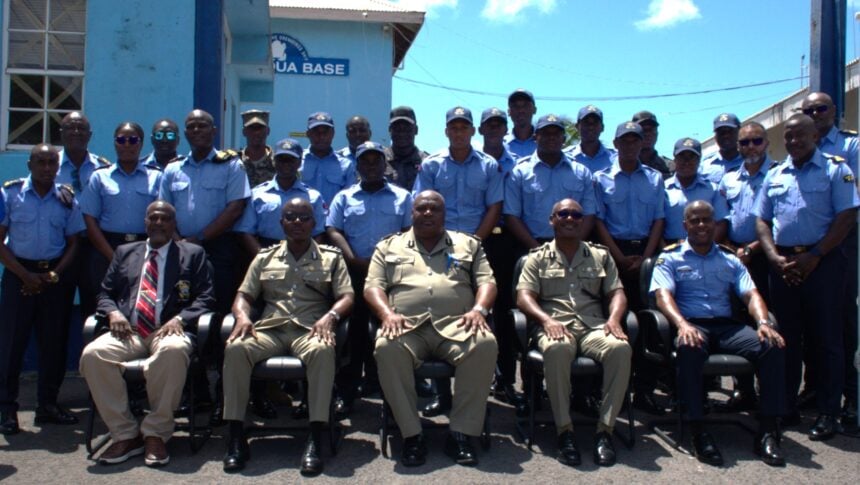
Six weeks of classroom instruction, demanding physical training and practical exercises at sea came to an end on Friday as 14 participants graduated from the SVG Coast Guard Service Basic Seamanship Course 1/2026.
The closing and passing-out ceremony was held at the SVG Coast Guard Base in Calliaqua, bringing together senior officers, members of the Coast Guard Service, instructors, relatives, invited guests and well-wishers.

The course ran from September 7 to October 16 and brought together recently enlisted Coast Guard Auxiliary personnel as well as members of the Rapid Response Unit and Special Services Unit.
In his opening remarks, Deputy Coast Guard Commander Lieutenant Commander Eddie Hamlet congratulated the graduates on completing the course and encouraged them to uphold the proud traditions of the Coast Guard Service.
He urged them to ensure that their conduct continued to reflect the core values of integrity, loyalty, discipline, teamwork, respect and devotion to duty, reminding them that the discipline and determination which carried them through training would also be required throughout their service.
Presenting the course report, Course Officer Sub-Lieutenant Alvis Daniel outlined the scope of the training and the standard expected of participants.
The course covered nautical terminology, knots and splices, anchoring, towing, boat handling, lookout and helmsman duties, ship husbandry, navigation, survival at sea, firefighting, first aid and damage control.
Participants were also exposed to international maritime law, maritime law enforcement, use of force, customs and immigration procedures, boarding procedures, engineering troubleshooting, aids to navigation and the international Rules of the Road for preventing collisions at sea.
But the programme was not confined to the classroom.
Trainees were required to apply what they had learnt in realistic operational settings, including a supervised training voyage to Saint Lucia aboard the Captain Hugh Mulzac.
During the voyage, participants assumed responsibility for navigation, helm and lookout duties, engineering rounds, securing the vessel alongside and preparing for departure, giving them an opportunity to experience first-hand the demands associated with operating at sea.
Participants were assessed throughout the six-week period in written examinations, practical assignments, physical training and the Rules of the Road examination.
The general passing average for the course was 70 per cent. However, participants were required to attain at least 90 per cent in the Rules of the Road examination, reflecting the high standard placed on navigation and collision prevention.
All 14 participants who began the programme successfully completed it, recording an overall course average of 83 per cent.
Sub-Lieutenant Daniel praised the graduates for meeting the required standard and reminded them that the certificate they received represented more than the successful completion of a course.
He told them that seamanship is knowledge passed from one generation to another and encouraged them to continue developing their skills so that, in time, they too could contribute to training future Coast Guard personnel.
The course was facilitated largely by trained personnel within the SVG Coast Guard Service, with support from other government agencies and departments, including the SVG Fire Brigade, National Emergency Management Organisation, Fisheries Department, Customs and Excise Department and Immigration Department.
That ability to train personnel from within the organisation was also highlighted by Commissioner of Police (Ag.) Mr. Trevor Bailey.
Commissioner Bailey said he was particularly pleased that the programme had been conducted and coordinated in-house.
He told those gathered that the successful delivery of the programme showed that the organisation did not have to look outside Saint Vincent and the Grenadines to produce quality training and that capable personnel already existed within its ranks.
The Commissioner also placed the training within the wider national context.
He reminded the graduates that Saint Vincent and the Grenadines is a multi-island state whose maritime space is central to its economy, security and way of life.
That reality, he said, placed a serious responsibility on Coast Guard personnel charged with maritime safety and security.
He encouraged the graduates not to regard their training as something completed simply because examinations were over, but to continue applying what they had learnt whenever they went to sea.
According to Commissioner Bailey, every operational assignment should be approached as another test of how much knowledge had been retained, how much the individual had improved and whether that officer was ready to advance to the next level of training and responsibility.
Speaking on behalf of the graduating class, Coast Guard Auxiliary Desron Lawrence gave an insight into the experience of the trainees over the six weeks.
He said the group entered the programme as individuals with different personalities, experiences and expectations but gradually developed into a team.
Lawrence said the course taught them that service in the Coast Guard involved much more than simply completing training.
It required discipline, responsibility, teamwork, awareness and an understanding of the role they would be expected to play in protecting the country’s coastal and maritime environment.
He also expressed appreciation to the instructors who guided the trainees throughout the programme and encouraged his fellow graduates to ensure that the knowledge gained did not end with the ceremony.
The feature address was delivered by Retired Coast Guard Commander Mr. Tyrone James, whose career has included service as Commander of the SVG Coast Guard, Director of Training within the RSVGPF and Director of Operations and Training with the Regional Security System.
Mr. James was also recognised during the ceremony for his contribution to the development of Coast Guard training and youth initiatives, including the Marine Cadet Corps, Coast Guard Youth Development Summer Programme and the Basic Seamanship Course itself.
Addressing the graduates, he reflected on his own years in maritime service and described their graduation as the beginning of a demanding but rewarding journey.
He reminded them that when fishermen, pleasure craft operators and other seafarers experience difficulty at sea, it is often the Coast Guard that they depend upon for help.
That responsibility, he said, meant Coast Guard personnel had to remain prepared regardless of weather, sea conditions or the hour at which the call for assistance came.
Mr. James urged the graduates to trust their training, rely on their shipmates, lead with integrity and place their mission and country first.
He also stressed the importance of understanding the unique culture and demands of maritime service, noting that Coast Guard operations require specialised knowledge, discipline and teamwork.
Among his final pieces of advice to the graduates were to master their craft, take care of their shipmates, remain mentally and physically ready and develop a genuine commitment to the work they had chosen.
The ceremony also recognised several participants who distinguished themselves during the course.
Police Constable Philroy Browne and CGA Dexter Jacobs shared the award for excellence in practical assessments.
CGA Amani Scarborough received the award for excellence in the International Regulations for Preventing Collisions at Sea.
CGA Dexter Jacobs also received the award for excellence in navigation.
PC Philroy Browne received recognition for the highest overall academic performance during the course.
CGA Je’ son Morgan was recognised for achieving the highest standard in physical fitness and was also named Most Outstanding Student, receiving the Commander Brenton Cain Award for the best overall performance on Basic Seamanship Course 1/2026.
Morgan later delivered the Vote of Thanks on behalf of the graduating class, expressing appreciation to the Coast Guard leadership, instructors, supporting personnel, families and others who contributed to the successful completion of the programme.
The completion of Basic Seamanship Course 1/2026 adds another group of trained personnel to the operational capacity of the SVG Coast Guard Service and, by extension, the Royal St. Vincent and the Grenadines Police Force.
For the 14 graduates, however, Friday’s ceremony represented less an ending than the beginning of the work for which the previous six weeks had prepared them: protecting the country’s maritime space, enforcing its laws at sea and responding when lives are placed in danger on the water.