

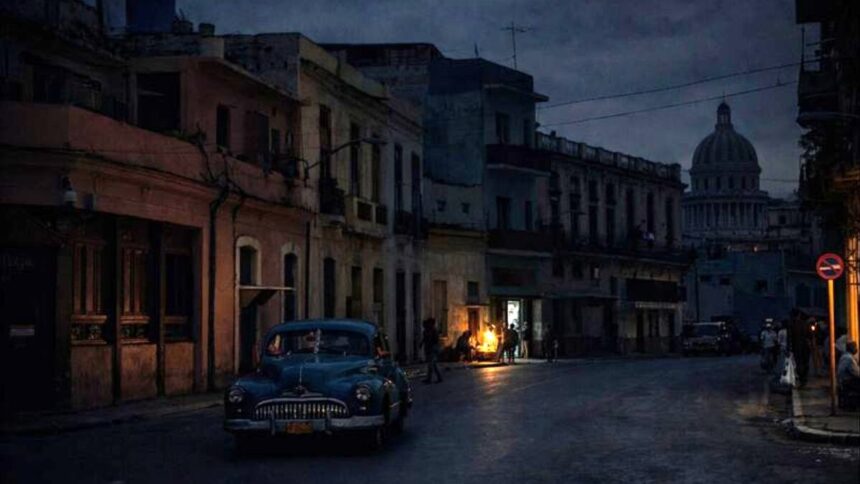
When the lights go out, human lives are at stake: Cuba cannot be punished into darkness.
There is a particular cruelty in a policy that turns a hospital’s operating room into a place of uncertainty, delays a child’s treatment, complicates the care of a pregnant woman, or forces a family to wonder whether an elderly loved one will receive the medical attention they need. There is an even greater injustice when these hardships are not the result of a natural disaster, but of deliberate political decisions that deprive an entire nation of the energy required to sustain everyday life.

This is the painful reality confronting Cuba today.
For more than six decades, the United States government has maintained an economic, commercial and financial blockade against Cuba. Its intensification through measures aimed at restricting the island’s access to fuel has taken this policy of economic coercion to an even more dangerous level. Energy is not a luxury. It is the foundation upon which hospitals function, food is produced and transported, water is supplied, medicines are distributed, and families maintain a dignified existence.
To restrict a country’s access to energy is, therefore, to strike at the very foundations of its society.
And behind every statistic lies a human being.
The human cost of an energy siege
The figures published by Cuba’s Ministry of Public Health and reported by the Cuban press reveal the extraordinary pressure being placed on the country’s healthcare system.
In March 2026, Cuban health authorities reported that 96,387 patients, including 11,193 children, were on surgical waiting lists. More than 32,000 pregnant women required diagnostic ultrasound examinations, while approximately 30,000 children faced the risk of not receiving their vaccinations on schedule because fuel shortages disrupted refrigerated transportation. Meanwhile, 16,000 patients required radiotherapy, and 2,888 depended on hemodialysis to sustain their lives. These figures illustrate the scale of the challenge facing a healthcare system struggling to maintain essential services under severe energy constraints.
Let us pause for a moment and consider what these numbers actually mean.
A child awaiting surgery is not a statistic. A pregnant woman waiting for an examination is not an accounting entry. A cancer patient whose treatment depends on reliable electricity cannot simply put their illness on hold until political disagreements are resolved. And a person requiring hemodialysis cannot negotiate with their disease for another day.
Behind every postponed procedure, there is a family living with anxiety. Behind every interrupted service, there are healthcare professionals doing everything within their power to protect their patients, often while facing shortages that no medical training or personal sacrifice can entirely overcome.
No political disagreement should ever be allowed to overshadow these elementary human realities.
In June 2026, Cuban health authorities reported that more than 100,000 people were awaiting surgery, including 5,152 patients requiring oncological operations. They also highlighted the particular difficulties of maintaining hemodialysis services, which depend on reliable electricity, water, specialised equipment and medical supplies.
These are not abstract consequences. They affect the possibility of recovery, the quality of life of patients, and the peace of mind of thousands of families.
When energy shortages reach the hospital bed
The damage inflicted on Cuba’s healthcare system goes beyond electricity cuts. Fuel shortages affect ambulances, the transportation of medical personnel, the distribution of medicines and the acquisition of essential supplies. Interruptions in transport can prevent medicines that have already been produced from reaching the patients who need them.
In March 2026, Cuba’s Deputy Minister of Public Health, Dr. Julio Guerra Izquierdo, reported that the sector had suffered losses exceeding US$4.183 billion over more than six decades of the blockade, including an estimated US$288 million in damages during 2025 alone. He also explained that 25 days of blockade-related damage were equivalent, in financial terms, to the US$339 million needed to cover the country’s basic medicines list for one year.
Imagine what those resources could mean if they were available to meet medical needs rather than being lost to an increasingly restrictive economic environment.
Imagine the medicines that could be purchased, the equipment that could be repaired, the diagnostic tests that could be performed and the patients who could receive treatment sooner.
These figures are not presented to diminish the challenges Cuba must address through its own efforts. Every country has responsibilities to its people, and Cuba is no exception. But it is impossible to have an honest discussion about the country’s economic and social difficulties without acknowledging the consequences of policies that systematically obstruct its access to financing, technology, fuel and international suppliers.
Cuba continues to reorganise medical services, prioritise emergencies and vulnerable patients, and expand the use of renewable energy in healthcare facilities. By March 2026, Cuban authorities reported the installation of solar panels in 282 polyclinics, 78 nursing homes, 97 maternal homes, 74 day centres for older adults and 15 hospitals.
These efforts demonstrate determination and ingenuity. Yet they also reveal the extraordinary burden that the country must carry simply to preserve essential services.
Resilience should be admired. It should never be exploited as an excuse to prolong suffering.
The economic crisis is also a family crisis
The energy blockade does not stop at the hospital gates. Its consequences spread through the entire economy, affecting transportation, agriculture, industry, commerce and the delivery of basic goods and services.
When fuel becomes scarce, farmers face greater difficulties moving produce to markets. Businesses struggle to maintain operations. Public transport becomes less reliable. The distribution of food and medicines becomes more complicated, while electricity shortages disrupt work, study, cooking and rest.
For Cuban families, this means more than inconvenience. It means additional hours spent trying to complete ordinary tasks, greater uncertainty over the availability of essential goods, and increased pressure on household budgets and livelihoods.
For older adults, people with disabilities, children and those living with chronic illnesses, these difficulties can be especially severe.
And for the mothers and fathers who try to reassure their children when the lights go out, the burden is emotional as well as material.
The right to a dignified life cannot depend on a country’s ability to withstand an external economic siege. Nor should the well-being of ordinary citizens be used as leverage in a political dispute.
The stated objective of coercive economic measures may be political change. Their immediate consequences, however, are experienced by people who have no control over the decisions being made thousands of miles away.
It is the ordinary Cuban citizen who must live with the consequences.
The voting on the annual resolution at the UN
On October 28, the United Nations General Assembly is expected to hold its annual vote on the resolution calling for an end to the economic, commercial, and financial blockade imposed by the United States against Cuba. This vote represents an important opportunity for the international community to express its position on a policy that Cuba considers a major obstacle to its economic and social development.
The resolution, which has traditionally received broad international support, reflects the ongoing debate over the impact of unilateral coercive measures, national sovereignty, and the principles of international law.
The upcoming vote will once again draw attention to the international community’s views on the longstanding dispute between the United States and Cuba and the repeated calls for an end to the blockade.
Cuba deserves the opportunity to live, work and develop in peace
Cuba does not ask the world to look away from its difficulties. It asks the world to understand the circumstances in which its people are struggling to overcome them.
Cubans are not asking for special privileges. They are asking for the right to work, study, receive medical care, raise their children and build their future without the additional burden of a policy designed to constrain their country’s economic life.
Every child deserves timely medical attention. Every cancer patient deserves access to treatment. Every pregnant woman deserves the examinations necessary to protect her health and that of her baby. Every older person deserves care and dignity. And every family deserves the basic security that comes from knowing that essential services will be available when they are needed.
These are not partisan demands. They are universal human aspirations.
The persistence of the energy blockade against Cuba raises a question that the international community cannot afford to ignore: how can we speak convincingly about human rights and human dignity while tolerating measures that make it more difficult for ordinary people to access essential services?
The Cuban people have demonstrated extraordinary perseverance in the face of prolonged adversity. But perseverance should not be confused with an absence of suffering, and resilience should never be mistaken for consent.
A people should not have to prove its capacity to endure hardship before being allowed to live in peace.
The lights must remain on in our hospitals. Medicines must reach those who need them. Children must receive their treatments. Families must be able to work, study and live with dignity.
The energy blockade against Cuba is not merely an economic question. It is a human question, a moral question and a test of our collective commitment to the principles we claim to defend.
The time has come to end this policy of collective hardship, to abandon economic coercion and to choose dialogue over confrontation.
Cuba has the right to develop without external interference. Its people have the right to live without the constant threat of deprivation imposed from abroad.
And the children, patients, mothers, fathers and older adults of Cuba deserve something that no political dispute should ever deny them: the opportunity to live their lives with dignity, security and hope.
